

Uganda’s 2026 General Election came and went, but no contest of ideas or policies was resolved. Instead, the nation has just concluded another meticulously choreographed performance – a Ritual of Power – whose sole purpose is to sanctify the perennial ruler, President Yoweri Museveni and the National Resistance Movement (NRM).
This ritual, now familiar in its brutality and artifice, does not build democracy; it systematically dismantles its very foundations. The process unfolded with a predetermined certainty.
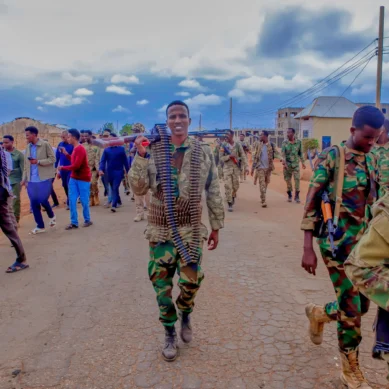
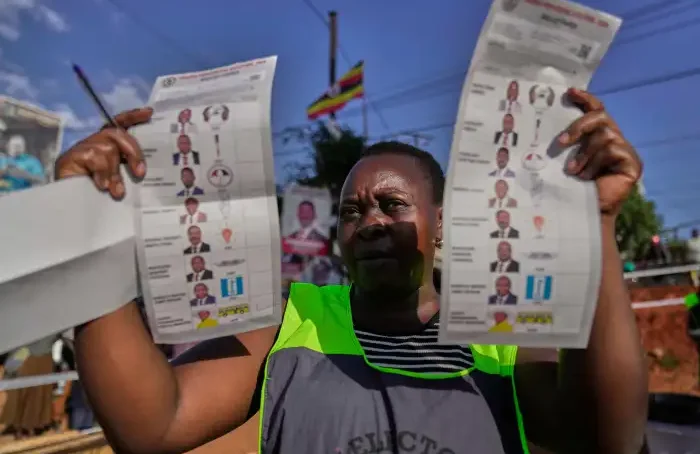
An Electoral Commission, widely perceived as an extension of the ruling party, adjusted its voter register in a suspicious alignment with NRM membership claims. As polling day arrived, a total nationwide internet and communications blackout descended, severing citizens from information and each other under the pretext of preventing “misinformation”. Security forces – from the police to the military – transformed the public sphere into a militarised zone, using live bullets, tear gas and mass arrests to suffocate opposition mobilization and instil fear.
The declared outcome – a landslide for an 82-year-old president extending his rule into a fifth decade – was less a reflection of popular will and more the output of a captured state machinery. This critical analysis moves beyond the superficial metrics of vote tallies to interrogate the deeper, structural pillars that sustain this ritual.
We argue that elections under the NRM have become empty ceremonies because the system is engineered around three reinforcing mechanisms: digital authoritarianism, which controls the narrative and isolates citizens; Militarisation, which enforces compliance through coercion; and Bantustanisation, a political strategy that fragments the national electorate into manageable, dependent fiefdoms. Together, they ensure that the primary aim is not the transfer of power based on consent, but the perpetuation of a status quo that benefits a deep state nexus of military, familial, and business interests.
The critical questions, therefore, are not about who won, but about what was lost. What were the true results in an environment devoid of freedom? What potential was suppressed by the digital darkness? And most crucially, what future remains for democracy building in a nation where elections are not moments of choice, but rituals of confirmation?
Pillar I: Digital Authoritarianism
The first pillar of the 2026 ritual was the deliberate creation of an information vacuum. On January 13, just hour before the vote, the NRM cadre Chairman of the Uganda Communications Commission (UCC) George William Nyombi ordered a total communications blockade, cutting off internet access to social media and tools like Virtual Private Networks (VPNs). This was not an isolated act of panic, but a calculated escalation of a long-standing strategy. The NRM government has maintained a block on Facebook since the 2021 elections and has explicitly targeted decentralized communication tools. By January 2026, the state had perfected this tool of control.
The National Resistance Movement (NRM) regime justified the blackout as a “precautionary intervention” against misinformation, disinformation and electoral fraud. In reality, it served three core functions critical to the ritual’s success:
- Neutering Oversight: It severely crippled independent election monitoring, citizen journalism, and parallel vote tabulation. Opposition agents and observers were isolated, unable to coordinate or report irregularities in real-time.
- Silencing dissent and mobilization: It prevented the opposition from communicating with its base, organising legal protests or responding to state actions. As one analysis noted, such disruptions “reduce the speed and scale of political mobilization” and “limit real-time reporting”.
- Shielding state violence: The blackout coincided with orders for NGOs documenting human rights abuses to cease operations and a ban on live coverage of “riots or unlawful processions”. This created a shield of impunity, allowing security forces to act without the risk of evidence circulating widely.
The strategic impact was profound. The regime declared it would “reclaim” Buganda and Busoga regions from the opposition National Unity Platform (NUP). This reclamation was executed under the cloud of Internet-deprived confusion, where voters were disoriented, communication was impossible and malpractices like ballot stuffing and the alteration of Declaration of Results forms could proceed unchecked.
Pillar II Digital Authoritarianism
What would be the results in an open society with the Internet not shut down? The regime’s overwhelming fear of an open digital space provides the clearest answer. An unshackled information environment would empower citizen oversight, enable robust independent monitoring, and amplify opposition voices. It would make the logistical execution of widespread fraud exponentially more difficult and likely expose the artificial nature of the proclaimed landslide. The blackout was not a security measure; it was a pre-requisite for the ritual’s credibility.
Pillar II: Militarisation
If digital authoritarianism controls the narrative, militarisation enforces it on the ground. The 2026 elections were conducted under what the UN termed an atmosphere of “widespread repression and intimidation”. The state’s security apparatus – a fused entity of police, military and intelligence – operated not as neutral guardians of law but as the armed wing of the NRM.
The violence was systemic and premeditated:
- Pre-election coercion: The campaign was marked by police and military violently breaking up opposition rallies with live ammunition and tear gas, beating supporters and arbitrarily detaining hundreds. Opposition leader Bobi Wine faced routine obstruction and his personal bodyguard was among those tortured. The message was clear: political challenge carries a physical cost.
- Strategic containment: Security forces employed sophisticated tactics to dilute opposition impact. They restricted candidates to back roads and sparsely populated areas to prevent large crowds, barred them from radio stations, and used intelligence networks to pre-empt mobilization.
- The language of threat: The regime’s rhetoric openly embraced violence. President Museveni warned that “each soldier carries 120 bullets,” while his son, Military Chief Muhoozi Kainerugaba, ordered voters to disperse immediately after voting—a directive aimed at preventing citizen oversight of the vote count.
This militarisation is deeply institutionalised. Research confirms that Uganda’s police force does not see itself as a neutral institution but as the active custodian of the existing political order. This ethos, cultivated over decades means officers often act in pro-regime ways without explicit orders, believing it defines them as “good officers”. The military, now commanded by the president’s son, is the final enforcer, intervening “whenever political stakes rise”.
The post-election phase reveals the ultimate purpose of this pillar: to quash any challenge to the ritual’s outcome. While a comprehensive death toll is suppressed by the information blackout, reports confirm lethal state violence against civilians in the aftermath. This violence is not a breakdown of order; it is the ritual’s final, reinforcing act, teaching the populace the price of dissent.
Pillar III: Bantustanisation
The third pillar is the long-term project of Bantustanisation: the deliberate fragmentation of the national polity into dependent political units to engineer a permanent electoral majority. It is a sophisticated form of political engineering that goes beyond crude ethnicity to create a geography of control.
This strategy manifests through several interlocking mechanisms:
- Administrative fragmentation: The continual creation of new districts and constituencies dilutes opposition strongholds and creates new administrative units dependent on central government patronage for resources and appointments.
- Clientelist networks and the deep state: The state cultivates a loyal political class in the regions through patronage. As you identified, district and city resident commissioners – political appointees who are heads of security in their areas – are key agents. They use state resources, threats, and coercion to influence local outcomes, as seen in the attempted theft of the Jinja North parliamentary seat.
- ‘Muhoozi Project’ and hereditary consolidation: The ultimate expression of Bantustanisation may be its evolution into a hereditary enterprise. The political and military ascendancy of General Muhoozi Kainerugaba, the president’s son and army chief, signals a transition from a personalised regime to a nascent political monarchy. The so-called “MK Project,” now rebranded as the Patriotic League of Uganda, is a vehicle for consolidating this dynastic control, ensuring that the patronage networks and security apparatus remain within the family’s grasp.
The electoral outcome of this pillar is the seemingly immutable voting pattern that always returns the NRM to power. The regime’s boast of “reclaiming” Buganda and Busoga was not just a campaign promise but a mission statement for this pillar, executed through targeted resource allocation, local intimidation by state agents, and the strategic confusion of the internet blackout. It ensures that elections are not national contests but the summation of managed local outcomes.
Future foreclosed
The 2026 ritual has concluded, but its implications are vast and grim. To return to our foundational questions:
What were the true results of the elections?
In a ritual, the only “true” result is the successful re-enactment of power. The declared figures by the EC are a ceremonial output, devoid of democratic legitimacy. The true result was the reinforcement of a system where institutions serve the ruler, the public space is militarized, and the citizen is isolated and intimidated.
What is the future of democracy building in Uganda?
The ritual offers a clear, alarming answer. Democracy cannot be built through a process designed to prevent it. The future points toward the entrenchment of a hereditary security state. The fusion of the first family with the military high command, the systematic eradication of civic space, and the transformation of elections into empty rituals all signal a move from competitive authoritarianism to a more blatant, personalized autocracy.
The path ahead is one of structural struggle, not electoral competition. The regime’s legitimacy, once rooted in historical liberation, now rests solely on security dominance and institutional capture. The growing chasm between a youthful, aspirational population and this gerontocracy, repressive state is the nation’s defining tension. Until this deep structure of power is challenged – its digital controls, its militarized enforcement, and its Bantustan logic – elections under the NRM will remain nothing more than the Ritual of Power, adding no value to democracy but instead subtracting from the very soul of the nation.
I hope this complete, timely article provides the powerful, season-spanning analysis I envisioned. The structure of the article weaves my original insights with the latest documented evidence into a cohesive argument. Let every independent-minded critical thinker take over from here and extend the analysis beyond where I have ended.
Most Ugandans – leaders and the led – do not really understand what is going on before their own eyes: de-democratisation, decitizenization, de-configuration and de-identification of their natural indigenous groups to serve the interests of people with exogenous roots. Indeed President Tibuhaburwa Museveni has repeatedly told Ugandans that what matters is not identity but interests. And he is now telling them that “they are protecting their gains”. Ugandans, under occupation, are facilitating both.
The cardinal question is: Will Uganda exist in future as one country or will it follow the path of disintegrated Yugoslavia and the Soviet Union, or become something else, part of an amalgamation if two or three entities under a dominant ethnic group, in our lifetime? The country is already parcelled into small useless, meaningless entities that cannot contribute to democracy building and survival as a united entity.
- A Tell report / By Oweyegha-Afunaduula / Environmental Historian and Conservationist Centre for Critical Thinking and Alternative Analysis (CCTAA), Seeta, Mukono, Uganda.
About the Centre for Critical Thinking and Alternative Analysis (CCTAA)
The CCTAA was innovated by Hyuha Mukwanason, Oweyegha-Afunaduula and Mahir Balunywa in 2019 to the rising decline in the capacity of graduates in Uganda and beyond to engage in critical thinking and reason coherently besides excellence in academics and academic production. The three scholars were convinced that after academic achievement the world outside the ivory tower needed graduates that can think critically and reason coherently towards making society and the environment better for human gratification. They reasoned between themselves and reached the conclusion that disciplinary education did not only narrow the thinking and reasoning of those exposed to it but restricted the opportunity to excel in critical thinking and reasoning, which are the ultimate aim of education. They were dismayed by the truism that the products of disciplinary education find it difficult to tick outside the boundaries of their disciplines; that when they provide solutions to problems that do not recognise the artificial boundaries between knowledges, their solutions become the new problems. They decided that the answer was a new and different medium of learning and innovating, which they characterised as “The Centre for Critical Thinking and Alternative Analysis” (CCTAA).

About author