



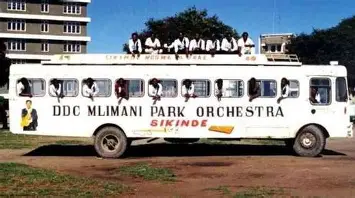
It is Saturday. Just hours after an absorbing ‘members day’ – a corruptive care-free start of the weekend when traditionally Kenyans sink themselves into mundane pleasures.
Nostalgia!
So, today I woke up listening to a tune in my head Visa Vimenichosa, vituko na dharau dada… na mengi…siwezi kuyavumilia…
It was throwback to the 1970s. That is DDC Mlimani Park Orchestra for you. It was made of evergreen Hassan Bichauka Muhidin aka ‘Super Almasi’ (because of his distinctively clear vocals), Cosmas Tobias Chidumule (who later abandoned secular music for gospel) and Joseph Mulenga.
The band was owned by Dar es Salaam city authorities hence the name Dar es Salaam Development Corporation (DDC).
Mlimani Park Orchestra was founded on August 1, 1978 by former Juwata Jazz Band members Muhiddin Maalim, Abdallah Gama, Tobias Cosmas Chidumule, Joseph Mulenga, Michael Enoch and Abel Balthazar. They were later joined by Hassan Bitchuka and Suleiman Mwanyiro also from Juwata Jazz Band.
Juwata was owned by the state and the musicians earned salaries to promote ruling Chama Cha Mapinduzi (CCM) ujamaa (socialism) ideologies.
So, why did they – DDC Mlimani Park Orchestra) music become so deeply nostalgic for many people in East Africa – especially those that were born in 1970 and before?
The answer is because DDC’s music captures a very specific emotional and cultural moment in the region’s history. Modern music can hardly capture these deep-lying emotional and experiential strands in the audience. A few reasons may explain why their music evokes powerful and timeless memories.
Rich storytelling
Their songs are not just dance music. They tell stories about love, heartbreak, family, betrayal, migration and everyday life. The audience connects the lyrics to their own experiences, especially in Kenya, Tanzania, Uganda and the wider Swahili-speaking world.
The golden era of rumba and dance music
DDC Mlimani Park emerged during a period when Tanzanian “dance” music was thriving. It blended the ‘cool’ Kamanyola dance style or slow rumba and the rhapsodic sebene.
Their sounds blended Congolese rumba with:
Rich Swahili poetry – often relayed through the sluggish and ‘laidback’ taarab.
Smooth horn sections
Emotional (even emotive) guitar melodies
Slow, memorable rhythms, which is the reason their tagline Sikinde ngoma Ukae. Ukae is small coastal community that relishes rich poetry and element of aristocracy. The outcome pieces of art that transcend age, culture and becomes combination that creates music that is timeless and captures every emotion.
Swahili language and poetic lyrics
DDC Mlimani Park’s lyrics are elegant and relatable. It is proof that grammatical Kiswahili produces quality music. The quality is unmatched by modern Bongo Flava genre or the headless Genge (from gangster) genre – often derided by fans of Swahili classical music as ‘quick and dirty’.
Swahili carries emotion beautifully in music, which is – probably – why sometimes Kiswahili is romanticised as Africa’s foremost love language. The band used all manner of figures of speech from proverbs, metaphors to riddles, tongue-twisters or onomatopoeia and conversational storytelling that still resonate with the Swahili music audience decades later.
Association with memories
For many East Africans, DDC Mlimani Park’s music are tied to family gatherings, road trips or travelogues, weddings, old radio broadcasts, social halls and discos, hence childhood memories. Nostalgia often comes from where and when we heard music, not only the music itself.
Warm analogue production
Older East African recordings had a softer, organic sound. The live instrumentation, tape recording texture and unpolished vocals feel human and intimate compared to over-processed modern music. Computer generated and modulated sounds lack the human touch as they are bereft of genuine creativity.
Emotional guitar arrangements
East African rumba guitar creates longing and reflection. Sometimes, there is an emotional inflection depending on the occasion and moment.
DDC Mlimani Park mastered melodic lead guitars that “sings” emotionally even before the vocals begin. Songs like Dunia, Mapenzi hayana sharia, Baba na mama, Usia, Sikinde and Hiba are notable for their singing lead guitar.
To this day, DDC Mlimani Park Orchestra music still trigger strong emotions because they fuse melody, poetry, rhythm and memory in a way modern music rarely does.
For close to 50 years, DDC Mlimani Park Orchestra has survived the turbulence in the music industry and still makes quality music.
The band’s rivalry with Msondo Ngoma – itself an offshoot of DDC – has kept entertainment sector in Tanzania and the wider East Africa alive. The two are the cut-off point between miziki ya wakongwe (older generation music) and miziki ya kizazi kipya (new age or novel generation).
Their music represents a shared East African cultural memory – especially for us fossils.
- A Tell Media report / By Peter Orengo Okumu


About author