


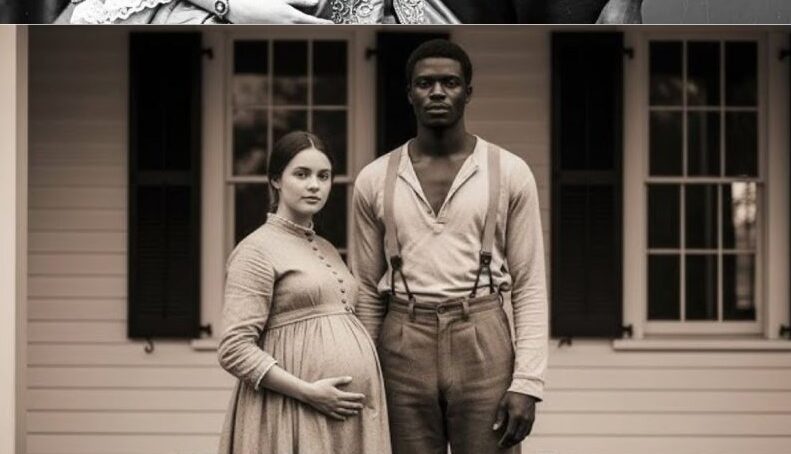
The truth was too terrible to contemplate. Samuel – a slave – saw his daughter for the first time when she was the days old.
Elellanena – a white aristocrat – brought the baby to the blacksmith shed at midnight. She watched Samuel hold the tiny bundle in his massive arms. She watched the tears roll down his face. Tears he could not shed in daylight. Tears he could not explain to anyone.
This was his child, his blood, his future. And he would never be able to claim her. He would never be able to hold her in public. He would never be able to call her daughter. She would grow up in the main house with white linens and music lessons and everything that enslaved children could never have. And he would watch from a distance pretending she was nothing to him.
This is what slavery did. This is what the system created. Not just chains and whips and forced labour, but the destruction of families, the denial of parenthood, the transformation of love into something that had to be hidden and coded and denied. Samuel understood this better than Elellanena ever could. He had lived it his entire life.
He had lost his mother and his sisters to the slave market. He had watched families torn apart at auction while white men counted money. And now he had a daughter he could never acknowledge. A daughter who would be raised to see him as property. A daughter who might never know who he really was.
The next two years were the strangest of Elellanena’s life. She was a mother and a plantation owner and a woman living a complete lie. She raised Josephine in the main house with the help of a wet nurse and the constant supervision of Hattie. She continued to manage Magnolia Grove with the efficiency that had surprised everyone. She maintained her social position in Charleston. She attended church.
She went to occasional parties. She wore the correct dresses and said the correct things and smiled at the correct people. And at night, when the house was quiet, she went to Samuel. She went to him because she could not stop. Because what was between them had grown beyond reason or caution or self-preservation. Because he was the only person who knew who she really was.
She became pregnant again in the winter of 1840.
This time there was no new fictional husband to explain the child. This time she had to rely entirely on the story of the Spanish cousin who had died. She told people that she had been pregnant when David died, that she had not known, that the grief had delayed her recognition of the symptoms.
It was a thin story. Some people had doubts. Elellanena did not care about their doubts. She cared about survival. She cared about protecting her children. She cared about the secret that could destroy everything. The second child was a boy born in August 1841. She named him Thomas after the overseer who had been loyal to her.
Thomas Garrett understood what was happening. He had to understand, but he never said a word. He was a quiet abolitionist who had come south out of some complicated sense of mission. He believed slavery was a sin. He believed the system would eventually collapse under the weight of its own evil.
In the meantime, he did what he could to ease the suffering of the people under his supervision. He looked the other way when Elellanena walked to the blacksmith shed after dark. He pretended not to notice when the children’s features became harder to explain. He was complicit in the lie because the lie was the only thing keeping everyone alive.
Josephine was two years old when her brother was born. She was already beautiful. She was already smart. She had started speaking early, mixing English with the fragments of Spanish that Elellanena taught her. She called Elellanena “Mama” and reached for her with tiny hands every time she entered the room.
She did not know that the man who made horseshoes in the work-yard was her father. She did not know why Mama sometimes cried when she looked at her. She did not know anything except that she was loved. That was enough for now. That was enough. Samuel met his son for the first time in the tobacco barn. It was 3:00 in the morning.
The plantation was silent except for the summer insects singing in the darkness. Samuel held the baby boy and felt something crack open inside him. Two children now. Two children he had brought into a world that would never let them be his. He looked at Elellanena in the darkness and asked: “What happens when they grow up? What happens when they start to understand? What happens when someone figures out the truth?”
Elellanena did not have answers. She had plans. She had strategies. She had money hidden away in a Charleston bank under a false name. She had contacts in Philadelphia and Boston who might help if everything fell apart.
She had maps of the roots north that escaped slaves used to reach freedom. She was preparing for a future she could not imagine. She was preparing for disaster. But she did not have answers. Not real answers. Not the kind of answers that could make any of this make sense. The truth is that she had stopped trying to make sense of it. She had stopped asking herself how she had ended up here.
A widow from a respected family, a plantation owner, a woman who had been raised to believe in the social order, a woman who now lived a daily betrayal of everything that social order demanded. She loved a man she was supposed to see as property. She had children she could never explain. She was trapped in a cage of her own construction and she could not imagine any way out that did not involve destruction.
But she also could not imagine stopping. She could not imagine going back to the loneliness of her marriage. She could not imagine pretending that Samuel was just a blacksmith and her children were just the offspring of a fictional dead husband. The lie had become more real than the truth. The secret had become more authentic than the public performance.
When she was with Samuel, when they talked in the darkness about books and ideas and the future they could never have, she felt more herself than she had ever felt in the drawing rooms of Charleston society. This is the paradox that slavery created. It destroyed families and created new ones in the shadows. It enforced brutal hierarchies and generated secret intimacies that defied those hierarchies.
It made monsters of ordinary people and revealed the humanity of people who were denied their humanity. Elellanena was not innocent. She owned human beings. She benefited from their unpaid labour. She was part of the system even as she broke its rules. Samuel was not simply a victim. He made choices. He took risks. He reached towards something that could have cost him his life.
They were both complicit in the horror of their world. They were both trying to find something human within that horror. The summer of 1842 brought changes to Magnolia Grove. The cotton market had fluctuated, and several neighbouring plantations were struggling. Elellanena had managed her finances well enough to remain stable, but the pressure from creditors and competitors increased.
Several Charleston families who had looked down on her as a woman managing alone now came to her for advice. She gave it carefully, revealing nothing about herself, maintaining the mask that protected her and her children. Josephine was nearly three years old. Thomas was almost one. They lived in the main house as Elellanena’s legitimate children.
They had a nursery with white curtains and wooden toys carved by one of the slaves. They had clothes made by the seamstresses in Charleston. They had everything that wealthy children had, except the truth about who they were, except a father who could hold them openly, except a life without the constant shadow of potential discovery.
Samuel continued his work as a blacksmith. He was essential to the plantation now. His skills had expanded beyond horseshoes and hinges. He repaired the cotton gin when it broke down. He built a new irrigation system for the rice fields. He designed tools that made the work more efficient.
Elellanena paid him nothing for this. Of course, slaves could not be paid, but she found ways to improve his conditions: better food, a larger cabin, medical care when he was injured. These small mercies were the only currency she had. These small mercies were the only way she could acknowledge what he meant to her without saying it out loud.
The danger grew as the children grew. Josephine’s skin was light enough to pass inspection from casual observers, but Thomas was darker. His features were stronger. As he got older, it would become harder to explain him as the child of a Spanish cousin. Elellanena began to consider options she had never considered before.
She began to think about leaving Charleston. She began to think about the North. She began to think about what it would mean to give up everything she had ever known in order to protect the people she loved. She wrote letters to contacts in Philadelphia. Careful letters, coded letters. She inquired about the community of free blacks in the city.
She asked about schools that accepted children of mixed race. She asked about the legal status of former slaves who reached the north. The answers she received were complicated. Pennsylvania was a free state, but prejudice existed everywhere. Mixed race children faced discrimination from both white and black communities. There were no easy answers.
There was no place where her family would simply be accepted. But there might be places where they could survive. There might be places where the truth would not mean death. Samuel listened to her plans without hope. He had seen too many escape attempts fail. He had seen too many people caught and returned and punished.
The fugitive slave act made it dangerous even in the north. Slave catchers operated in Philadelphia and Boston. Freedom was never guaranteed. But he also understood that staying was becoming impossible. The children were getting older. The questions would come. Someone would see what should not be seen. Someone would say what should not be said.
The secret could not last forever. Nothing could last forever. In the fall of 1842, Elellanena discovered she was pregnant for the third time. She stood in her bedroom looking at herself in the mirror and felt the weight of what she had done and what she would continue to do. Three children, three impossible children, three reasons to keep living, and three reasons to fear that she could not protect any of them.
She had built a castle of lies around herself. She had furnished it with stories and documents and performances convincing enough to fool everyone who wanted to be fooled. But the foundation was sand. One strong wind could collapse everything. She did not tell Samuel immediately. She waited until she was certain.
She waited until she could see the slight curve of her belly in the candle light. Then she went to him in the blacksmith shed on a December night when the stars were sharp and cold above the Carolina pines. She told him. She watched his face. She saw the same mixture of wonder and grief that she had seen twice before.
Another child, another secret, another piece of their hearts that would have to be hidden from the world. They held each other in the darkness. They did not speak of the future. They did not make plans. They simply existed together in that moment. Two people who had found each other across an impossible divide.
Outside the plantation slept – the slaves in their quarters, the overseer in his cottage, the children in the main house – everyone dreaming their separate dreams, everyone unaware that the centre of Magnolia Grove was this small shed where a white woman and a black man clung to each other in defiance of everything their world believed.
The winter passed slowly. Elellanena managed the plantation through the cold months, planning for the spring planting, reviewing accounts, maintaining the appearance of a respectable widow, raising her children alone. Her pregnancy was not yet visible beneath the layers of winter clothing. She had time – not much time, but enough to prepare another story, enough to arrange another performance, enough to create another fiction that would protect the truth.
But something else was building at Magnolia Grove. Something Elellanena did not see. Something that moved through the slave quarters in whispers and glances. The overseer, Thomas Garrett, had hired an assistant for the spring planting season. A man named Marcus Webb. Webb was different from Garrett. Webb was harder. Webb had worked on plantations in Mississippi and Alabama, where discipline was maintained through terror.
He did not understand Garrett’s gentle methods. He did not approve of the relative freedom the slaves at Magnolia Grove enjoyed. And he had sharp eyes, eyes that noticed things other people missed. Marcus Webb noticed that the blacksmith worked unusual hours. He noticed that the mistress of the house took walks after dark. He noticed the children who did not quite look like the Spanish portrait hanging in the parlour.
He noticed everything and he began to put the pieces together. He began to understand the secret that Elellanena had protected for almost four years. He did not say anything. Not yet. He waited. He watched. He gathered his evidence. Because Marcus Webb understood something that Elellanena had forgotten: Secrets have value. And in the south in 1842, the right secret could make a man’s fortune.
The spring came early that year. The magnolia bloomed in March. The cotton went into the ground by the 1st of April. Elellanena’s pregnancy became visible and she deployed her prepared story. Another child from her tragically dead husband. A final gift from a love cut short by yellow fever. The neighbours nodded sympathetically. Some of them had doubts – more doubts than before – but no one spoke them aloud. Speaking them aloud would have meant confronting something too terrible to acknowledge.
Meanwhile, Marcus Webb wrote a letter. He wrote it on a Sunday afternoon when the plantation was quiet with the enforced rest that southern law required for slaves. He wrote it carefully in the plain handwriting of a man who had not received much education. He addressed it to Elellanena’s closest neighbours – the Hendersons, whose plantation bordered Magnolia Grove to the east.
In the letter, he described what he had observed. In the letter, he made accusations that could destroy everything. He did not send the letter immediately. He held it. He calculated. He waited for the right moment to use it because Marcus Webb wanted something. He wanted power. He wanted position. He wanted the life that men like Thomas Garrett took for granted. And he believed that Elellanena Ortega’s secret was his path to getting everything he wanted.
Elellanena did not know about the letter. She did not know that her careful world was about to collapse. She continued through the spring of 1843, managing her plantation, raising her children, visiting Samuel in the darkness. She felt the new baby growing inside her. She made plans for the birth. She arranged for Hattie to attend her again. She prepared the back room where Josephine and Thomas had been born. She believed that she could continue. She believed that her lies were strong enough. She believed that love could survive anything. She was about to discover how wrong she was.
The letter arrived at the Henderson plantation on a Tuesday morning in late April 1843. Margaret Henderson was having breakfast with her husband, Robert, when their house servant brought it in on a silver tray. The handwriting was unfamiliar. The paper was cheap. Margaret almost threw it away without reading, but something made her open it. Curiosity, boredom, the particular hunger for scandal that defined Charleston society in those years.
She read the first paragraph. Then she read it again. Then she handed it to her husband without saying a word. Robert Henderson was 62 years old. He had been a plantation owner for 40 years. He had served in the South Carolina legislature. He sat on the board of the Charleston Cotton Exchange. He was a man who understood how the world worked and how it was supposed to work.
When he read Marcus Webb’s letter, his face turned the colour of ash. He sat down his coffee cup with a hand that trembled slightly. He looked at his wife. She looked back at him. Neither of them spoke for a long moment. The letter accused Elellanena Ortega of carrying on a sexual relationship with one of her slaves.
It named Samuel the Blacksmith specifically. It claimed that her three children were not the offspring of a fictional Spanish cousin, but the products of this criminal union.
It offered evidence: the timing of the pregnancies, the appearance of the children, the midnight visits to the blacksmith shed. Marcus Webb had been watching for months. Marcus Webb had documented everything and now Marcus Webb wanted payment for his silence. Robert Henderson did not pay Marcus Webb. Robert Henderson was not that kind of man.
Instead, he called for his carriage and rode directly to Charleston. He visited the county sheriff. He visited a judge he had known for 30 years.
He visited the office of the Charleston Mercury and spoke with the editor. By sunset, Elellanena Ortega’s secret was no longer a secret. By sunset, the machinery of Southern Justice had begun to move. Elellanena learned what had happened the following morning. Thomas Garrett rode up to the main house at dawn with his face grey and his hands shaking.
He had heard from a contact in Charleston. He had heard that warrants were being prepared. He had heard that a mob was forming. He told Elellanena everything in the parlour while Josephine and Thomas played upstairs, unaware that their world was ending. Elellanena listened without crying. She had always known this day might come. She had prepared for it in the back of her mind, even as she refused to believe it would actually happen.
She had money. She had contacts. She had plans. But none of her plans had accounted for the speed of what was unfolding. None of her plans had imagined that she would have less than 24 hours to save everyone she loved. She sent Thomas Garrett to warn Samuel. She sent Hattie to pack essential items for the children. She went to her bedroom and opened the hidden compartment in her wardrobe where she kept documents and cash.
She had accumulated almost $3,000 over the past four years. Enough to buy passage north. Enough to start over somewhere else. Enough to survive if they could escape before the mob arrived. Samuel received the news in the blacksmith shed. He had been working on a set of hinges for the barn door. Simple work, routine work, the kind of work that let his mind wander to places it should not go.
When Thomas Garrett appeared in the doorway with terror in his eyes, Samuel knew immediately. He had always known this moment would come. He had been waiting for it since the first night Elellanena touched his hand in the darkness. He set down his hammer. He removed his leather apron. He walked toward the main house for the first time in daylight.
The next hours were chaos. Elellanena gathered what she could carry. She dressed the children in travelling clothes. She wrote a letter to her lawyer in Charleston transferring ownership of Magnolia Grove to Thomas Garrett with instructions to free all the slaves upon her death or departure. She did not know if the transfer would be honoured. She did not know if the law would recognise it, but she had to try.
She had to do something for the 200 people whose lives depended on the plantation she was about to abandon. Samuel could not travel with them openly. This was the brutal mathematics of their situation. A white woman traveling with a black man would be stopped at every checkpoint. They would be questioned. They would be detained. Samuel would be arrested and returned to Magnolia Grove to face whatever punishment the county decided to impose.
The penalty for a slave who had sexual relations with a white woman was death. Not prison, not whipping. Death – usually by hanging, sometimes by burning. The law was explicit. The law was absolute. The law did not recognise love or consent or humanity. They decided to separate. Elellanena would take the children and travel by carriage toward Columbia.
She had a contact there, a woman named Mrs Peton, who had abolitionist sympathies and might shelter them while they arranged passage further north. Samuel would travel by foot and by night, following the routes he had memorised from other slaves who had attempted escape. They would reunite in Philadelphia. This was the plan. This was what they told themselves. Neither of them believed it would actually work.
The goodbye happened in the backroom where their children had been born. Josephine was three-and-a-half years old. She understood that something was wrong. She clung to her mother’s skirt and asked questions that Elellanena could not answer. Thomas was almost two. He did not understand anything except that the adults around him were frightened. And inside Elellanena’s belly, their third child kicked and turned, completely unaware of the danger surrounding them all.
Samuel held his children for what he believed would be the last time. He held Josephine and whispered words in her ear that she would remember for the rest of her life. He told her: “You are loved. You are strong. No matter what happens, no matter what anyone tells you, you should never be ashamed of who you are.”
Josephine did not understand the words, but she understood the weight behind them. She understood that this man who smelled like iron and fire was somehow important. She would spend years trying to understand why. Elellanena and Samuel did not embrace. They could not risk being seen. They stood 3 feet apart in the dim light of that back room and looked at each other with everything they could not say.
Four years. Four years of stolen moments and impossible love. Four years of building a family that should not exist. It had all led to this- a hurried goodbye, a desperate plan, and the almost certain knowledge that they would never see each other again. Samuel left first. He slipped out the back of the main house and disappeared into the pine forest that bordered the plantation to the west.
He carried nothing except a knife and a small amount of food. He knew the stars. He knew which way was north. He knew that the journey to Philadelphia was over 600 miles through territory filled with people who would kill him on sight if they knew what he had done. He started walking anyway. He had no choice. Staying meant death. Running meant a chance. Even a small chance was better than none.
Elellanena left an hour later. She loaded the children into the carriage with Hattie, who had refused to stay behind. Hattie was free now, legally free, according to the document Elellanena had signed that morning. But freedom meant nothing without somewhere to go. Hattie chose to go with the family she had served her entire life. She chose to protect the children she had helped bring into the world.
This was loyalty beyond obligation. This was love in its most practical form. The carriage headed northwest toward Columbia. The roads were rough and the horses were tired, but Elellanena pushed them as fast as they could go. She knew the mob would discover her absence soon. She knew they would follow. She had maybe a few hours’ head-start, maybe less.
The spring mud slowed the wheels. The children cried. Hattie sang quiet songs to calm them. Elellanena sat rigid in her seat and watched the road ahead and prayed to a god she was not sure she believed in anymore. They made it 20 miles before the first riders appeared behind them. There were six men on horseback.
Elellanena recognised one of them as a neighbour’s son, a young man named William Crawford, who had once asked to court her before she married Cornelius. The others were strangers, hired men, the kind of men who tracked runaway slaves for bounty money. They caught up to the carriage just as the sun was setting. They surrounded it on the narrow road.
William Crawford rode up to the window and looked at Elellanena with contempt and something else, something that looked almost like satisfaction. They did not arrest her immediately. The law regarding white women in these situations was complicated. She had committed a crime, yes, but she was also a widow from a respected family. She was also pregnant.
Southern chivalry, such as it was, created hesitation, even in moments of moral outrage. William Crawford demanded that she return to Magnolia Grove to face questioning. He demanded that she surrender the children. He demanded that she tell them where Samuel had gone. Elellanena refused. She sat in that carriage with her children and her ancient servant and looked at six armed men and refused.
- A Tell Media report / Source: Anonymous


About author