



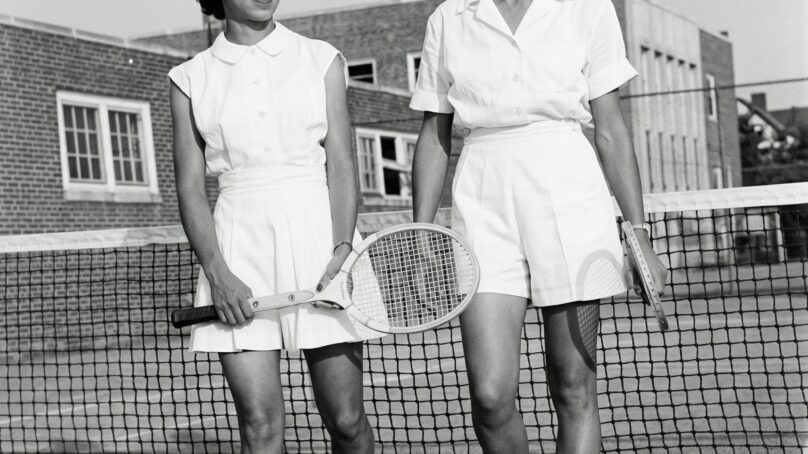
Two Black sisters won 14 national tennis titles and never saw a dime. They paid for their own rackets, their own travel, their own entry fees, out of a teacher’s salary. The sport took everything they gave it and gave them nothing back but trophies.
The courts at Rose Park were made of nothing. Sand, dirt, loose rocks, and dry lime that two girls sprinkled by hand to mark the baselines on a patch of ground in Georgetown that the city of Washington had designated for coloured children.
Margaret Peters was 10 years old the first time she picked up a racket at that park on the corner of 26th and O Streets. Her younger sister Roumania was eight.
They lived less than two blocks away, at 2710 O Street NW, in the working-class Black section of Georgetown that most histories of the neighbourhood never bother to mention. The courts had no nets worth speaking of, no proper surface, no maintenance budget.
What they had was two sisters who showed up every single day.
By the time Margaret was fifteen, she could place a backhand with enough precision to make grown men step back. Roumania, two years behind her but just as fierce, developed a chop shot so quick that opponents would still be reading the spin when the ball passed them.
They played on those dirt courts with their homemade lime lines, and they played like the courts were centre stage at Forest Hills. They never got to see Forest Hills.
The American Tennis Association noticed them first. Founded on November 30, 1916, in Washington, DC by a group of Black businessmen, professors and physicians, the ATA existed because the United States Lawn Tennis Association refused to let Black players compete.
It was the oldest Black sports organisation in the country. By the mid-1930s it had built a parallel world of tournaments held at historically Black colleges, where the best Black tennis players in America tested themselves against each other because every other door was locked.
In 1936, when Margaret was twenty-one and Roumania nineteen, the ATA invited both sisters to compete in their national championships at Wilberforce University in Ohio. Roumania made it all the way to the finals before losing to three-time champion Lulu Ballard.
That performance caught the attention of Cleveland Leigh Abbott, the athletic director at Tuskegee Institute in Alabama. Abbott was no ordinary coach.
He had been recruited to Tuskegee by Booker T. Washington himself and had initially worked as an agricultural chemist under George Washington Carver before turning to athletics. By the 1930s, he had built Tuskegee into a powerhouse for women’s sports, a program that would eventually produce Alice Coachman, the first Black woman to win an Olympic gold medal.
Abbott had invested in fourteen tennis courts on campus, most surfaced with Alabama red clay, some equipped with floodlights for evening play. He offered both Peters sisters full four-year scholarships.
Margaret was ready to go, but she would not leave without her sister. Roumania still had a year left of high school.
So Margaret waited. She put her own future on hold for twelve months, and in 1937 they walked onto the Tuskegee campus together. That decision, the quiet one made before any championship was won, tells you everything about who these two women were. Margaret would not start without Roumania.
At Tuskegee, they played basketball and tennis, earning degrees in physical education by 1941. But it was their doubles play that turned heads across the entire ATA circuit. They were known for their slice serves, their devastating backhands, and a court awareness that bordered on telepathy. Opponents called them “Pete” and “Re-Pete” and the nicknames stuck because the sisters made the same impossible shot twice.
Between 1938 and 1941, they won four consecutive ATA doubles championships. Then the war came and the ATA suspended tournaments, but when play resumed in 1944, the Peters sisters picked up exactly where they left off.
They would win 10 more doubles titles between 1944 and 1953, bringing their total to fourteen. That record still stands.
But Roumania was more than half a doubles team. She won the ATA national singles championship in 1944 and again in 1946, and that second title is the detail that history almost swallowed whole.
August 30, 1946. Wilberforce College, Ohio.
The sky was clear, the sun was bright, and more than three thousand spectators packed the grounds, dressed impeccably, many having travelled from across the country. The ATA nationals featured fashion shows, formal dances and parties alongside the matches because for affluent Black America in the Jim Crow era, this was where you went to see and be seen.
On the court that afternoon stood Roumania Peters, 29 years old, the defending champion from Georgetown. Across the net stood a 17-year-old from Harlem named Althea Gibson. Gibson had already won the ATA girls’ championships in 1944 and 1945. She was fast, aggressive and hungry in a way that made veterans nervous.
She would go on to become the first Black player to compete at the US National Championships, the first Black woman to win Wimbledon, the first to win the French Open. She would win 11 Grand Slam titles.
Bob Ryland, who later coached Venus and Serena Williams, would say that Gibson could have beaten the Williams sisters. But on that August afternoon in Ohio, Roumania Peters beat her.
The match went three sets. Roumania took the first, 6-4, Gibson clawed back to win the second, 9-7, and in the decisive third set, Roumania steadied herself and closed it out, 6-3.
The crowd at Wilberforce watched a 29 year-old woman from a dirt court in Georgetown outplay a future legend. Roumania Peters remains the only Black woman ever to defeat Althea Gibson in a major competition.
Gibson got her revenge the following year, winning 7-5, 6-0, and then won 10 consecutive ATA national titles after that. She never lost to another Black woman again. But Roumania had already written a sentence into the record books that no one could erase.
Their victories travelled in ways that most tennis matches never did. Highlights of their championship wins were shown in Black movie theatres, including the Mott in Washington DC.
Both sisters were asked to sign autographs and pose for publicity photographs. They played exhibition matches for British royalty and hit with the actor Gene Kelly on the very same Rose Park courts where they had once swept rocks off the baseline.
And none of it paid a single bill.
Tennis in the 1940s was strictly amateur. The Peters sisters received no prize money, no sponsorships, no compensation of any kind. They paid for their own rackets, their own travel, their own entry fees. They funded a career of national championships by working as schoolteachers.
Fourteen doubles titles, two singles titles, celebrity across Black America, and every cent came out of their own pockets.
The colour line in tennis began to crack in 1950 when the USLTA finally invited Althea Gibson to compete at the US National Championships at Forest Hills. ATA officials and retired champion Alice Marble had lobbied relentlessly, and Marble had published a blistering open letter demanding Gibson’s inclusion.
The door opened. But it opened for Gibson, who was twenty-three. Margaret Peters was thirty-five. Roumania was thirty-three. In tennis, those are retirement years, not debut years. The sisters who had dominated Black tennis for over a decade watched integration arrive just in time to pass them by. They never competed against a white opponent in a sanctioned tournament.
Not once.
After retiring from ATA competition in the early 1950s, both sisters earned master’s degrees in physical education from New York University. Margaret returned to Washington and became a special education teacher, later earning a second master’s degree from Coppin State College in Baltimore.
She never married. She never had children. She spent decades quietly serving students that other teachers had given up on. Roumania’s story took a turn that sounds like it belongs in a novel.
James Walker, a mathematics professor, saw her photograph in a newspaper and travelled to Tuskegee because of it. They married in 1957 and had two children, a daughter named Frances Della and a son named James George. Roumania taught at Howard University in the 1950s and then in the DC public school system from 1964 to 1981.
And then she went back to Rose Park.
The same courts where she had once swept rocks off the baseline as a child became her classroom again. Through the DC Department of Recreation, Roumania ran a tennis camp for underprivileged children at the park where she and Margaret had learned to play.
She taught there for years, pushing young players the same way Cleve Abbott had once pushed her. She gave them the same thing those dirt courts had given her: a place to prove what they were worth.
A former student remembered her as slender, unassuming, not particularly tall. The children at Rose Park knew her simply as Mrs Walker. They had no idea she held 14 national titles. They had no idea she had once beaten Althea Gibson in front of three thousand people. She never mentioned it. She just taught them how to hold a racket.
Many of her students went on to earn tennis scholarships to college. Some received complimentary tickets to the Washington Star Tennis Tournament at Rock Creek Tennis Centre, a USTA event that Roumania and Margaret would never have been allowed to enter during their playing days.
In 1977, both sisters were inducted into the Tuskegee Hall of Fame. In 2003, the United States Tennis Association, the same organisation that had barred Black players during most of their careers, presented them with an achievement award and inducted them into the USTA Mid-Atlantic Section Hall of Fame.
In 2012, they were inducted into the Black Tennis Hall of Fame. The honours kept arriving decades after the courts had gone silent.
Roumania died of pneumonia on May 16, 2003. She was eighty-five years old. Margaret, by then suffering from Alzheimer’s disease, died on November 3, 2004. It was one week before what would have been her ninetieth birthday.
The disease had taken the memory of 14 championships, of Tuskegee, of Gene Kelly on the courts, of the sister who had waited for her and then walked beside her for the rest of her life.
In October 2015, the Washington, DC, city council officially renamed the tennis courts at Rose Park. They are now called the Margaret Peters and Roumania Peters Walker Rose Park Tennis Courts.
A historical marker stands at 26th and O Streets, in the neighbourhood where two girls once sprinkled dry lime on dirt to make something that looked like a court. The marker says the Peters sisters taught tennis to thousands of children on those courts and across the city, extending to them life lessons and the meaning of humility.
Roumania’s daughter, Frances Walker Weeks, once shared what her father used to say about the sisters’ careers. He said they came along at the wrong time, but they were happy with their lives.
That is the gentlest way anyone has ever described what segregation stole. Two women who were the best in the country at what they did, who proved it fourteen times over, who beat the player that history would remember as the greatest, and who were told, in every way that mattered, that the real game was not for them.
They answered by going home and teaching children how to play on the same courts where they had taught themselves. The lime lines are gone now. The courts have proper surfaces, proper nets, proper names. But the names on those courts belong to two sisters who never needed any of that to know exactly who they were.
- A Tell Media report / Source: Black History Archives


About author