


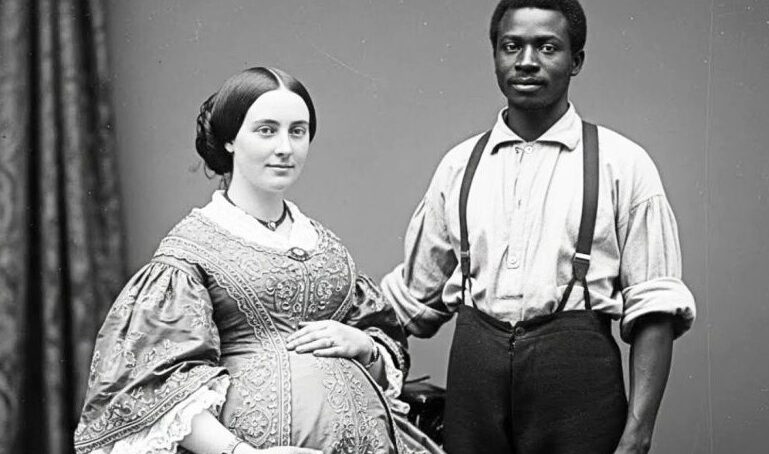
Elellanenna, white aristocrat and plantation owner, told the slave hunters that she would rather die than let them touch her children. She told them that Samuel – the Black slave she adored – was already beyond their reach. She told them that what she had done was not their concern.
Her voice did not shake.
Her hands did not tremble. She had spent eight years married to a cruel man. She had learned how to face violence without showing fear. That training saved her life in that moment.
William Crawford did not know what to do. He had expected Elellanena to collapse. He had expected tears and confessions and the satisfaction of bringing a fallen woman to justice. He had not expected defiance. He conferred with the other riders. They argued. They disagreed. Some wanted to drag Elellanena from the carriage by force. Others worried about the legal consequences of harming a pregnant white woman, even a disgraced one.
While they argued, the sun finished setting. Darkness fell over the Carolina Road. Hattie used the darkness. She had grown up on a plantation. She knew how to move without being seen. While the men argued 20 feet away, she slipped out the far side of the carriage and disappeared into the trees. She carried Thomas in her arms. Elellanena passed Josephine through the window to her.
The children were silent. They had learned already that silence meant survival. Hattie vanished into the forest like smoke dissolving in air. When William Crawford finally approached the carriage again, he found only Elellanena inside. The children were gone. The old slave woman was gone. He screamed at her. He demanded to know where they had gone.
Elellanena smiled. It was the first time she had smiled in days. She told him: “Search the forest if you want. You will never find them. My children are already free.”
They took Elellanena back to Magnolia Grove. They locked her in her own bedroom. They posted guards at the door. They sent riders in every direction to search for the children, for Hattie, for Samuel. They found nothing. The forest had swallowed everyone Elellanena loved. She sat alone in the room where she had planned her escapes, where she had dreamed her impossible dreams, and she waited for whatever came next.
The trial happened three weeks later in Charleston. It was not really a trial. It was a performance. The outcome had been decided before the first witness spoke. Elellanena stood before the judge in a dress that no longer fit properly over her growing belly. She listened to testimony from Marcus Webb, who described in graphic detail what he claimed to have witnessed.
She listened to Robert Henderson express his shock and outrage on behalf of civilised society. She listened to a parade of neighbours and acquaintances who had always suspected something was wrong with the Spanish widow and her two dark children. She did not defend herself. Her lawyer had advised her to show remorse, to beg for mercy, to claim that she had been seduced or manipulated or forced. Elellanena refused.
She stood in that courtroom and said nothing because there was nothing to say. She had loved Samuel. She had borne his children. She was not sorry. She would never be sorry. Let them punish her for that if they wanted. She would not pretend to regret the only real thing she had ever done. The judge sentenced her to five years in the South Carolina women’s prison in Columbia.
This was considered a lenient sentence. Many in the courtroom had wanted her hanged, but southern law was reluctant to execute white women, especially pregnant ones. The judge made it clear that Elellanena’s social status was the only thing saving her life. He made it clear that her children, if found, would be taken from her permanently. He made it clear that she would never be welcome in Charleston society again.
Elellanena listened to all of it with the same calm expression she had worn throughout the trial. When the guards led her away, she did not look back. The prison in Columbia was a brick building designed to hold approximately 50 women. When Elellanena arrived, there were over 80 inmates crowded into cells meant for two or three.
Most of the prisoners were there for minor offenses – theft, prostitution, public drunkenness. A few were there for violence. Elellanena was the only one there for loving across the colour line. The other prisoners did not know how to treat her. Some admired her defiance. Some despised her sin. Most simply avoided her, uncertain which response would bring them the least trouble.
Elellanena gave birth in the prison infirmary on August 7, 1843. The baby was a boy. He had his father’s eyes and his mother’s stubborn chin. Elellanena held him for exactly six hours before the prison authorities took him away. They told her: “He will be placed with a family in Charleston. You will not be given information about where he went. This is the consequence of your choices.”
Elellanena did not scream. She did not beg. She simply watched them carry her son through the infirmary door and disappeared inside herself to a place where the pain could not reach her. She named him Samuel in her heart. She would never know what name his adoptive family gave him. She would never know if he survived childhood. She would never know if he ever learned the truth about where he came from.
This was her punishment. Not the prison walls, not the hard labour, not the years of her life taken away. The punishment was not knowing. The punishment was imagining a thousand different futures for her child and never learning which one was real.
Meanwhile, somewhere in the forests of North Carolina, Hattie walked north with two children clinging to her skirts.
She travelled by night and hid by day. She begged food from slave quarters on plantations she passed. She followed the stars and the whispered directions of strangers who recognised what she was doing.
The Underground Railroad was not a formal organisation in 1843. It was a network of sympathetic individuals, some black and some white, who risked their lives to help escaped slaves reach freedom.
Hattie was not a slave anymore, but Josephine and Thomas were something more complicated, something the law had no category for. She protected them anyway. They reached Philadelphia in October 1843 after five months of travelling. They arrived at the door of a Quaker family named the Motts who had been expecting them.
Elellanena had written to Lucretia Mott years earlier, establishing a connection that now proved essential.
The Motts took in Hattie and the children without hesitation. They provided food and shelter and new identities. Josephine became Josephine Freeman. Thomas became Thomas Freeman. The name was intentional. The name was a statement. Whatever they had been in the South, here they were free. Samuel arrived in Philadelphia two weeks later. He had travelled over 600 miles in six months. He had nearly died three times.
He had been shot at in Virginia. He had almost drowned crossing the Potomac. He had spent two weeks hiding in a barn in Maryland while slave catchers searched the surrounding area. But he had made it against all probability. Against all reason, he had made it. When he walked through the door of the Mott household and saw his children playing in the parlour, he fell to his knees and wept.
The reunion was not what any of them had imagined. Samuel was gaunt from the journey, barely recognizable as the strong man who had worked the forge at Magnolia Grove. Josephine did not remember him. Thomas had been too young to remember anything. They looked at this stranger their aunt Hattie embraced and did not understand who he was.
Samuel had to introduce himself to his own children. He had to earn their trust like any other stranger. This was another cruelty of the system that had separated them. Even after escape, the damage continued. Samuel found work in Philadelphia as a blacksmith. His skills were valued in the north just as they had been in the south.
The difference was that now he earned wages. Now he could rent a small house for his family. Now he could walk down the street without looking over his shoulder for patrollers. The fear never completely disappeared. The fugitive slave act meant that he could be captured and returned to South Carolina at any time. But each day that passed made that possibility a little more remote. Each day that passed made freedom a little more real.
Josephine and Thomas grew up in Philadelphia knowing part of the truth about their origins. Samuel told them what he could. Hattie filled in what he left out. They learned that their mother was a white woman in a southern prison. They learned that they had a baby brother somewhere who they might never meet. They learned that their family had been torn apart by laws designed to keep people like them from existing.
They learned to be proud of their survival even as they grieved for what they had lost. Elellanena served three years of her 5-year sentence. She was released early in 1846 due to good behaviour and overcrowding in the prison. She emerged into a world that no longer had a place for her. Magnolia Grove had been sold to pay her legal debts.
Her family in Charleston refused to acknowledge her. The social position she had once occupied no longer existed. She was 39 years old, penniless, and completely alone. She made her way north. It took her almost a year, working domestic jobs in cities along the way, saving every penny she could. She arrived in Philadelphia in the spring of 1847.
She found the Mott household. She asked about her children. Lucretia Mott looked at this haggard woman on her doorstep and did something remarkable. She told the truth. She gave Elellanena the address where Samuel and the children were living. She warned her that the reunion might be difficult. Then she embraced Elellanena and welcomed her to freedom.
The meeting happened on a Sunday afternoon in April 1847. Elellanena walked up the steps of a modest row-house in a neighbourhood of free blacks and recent immigrants. She knocked on the door. Samuel opened it. They stood there looking at each other for a long moment. Four years had passed since their desperate goodbye at Magnolia Grove.
They had both aged. They had both suffered. They had both survived. Samuel stepped aside and let her enter. Josephine was seven years old now. She had grown tall and serious. She looked at Elellanena with her father’s eyes and did not recognise her. Thomas was five. He hid behind his sister and peeked out at the strange white woman who had entered their house.
Elellanena knelt down to their level. She did not cry, although she wanted to. She introduced herself carefully, the way Samuel had introduced himself years earlier. She told them she was their mother. She told them she had been away, but she was back now. She told them she would never leave them again.
The children did not run to her arms. They did not call her mother. They stood with their father and their aunt Hattie and regarded her with the caution of people who had learned not to trust easily. This was fair. This was reasonable. Elellanena had disappeared from their lives when they were babies. She was a story they had been told, not a person they remembered.
Building a relationship would take time. Building trust would take years. Elellanena was prepared to wait. She had waited this long; she could wait longer. Samuel and Elellanena did not marry. They could not marry. Interracial marriage was illegal in Pennsylvania in 1847. It would remain illegal until 1870, but they lived together as a family.
They shared the small row-house with their children and Hattie, who refused to live anywhere else. Samuel worked his forge. Elellanena took in sewing and later found work teaching at a school for black children. They were poor by the standards of the society they had left. They were rich by the standards of what they had survived.
The third child, the son Elellanena had named Samuel in her heart, was never found. Elellanena searched for years. She wrote letters to contacts in Charleston. She hired investigators when she could afford them. She followed every rumour and every lead. Nothing ever came of it. The boy had disappeared into the system of southern families who adopted children of unclear origins.
He might have grown up wealthy. He might have grown up poor. He might have died young. Elellanena would never know. She carried that absence with her like Samuel had carried the absence of his mother and sisters. Some losses never heal. Some questions never get answered. Josephine grew into a remarkable woman. She inherited her mother’s intelligence and her father’s quiet dignity.
She attended school, then became a teacher herself, then became an activist in the growing movement for abolition and women’s rights. She spoke at meetings and wrote pamphlets and organised protests. She told her story to anyone who would listen. She became living proof that the boundaries the South had drawn between races were arbitrary and cruel and ultimately meaningless.
In 1858, she married a free black man named James Wilson, and they had four children who grew up knowing exactly who they were and where they came from. Thomas followed a different path. He became a minister in the African Methodist Episcopal Church. He preached sermons about justice and redemption and the complicated nature of love.
He travelled throughout the North speaking about his experiences using his own family as evidence of slavery’s absurdity. How could a system that classified him as property because of his father’s blood ignore the fact that his mother’s blood made him free? How could the law recognize Elellanena’s ownership of Samuel while refusing to recognize their love?
Thomas asked these questions from pulpits across Pennsylvania and New York and Massachusetts. He did not have answers, but he believed the questions themselves had power. Samuel died in 1862 just as the Civil War was beginning to turn against the South. He was 51 years old. His heart gave out on an ordinary Tuesday while he was working at his forge.
Elellanena found him on the floor of the workshop, still holding his hammer, as if he had simply paused in the middle of a task. She sat beside him for an hour before she called for help. She talked to him in the quiet way they had always talked in the darkness of the blacksmith shed at Magnolia Grove. She told him: “I love you. I have always loved you. Our children are safe and free and will stay that way forever.”
Elellanena lived another 20 years. She saw the end of the Civil War. She saw the passage of the 13th Amendment that abolished slavery. She saw the brief hope of reconstruction and the terrible betrayal that followed. She watched the country that had tried to destroy her family struggle to understand what it had done and what it owed to the people it had wronged.
She never returned to South Carolina. She never wanted to see Magnolia Grove again. But she followed the news from Charleston with careful attention. She learned that Thomas Garrett had freed all the slaves on the plantation as she had instructed. She learned that many of them had stayed on as free workers, building new lives on the land where they had been held captive.
She died in 1882 at the age of 75. Josephine and Thomas were at her bedside. So were her grandchildren and her great grandchildren. Four generations of the family that should not have existed according to the laws of South Carolina in 1839.
Elellanena looked at them gathered around her bed and felt something she had not expected to feel: Peace.
After everything. After the hiding and the fear and the prison and the loss. After the years of struggle and the weight of secrets, peace. She had done something impossible. She had loved against the rules. She had created life against the law. And here was the result. Here were her children and their children, and the future spreading out ahead of them like a road with no end.
Her last words were to Josephine. She whispered them so quietly that Josephine had to lean close to hear. She said: “Tell them the truth. Always tell them the truth. They need to know where they came from so they know who they can become.”
Josephine did tell the truth. She wrote it all down in a memoir that was published in 1885, three years after her mother’s death. The book was called Children of Two Worlds: A Family’s Journey from Slavery to Freedom. It told the whole story: Elellanena and Samuel, the three pregnancies, the midnight meetings in the blacksmith shed, the betrayal and the escape, and the years of separation – everything.
Josephine did not hide anything. She did not soften the edges. She wrote it exactly as it had happened because she understood that the truth was the only thing that could not be taken away. The book found readers throughout the north. It was discussed in abolitionist circles and women’s rights meetings. It was cited in debates about race and family and the legacy of slavery. It became in its small way part of the historical record.
Evidence that the boundaries between black and white were never as fixed as the law pretended. Evidence that human beings had always found ways to reach across the divides that society created. Evidence that love, however complicated and imperfect, could survive conditions designed to make it impossible. There is a house in Philadelphia that still stands on the street where Samuel and Elellanena raised their children.
It has been renovated many times. Different families have lived there over the decades. None of them know the history of what happened within those walls. None of them know about the blacksmith who escaped from South Carolina or the widow who defied an entire society or the children who grew up to change the world in small but measurable ways.
But the story survives in other forms. In the memoir Josephine wrote, in the sermons Thomas preached, in the descendants who carry DNA that connects them to a plantation in Charleston and a forge where iron was bent into new shapes. The story survives because Elellanena was right. The truth matters. Where we come from shapes who we can become.
And the impossible families created in the darkness of slavery are part of the American story whether the country wants to acknowledge them or not. This was Magnolia Grove. This was Elellanena Ortega and Samuel. This was a love that broke every rule and paid every price – and somehow, against all odds, survived. Not intact, not undamaged, but survived.
In the children who reached Philadelphia, in the grandchildren who fought in the Civil War, in the great-grandchildren who marched for civil rights a century later, in every generation that carried the memory forward, refusing to let it disappear. The plantation is gone now. The land was subdivided and sold and resold until nothing remained of the original Ortega estate.
The slave quarters were torn down. The main house burned in a fire in 1891. The Magnolia trees were cut down to make room for development. But if you go to that spot outside Charleston today, if you stand on the ground where the blacksmith shed once stood, you can still feel something – a vibration in the air.
A weight in the silence. The echo of hammer on anvil. The whisper of voices that refuse to be silenced. Some stories do not end. They transform. They become part of the people who hear them. They shape how we understand ourselves and our history and our capacity for both cruelty and love. The story of Elellanena and Samuel is one of those stories.
It asks us to consider what we would do in impossible circumstances. It asks us to examine the rules we accept without question. It asks us to imagine a different world – one where love is not a crime and families are not property and human beings are valued for their humanity rather than their usefulness. We are still building that world.
We are still failing to build it. We are still trying. And somewhere in the archives of Philadelphia, in a box that no one has opened in decades, there is a letter. It is dated 1847. It is written in a woman’s careful handwriting. It is addressed to a child she never got to hold, a child who was taken from her after six hours.
A child named Samuel in her heart. The letter says everything a mother wants to say to her son. It says: “I love you. I am sorry. I hope you find happiness wherever you are. I will never stop looking for you.”
The child never received the letter. The child probably never knew it existed. But the letter exists. The words exist. The love exists. And in some way that defies logic and time, that is enough. It has to be enough. Because sometimes in history, as in life, survival is all we can offer. And survival, as Elellanena Ortega learned in a prison cell in South Carolina and a row-house in Philadelphia, is its own form of victory.
This is how the story ends. Not with triumph, not with tragedy, but with survival. With the stubborn persistence of love across generations and borders and all the barriers that human beings build to separate themselves from each other. With children who grew up free because their parents refused to accept that freedom was impossible.
With a family that should not have existed existing anyway. That is the lesson of Magnolia Grove. That is the truth Elellanena wanted her descendants to remember. Love survives even when everything is designed to destroy it – even when the law says it cannot exist.
- A Tell Media report / Source: Anonymous


About author