
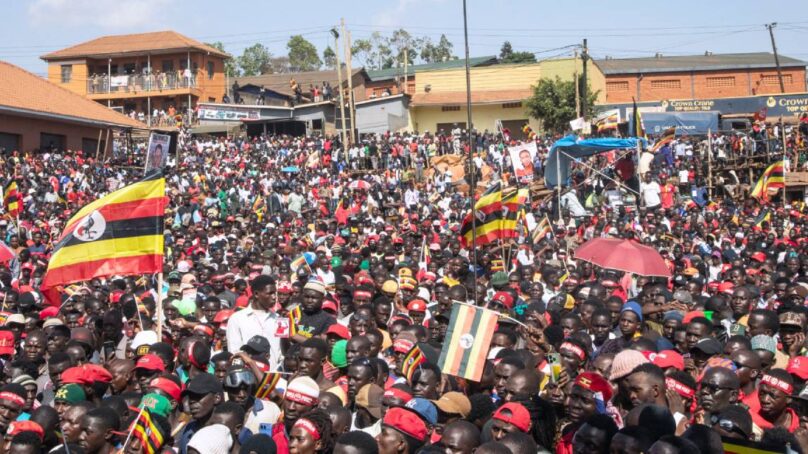
Despite high levels of intimidation and violence, Ugandan opposition candidates continue to contest presidential and legislative races, channelling Uganda’s youthful population’s demands for more jobs, freedoms and transparency.
Crowds carrying Ugandan flags and symbols of the National Unity Platform (NPU) fill the streets far into the distance.
Ugandan President Yoweri Museveni is seeking his seventh term in office in the January 15 presidential election that kicks off Africa’s 2026 election calendar. He and his National Resistance Movement (NRM) party are running on the campaign theme of “Protecting the Gains: Making a Qualitative Leap into High Middle-Income Status.”
This election cycle marks the 40th anniversary of the former revolutionary military leader’s tenure in power – the third longest on the continent, following Teodoro Obiang Nguema in Equatorial Guinea and Paul Biya in Cameroon.
The 81-year-old Museveni has extended his time in office by eliminating previously established term limits in 2005 and 2017. Museveni’s campaign this year is also shadowed by the increasingly prominent role played by his son, 51-year-old Muhoozi Kainerugaba. Now the Chief of Defence Forces following a series of rapid promotions, Kainerugaba is widely viewed as being groomed for the presidency as part of a carefully orchestrated hereditary succession.
The normalisation of violence around elections in Uganda follows a pattern in the East African region.
As in the 2021 election, when the opposition faced up to 3,000 abductions and 54 fatalities (plus 18 who remain unaccounted for), the 2026 election process has been characterised by intimidation and violence directed against the opposition. Hundreds of opposition supporters have been detained, and opposition rallies often face active disruption, including roadblocks, arbitrary arrests, tear gassing and the use of water cannons against supporters by police.
Injuries and fatalities have been reported at multiple opposition campaign rallies with the police using live rounds at times.
The violence is so pervasive that the leading opposition candidate, Bobi Wine of the National Unity Party (NUP), has likened the campaign to a war zone. In May 2025, Kainerugaba publicly boasted of personally torturing Wine’s chief bodyguard Edward Sebuufu (aka Eddie Mutwe), who had been abducted five days earlier.
The persistent intimidation has prompted the Chair of Ugandan Electoral Commission (EC) Justice Simon Mugenyi Byabakama, to condemn the violence and reiterate that all presidential candidates are lawfully allowed to campaign anywhere in Uganda.
Supporters of Bobi Wine run and cover their heads as the air fills with tear gas.
The normalisation of violence around elections in Uganda follows a pattern in the East African region. Tight restrictions against the opposition campaigning in the run-up to the October 2025 Tanzanian elections were followed by an unprecedented level of abductions, arrests and killings of an estimated several thousand opposition supporters and ordinary citizens, belying the claim of a 98 per cent electoral tally in support of incumbent President Samia Suluhu Hassan.
Recent years have also seen greater levels of cooperation among East African governments in restricting acts of opposition and civil society solidarity. Even though he was not expected to be a candidate in 2026, long-time Ugandan opposition leader Dr Kizza Besigye was abducted in Kenya in November 2024 and forcibly transported to Uganda, where he initially faced a military trial. He remains in detention under the charge of treason and the threat of the death penalty. Kenyan and Tanzanian lawyers who have attempted to represent or observe his trial have faced a series of roadblocks from doing so.
The past year has also seen heightened intimidation of journalists covering the Ugandan elections, including attacks, detention and torture. At least 15 journalists covering the by-elections in Kawempe North in March 2025 were targeted by the Anti-Terrorism Task Force, causing several media outlets to pull their journalists from this coverage. This is particularly noteworthy in that the government has historically tolerated relatively greater space for independent media and the exercise of civil liberties, despite the NRM’s long dominance.
Even with these formidable obstacles, seven opposition candidates are contesting the presidential election in Uganda, where a winning candidate must obtain an absolute majority or move to a second round between the two leading vote-getters.
Only 90,000 out of 700,000 graduates each year can find employment in the formal sector.
Bobi Wine is by far the most prominent of the opposition candidates. As in the 2021 campaign, the 43-year-old candidate has drawn large crowds wherever he speaks. The popular reggae star has galvanised the youth vote around themes of restoring democracy and constitutionalism, fighting corruption and creating jobs for youth through economic reform.
An estimated 33 million of Uganda’s 46 million population are under the age of 30, including 10.7 million voters. As in other African countries with large, youthful populations, young people are the leading edge of demands for political and economic reform.
Surveys indicate that unemployment and corruption are the leading concerns for Ugandan voters. Uganda ranks 140 out of 180 countries on Transparency International’s annual Corruption Perceptions Index. The country’s overall unemployment rate stands at 12.6 percent, while youth unemployment is 43 per cent. Only 90,000 out of 700,000 graduates each year can find employment in the formal sector. Uganda’s annual per capita income of $987 has grown by an average of 1.8 per cent over the past 4 years.
Perhaps the most vital issue to watch in the 2026 election is the degree of transparency surrounding the vote counting. In 2021, rather than reporting electoral results by each polling station as required by law, the EC announced results by region. This limited the scope for validating these results and created widespread scepticism around the announced tally of a Museveni victory, with 58 percent of the vote in the first round of voting.
While the exact figures remain disputed, the NUP did gain majorities in the key population centres of Kampala, Buganda (central Uganda), and Busoga (eastern Uganda). Opposition party members of parliament now collectively control roughly 100 seats out of the 556-seat legislative body.
The election in Uganda is in many ways a microcosm of the crosscurrents shaping the political space in Africa.
Reflective of the concerns for security and transparency, on November 25, 2025, faith leaders under the Inter-Religious Council of Uganda called for measures to safeguard peace, justice and integrity in the elections. On December 3, Father Deusdedit Ssekabira, a Catholic priest from the city of Masaka, was abducted. The military confirmed nearly two weeks later that he was being held in a military prison for “subversive activities,” charges the Masaka Diocese has denied.
The election in Uganda is in many ways a microcosm of the sharp crosscurrents shaping the political space in Africa. Long-dominant parties are attempting to hold onto power despite waning popularity and growing demands for greater pluralism from a restive, youthful population that has known only one leader. The question for Ugandans is whether elections will be a catalyst for reform and democratic self-correction – or more of the same.
- A Tell Media report / By Africa Centre for Strategic Studies


About author