

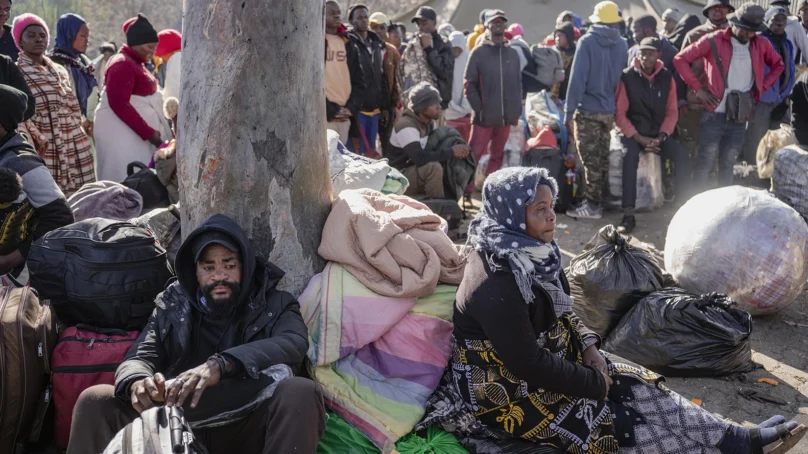
South Africa’s xenophobia has been nurtured by the country’s deep structural problems and decades of policy failures, said William Gumede, founder of the non-profit Institute for Social Dialogue.
“If all non-South Africans are kicked out, it’s not going to deliver jobs, employment and services,” he said.
South Africa has been burdened for decades by a crippling unemployment rate. In the first quarter of 2026, just over 60 per cent of young people aged 15 to 24 were unemployed, and it’s around 41 per cent for those aged 25 to 34.
That’s partly a reflection of a deeply flawed schooling system. Just over 80 per cent of 9 and 10-year-olds cannot read for meaning, limiting future work and education opportunities. Benchmarked against international peers, South African learners consistently come last in maths and science surveys, with hundreds of public schools not teaching the subjects at all.
“Education cannot solve unemployment alone, but weak education almost guarantees that unemployment becomes hereditary,” Linda du Plessis, senior deputy vice chancellor of the University of the North West, says.
Critics of South African business accuse employers of deliberately hiring exploitable foreign nationals who do not know – or cannot demand – their rights under the country’s labour laws, and accept less than the minimum wage.
The counter-claim by employers is that they struggle to find South African candidates with the right skillsets – which schools in neighbouring countries do seem able to produce – and as a result have called on the Department of Home Affairs to issue waivers to allow them to hire foreign citizens legally.
Jassat Esat runs a textile factory with a workforce dominated by locals, but with machinist and technical staff positions generally filled by people from the region. “I fully understand the demand for us to employ locals,” he said. “But we employ people based on training, capabilities, and their work ethic.”
He fears that the textile industry, facing stiff competition from cheap second-hand clothing, will be further damaged as staff leave as a result of a now-entrenched xenophobia, backed by immigration raids.
Agriculture is especially dependent on labour from the region. In KZN’s sugar belt, one farmer reported he had lost up to 80 per cent of his cane-cutting workforce virtually overnight. The same concerns are aired in the horticulture, fruit and vegetable sectors, which already face narrowing profit margins and climate uncertainty.
The structure of the agriculture labour market has historically been skewed to workers from Zimbabwe, Mozambique, and Lesotho. Employers say they have struggled to retain South Africans for what is seasonal, back-breaking work, typically on remote farms. Growing mechanisation – and the demand for greater skills – will reduce demand still further.
Gumede believes that South Africa’s xenophobia has done potentially irreparable harm. Not only has the country become diplomatically isolated across much of the continent, but it threatens trade links worth $42 billion annually.
“Around 30 per cent of our exports go to the rest of Africa. If you add informal trade, it could be 35 per cent,” he said. “We’re fighting the rest of Africa, while we’re also destroying our economy.”
Dube of March and March is confident that employers are beginning to respond to the demand to hire locally – backed by the fear of legal sanctions – but he also acknowledges the economic disruption his movement has caused.
“There is no way you can’t be worried about the shake-up of the economy, but I’m also worried about crime,” he said. “You can’t say because of economic benefits you leave a crime – you cannot leave the drug pushers and human traffickers.”
Blaming foreigners for South Africa’s stagnation is low-hanging fruit for politicians. It’s a sentiment increasingly shared by a middle class that fears job losses and competition in an economy growing by barely 1 per cent.
The political fragility of the ANC, after 30 years in power, has allowed populist parties to fill the vacuum – and they are expected to make significant gains in November’s local government elections.
“Intellectually, xenophobia is not being contested,” said Gumede. “Instead, people are looking for scapegoats. It’s a tragedy.”
- A Tell Media report / By Obi Anyadike and Oscar Nkala / Originally published by The New Humanitarian s


About author