

Bob Marley stops walking. Corner of King Street and Orange Street, Kingston. February 12, 1979.
At 11:23am, a crowd has gathered around something on the sidewalk. Bob pushes through. A man lies dead on the pavement. Homeless, no shoes, clothes worn to threads, nobody knows his name. Police are calling for a wagon to take the body to Potter’s Field.
Bob’s voice cuts through the murmuring crowd. “Wait. How much does a funeral cost?”
This was in Kingston, Jamaica, on February 12, 1979, at 11:23am. The dead man is maybe 50, maybe 70. The street erases age. His skin is dark from sun and dirt, hands calloused and cracked. He’s lying on his side, eyes closed, like he simply laid down and stopped.
The crowd keeps distance. Ten people, maybe 15, watching. Not helping. Two police officers stand over the body. One writes in a notebook, the other is on radio calling for transport. “No identification. Looks like he’s been sleeping rough for years. Nobody knows who he is. Potter’s Field? Potter’s Field.”
Bob Marley pushes through, dreadlocks tied back. Simple shirt and pants. He looks down at the dead man.
“You know him?” one officer asks.
“No,” he replies.
“Then move along. We need to clear this area.”
Bob doesn’t move.
“What happens to him now?” he asks.
“Unclaimed body. City takes him to indigent cemetery. Basic burial, no marker,” the officer xaplins.
“No funeral?”
“He’s got no family, no money, no funeral.”
Bob is quiet for several seconds.
“How much does a funeral cost?”
The officers exchange glances.
“A proper funeral, church service, coffin, burial plot, headstone. Maybe $800.”
Bob nods.
“I’ll pay for it.”
“You’ll what?”
“I’ll pay for his funeral, everything. Church, coffin, burial, headstone.”
“Sir, you don’t know this man.
“I don’t. But he’s my brother. Every person who dies forgotten is my brother.”
The officers don’t know what to say. Bob gives them his contact information.
“What should the headstone say? We don’t even know his name.”
Bob thinks. “Put this, brother. Known to God. Mourned by Bob.”
Three days later. February 15th, 1979.
Holy Trinity Cathedral, Kingston. Time: 2:00 p.m. The funeral is modest, but dignified. Wooden coffin, simple, but solid. The church is nearly empty. A priest in white vestments. Bob Marley in the front pew, wearing a dark suit someone loaned him because he doesn’t own one. Two altar boys who don’t understand why they’re here for a funeral with no family.
The cathedral is built for hundreds. Today, it holds four. The emptiness makes every sound echo. The priest’s footsteps. The rustle of his robes. Bob’s breathing. Afternoon light streams through stained glass windows, casting coloured patterns across the coffin. Red. Blue. Gold. The dead man inside never saw the inside of a church this beautiful while he was alive.
Now he’s here. Bathed in holy light. The priest delivers a brief service. He didn’t know the deceased. Nobody did. He speaks about God’s love for all people. About every soul having value in the eyes of the creator. About no one being truly forgotten, even when the world forgets. His voice echoes in the empty cathedral.
The words feel both inadequate and essential. How do you eulogise a man whose name you don’t know? How do you honour a life that left no visible mark? Bob sits in the front pew, head bowed, hands clasped. He hasn’t moved since sitting down. His dreadlocks fall forward, hiding his face. He’s so still, he could be praying. Or sleeping. Or both. When the priest finishes, he looks at Bob.
“Would you like to say anything?”
Bob stands slowly. His borrowed suit doesn’t quite fit. Sleeves too short, shoulders too tight. He walks to the coffin. Places both hands on the wood. The varnish is smooth, cool under his palms. He stands there in silence for almost a minute.
The priest shifts uncomfortably. The altar boys exchange glances. Finally, Bob speaks. His voice is quiet, but clear, filling the empty cathedral in a way the priest’s voice didn’t.
“I don’t know your name, brother. But Jah knows. And that’s enough. You walked this earth carrying burdens I can’t imagine. Burdens that bent your back and broke your spirit,” Bob says. “The street took your dignity while you were alive. Took your name. Took your story. Took everything that makes a person visible to the world. But you weren’t invisible to Jah. And you’re not invisible to me. I’m giving back what the street took. Your dignity. Your name is brother. Your story is that you mattered.”
He paused.
“You go to the ground with ceremony, with respect, with the acknowledgement that your life had value. Rest well, brother. You carried enough weight. You walked enough miles. You suffered enough cold nights and empty days. Rest now. You’re not forgotten. Not by Jah. Not by me.” Bob’s voice breaks slightly on the last word.
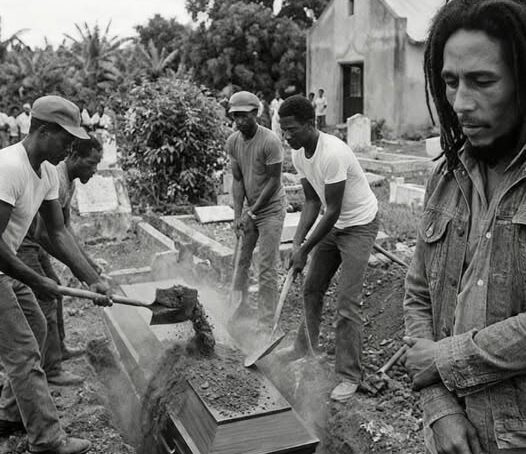
He stays at the coffin a moment longer, then returns to his pew. The service ends. Four men from the funeral home, hired, professional, expressionless, carry the coffin to the hearse. Bob follows. The procession to May Pen Cemetery is small. One hearse. One car carrying Bob and the priest. That’s all. At May Pen Cemetery, plot 247, two gravediggers wait.
They’ve dug the hole this morning, 6-foot deep. Perfectly rectangular. One gravedigger recognises Bob Marley. Whispers to the other.
“That’s Bob Marley. What’s he doing here?”
“Burying someone.”
“Nobody else here.”
The funeral home men lower the coffin on ropes. It hits bottom with a soft thud. The priest says final prayers.
“Ashes to ashes. Dust to dust.”
Bob stands at the edge, looking down. The priest finishes, leaves. The funeral home men pack equipment, drive away. Bob doesn’t leave. After 10 minutes, one gravedigger approaches.
“Sir, we need to fill in the grave.”
“I’ll stay while you do it.”
“Most people don’t want to watch.”
“I’ll stay.”
The gravediggers begin shovelling, earth hitting wood.
Each shovelful is a small violence. The coffin disappearing under soil. Bob watches every shovelful. Doesn’t look away. Just watches. It takes 20 minutes. When they finish, the ground is mounded slightly. Fresh red dirt against older brown earth. Bob thanks them. Gives them each $20. They leave, confused by the generosity. Bob stands alone at the fresh grave.
February afternoon, heat presses down. He stands there 10 more minutes. Then leaves. Two weeks later, the headstone arrives. Simple granite. Brother. Known to God. Mourned by Bob. Bob visits once. Reads the words he chose. Nods. Leaves. Never returns to that specific grave. Five months later. July 8, 1979. Bob is walking through Denim Town when he sees another crowd.
Another body. Another homeless man. Dead in the street. No identification. Bob doesn’t hesitate. Walks straight to the police.
“I’ll pay for the funeral.”
The officers recognise him now.
“Mr Marley, this is the second time.”
Call the funeral home. Same process. Church service. Bob is the only mourner. Burial. Headstone. Brother. Known to God.
Mourned by Bob. October 1979. A homeless woman dies outside Coronation Market. Bob pays for her funeral. Headstone, sister, known to God, mourned by Bob. December 1979 another man another funeral January 1980 another April 1980 another June 1980 another August 1980 the eighth funeral in 18 months. Bob’s accountant Michael Chen finally speaks up.
They’re reviewing expenses. Chen puts down the ledger.
“Bob, we need to talk about these funerals. You’ve spent $15,000 on eight funerals for people you don’t know.”
“And…?”
“That’s significant money. Your touring is limited because of health. You have family to support. A compound to maintain. How much did we spend on the new studio equipment?
Chen checks.
- A Tell Media report / Source: Life Story


About author