



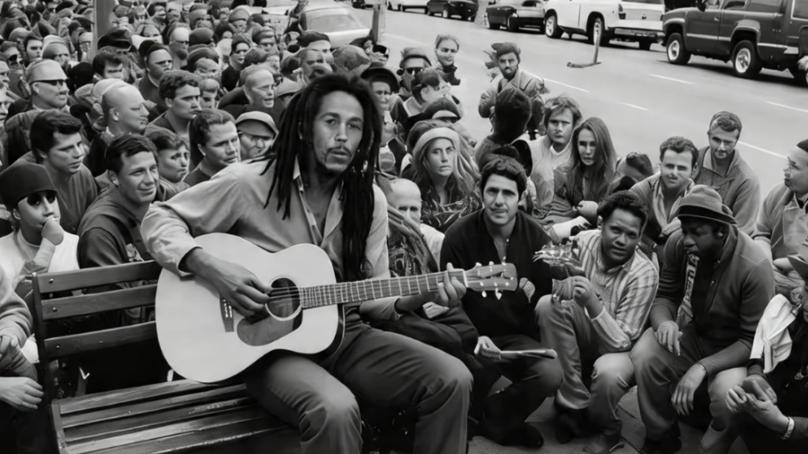
On September 14, 1978. 2:30pm, Bob Marley stood outside Magnolia Sound Studios, in Nashville, Tennessee, holding his guitar case and looking at the closed sign that had just been flipped in his face.
Five minutes earlier, he had been inside the most prestigious recording studio in Nashville, ready to lay down tracks for his upcoming album.
Now he was on the sidewalk banned from entering. The man who had kicked him out was Richard Wittmann, owner of Magnolia Sound Studios, a 52-year-old businessman who had built his reputation recording country music legends and rock stars.
But Bob Marley in Wittman’s mind – that was where he drew the line. 2:25pm. Five minutes earlier, inside the studio, Bob had arrived right on time for his scheduled session. He’d paid the deposit, confirmed the booking and brought his best musicians. The Whalers were setting up their equipment when Wittmann burst through the studio doors.
“Stop, everyone, stop,” Wittmann announced. “There’s been a mistake.”
Bob looked up from tuning his guitar. “What kind of mistake, brother?”
“You can’t record here. I’m cancelling your session.”
The studio went silent. Bob’s band members looked at each other in confusion. This was Magnolia Sound Studios. They didn’t just cancel sessions without reason.
“We have a contract,” Bob said calmly. “We paid your deposit.”
Wittman’s face was red with anger. “I don’t care about the money. I just found out what kind of music you make. Reggae – that that jungle music. This is a respectable studio. We record real music here.”
Bob’s keyboardist, Tyrone Downey, stepped forward.
“Excuse me! What did you just say?
“You heard me. We don’t record that kind of music in this studio. And we don’t record for people who…” Wittmann looked at Bob’s dreadlocks with disgust. “…People who look like that.”
Bob remained calm, though his band members were getting angry.
“Mr Wittman, music is music. Love is love,” Bob told him. “Why does it matter what we look like or where our music comes from?”
“Because this is Nashville,” Wittmann snapped. “This is music city. We have standards here. We have traditions. And your kind of music? Your kind of people? You don’t fit those traditions.”
“Our kind of people?” Bob repeated quietly.
“You know exactly what I mean. Now get your equipment and get out,” Wittmann ordered. “The deposit will be refunded.”
Bob looked around the studio. The same studio where countless music legends had recorded, where dreams became reality. Now those doors were being slammed shut because of the colour of his skin and the style of his music.
“Come on, Bob,” said Junior Marvin, Bob’s guitarist. “This place doesn’t deserve our music.”
But Bob didn’t move. He was thinking about something bigger than just one recording session. 2:30 p.m. Outside the studio, Bob stood on the sidewalk looking at the studios large windows. People walking by recognised him.
Bob Marley was becoming internationally famous, even if Nashville’s recording elite wanted to pretend he didn’t exist.
“What are we going to do, Bob?” Tyrone asked. Bob smiled. Not a bitter smile, but the calm, knowing smile of someone who had just figured out how to turn an obstacle into an opportunity.
“We’re going to record our music,” Bob said.
“Where?”
“Every other studio in town will probably say the same thing once they hear what happened here.”
Bob looked at the small park across from the studio. Trees, benches, open space right here.
“Here on the street. Why not? Music doesn’t need fancy walls, brother. Music needs heart, and the street got more heart than any studio,” Bob said as he walked to the park area directly across from Magnolia Sound Studios, sat down on a bench, and opened his guitar case.
2:45 p.m. Bob started with a simple acoustic version of One Love, his voice carrying across the street.
A few people walking by stopped to listen. Then a few more. Within 10 minutes, a small crowd had gathered.
“What’s happening?” asked a young woman who had recognised Bob.
“The studio over there refused to let us record,” Bob explained, continuing to play. “So, we’re recording here instead outside where music belongs to everyone.”
The crowd began to grow. 20 people, then 40, then 60. Someone had called local musicians, and they started showing up with their own instruments. Word spread quickly in Nashville’s tight-knit music community that Bob Marley was performing an impromptu concert across from Magnolia Studios.
Inside the studio, Richard Wittmann watched through the window as the crowd continued to grow. He was getting nervous. 15pm. By now, over 200 people had gathered in the small park. Local musicians had joined Bob on stage, a makeshift stage that was really just the park’s small pavilion. Country musicians, rock players, even some gospel singers had come to support Bob and protest the studio’s discrimination.
Sarah Mitchell, a well-known Nashville session singer, took the microphone. I’ve recorded in that studio for 15 years, she announced, pointing at Magnolia Sound. Today, I learned that they judge musicians not by their talent, but by their race and the style of their music. That’s not the Nashville I know. That’s not the music community I want to be part of.”
The crowd cheered. Bob stepped up to the mic.
“Brothers and sisters,” Bob said, “This isn’t about one studio or one man. This is about music. Music is supposed to bring people together, not divide them. Music is supposed to heal, not hurt. Today, we’re showing Nashville what music really looks like.”
Bob started playing Get Up, Stand Up, and the crowd of musicians and fans sang along. The sound was incredible. Acoustic guitars, harmonising voices, people clapping and swaying together. 3:30 p.m. Local news crews had arrived. The story was spreading. Bob Marley banned from Nashville studio holds protest concert across the street.
Other musicians were showing up to express solidarity inside Magnolia Studios. The phone was ringing incessantly. Other artists who had sessions booked were calling to cancel. They didn’t want to record at a studio that discriminated against musicians. Tommy Morrison, a country music star, pulled up in his car and got out carrying his guitar.
“Bob Marley,” he said, approaching the makeshift stage. “I don’t know much about reggae music, but I know talent when I hear it, and I know wrong when I see it. Mind if I play a song with you?”
The crowd erupted as Tommy Morrison, one of Nashville’s biggest stars, joined Bob Marley on the park stage.
They performed an acoustic version of No Woman No Cry that brought tears to people’s eyes. The crowd had grown to over 500 people. Cars were stopped in traffic as drivers got out to listen. Local businesses were closing early so employees could join the impromptu festival. Maria Santos, a Hispanic singer who had also faced discrimination in Nashville, took the microphone.
“How many of us have been told we don’t fit?” She asked the crowd. “How many of us have been told our music isn’t Nashville enough or we don’t look country enough? Today, Bob Marley is standing up for all of us.”
Inside the studio, Richard Wittmann was panicking. His biggest clients were cancelling sessions.
The local media was calling him a racist. His reputation was being destroyed in real time. At 3:30 pm Bob performed Redemption Song as his final song of the impromptu concert, but he changed some lyrics to reflect what was happening.
“Won’t you help to sing these songs of freedom, cuz all we ever have is redemption songs,” he sang. “These songs of freedom. Songs of freedom.”
When he finished, the crowd of 500 plus people was silent for a moment, then erupted in applause that lasted 10 minutes. Bob stood up and pointed to Magnolia Studios.
“Mr Wittman,” he called out, his voice carrying across the street. “If you’re listening, I want you to know I don’t hate you. I don’t even blame you. Fear makes people do things they’ll regret later, but music is stronger than fear. Love is stronger than hate. And today, Nashville showed the world what music really stands for.”
Six months later, March 1979, Magnolia Sound Studios had closed permanently. The boycott by Nashville musicians had been swift and complete.
No major artists would record there after Bob’s public rejection. Richard Wittmann had lost everything. His business, his reputation, his livelihood. But something unexpected happened. Six months after the incident, he showed up at Bob’s hotel room when Bob returned to Nashville for a concert.
“Mr Marley,” Whitman said, his voice shaking. “I came to apologise. What I did, what I said, it was wrong. It was evil. I let my prejudices destroy my business. But more importantly, I hurt people. I hurt you.”
Bob looked at the broken man standing in front of him.
“Mr Whipman, thank you for coming. “That takes courage”
“I lost everything because of what I did to you,” Wittmann continued. “My studio, my clients, my reputation, but I deserved it.”
Bob was quiet for a moment. “You didn’t lose everything, brother. You lost your prejudice. That’s not a loss. That’s a gain.”
Wittmann started crying, saying, “How can you be kind to me after what I did?”
“Because holding on to anger is like holding on to poison.” Bob said. “It hurts me more than it hurts you. Besides, you came here. You apologised. You learned. That’s what matters now.”
Bob offered Wittman his hand. “Mr Wittman, would you like to come to my concert tonight as my guest?”
Wittmann shook his hand, tears streaming down his face. I would be honoured.”
In that night’s concert, during One Love, Bob brought Richard Wittmann on stage.
The Nashville crowd, many of whom remembered the studio incident, watched in stunned silence.
“This is Mr Wittman,” Bob announced. “Six months ago, he refused to let me record in his studio because of my race and my music. Today he came to apologise. He lost his business. He lost his reputation. But he found his humanity. And that’s more valuable than any studio.”
Bob put his arm around Wittmann. “Music teaches us that people can change. Love teaches us that everyone deserves a second chance. Mr Wittman, would you like to sing with us? Together they sang One Love, the reggae legend and the disgraced studio owner, showing Nashville that redemption was possible for anyone willing to seek it.
The park where Bob held his protest concert is now called Marley Freedom Park. Every year on September 14, Nashville holds a free concert there celebrating musical diversity and unity. Richard Wittmann spent the rest of his life working with civil rights organisations, using his story as a cautionary tale about prejudice and a hopeful example of redemption.
- A Tell Media report / Source: Life Story


About author