

There was a man in the third row who came to that concert with one purpose. Destroy Bob Marley. His name was Derek Mitchell. And he had spent three weeks planning this moment. He had the signs ready. He had the words memorized. He had his friends positioned throughout the venue.
And when the time came, he was going to show everyone that Bob Marley, this drug-promoting, race mixing, Rastafarian preacher, didn’t belong in their city.
But something happened that night in Oakland, California, that Derek Mitchell never saw coming. Something that would change his life so completely, so profoundly that 20 years later, he would stand in front of a church congregation and say:
“The night I tried to destroy Bob Marley was the night Bob Marley saved my soul.”
It was in Oakland Coliseum Arena, on June 7, 1979 7RPM. Derek Mitchell sat in his pickup truck in the parking lot, staring at the arena entrance. Thousands of people were streaming in: Black, White, Asian, Latino, all moving together toward the same destination.
The sight made his stomach turn. Derek was 28 years old. He’d grown up in rural Oregon. The son of a logger who taught him that the world had an order, a hierarchy and that mixing races was against God’s plan. By the time Derek was 20, he’d joined a white supremacist group. By 25, he’d been arrested twice for assault at civil rights rallies.
But Derek had never attacked someone famous before, never targeted someone with a platform. His group’s leader had been clear. You want to make a real impact? Go after their heroes. Go after the ones leading our youth astray. Bob Marley was the perfect target. Here was a Black man singing about unity, about love, crossing all boundaries, about revolution.
Young white kids were buying his albums. White college students were growing dreadlocks. The boundaries that Derek’s worldview depended on were being erased by reggae music. So Derek and five others from his group bought tickets to Bob Marley’s concert.
The plan was simple. Wait until Bob was mid-performance, then rush to the stage with signs and Confederate flags, disrupting the show and making a statement that would be covered by every news outlet.
But there was a problem Derek hadn’t anticipated. To get close enough to rush the stage, Derek had to arrive early, which meant he was sitting in the third row surrounded by Bob Marley fans for two hours before the show started. And despite everything Derek believed, despite every wall he’d built in his mind, he couldn’t help but notice something. These people were happy.
The black family to his left was laughing together. The father teaching his young son about Bob Marley’s message. The white couple to his right was holding hands, swaying already to imaginary music. Behind him, a group of college students, mixed races, mixed genders, were sharing stories about what Bob’s music meant to them.
Derek tried to hold on to his anger, he tried to remember his mission, but sitting there, surrounded by this sea of joy and anticipation. Something inside him began to crack. At 8:30pm, the lights went down. The crowd erupted, and Bob Marley walked onto that stage. Derek had seen photos of Bob before, but seeing him in person was different.
Bob radiated something. Not just charisma, but something deeper, peace, power, purpose. Bob opened with positive vibration, and the arena transformed into pure energy. 15,000 people moved as one, sang as one, breathed as one. Derek stayed seated, arms crossed, jaw clenched. This was the enemy. This was everything he’d been taught to fight against.
But then Bob started speaking between songs. I want to tell you something, Bob said, his voice carrying clearly through the arena.
“The same people who enslaved Africans, who colonised Jamaica, who built their wealth on suffering. They want you to believe that we are enemies, black and white, rich and poor. They want division because divided people are easy to control,” he said.
The crowd was silent now, hanging on every word.
“But I’m here to tell you the truth,” Bob continued. “We are one people, one love, one heart. And when we recognise that truth, when we come together, we become unstoppable.”
Derek felt something shifting inside him, a discomfort, a doubt. Bob began playing war, his adaptation of Haile Selassie’s speech to the United Nations.
The lyrics hit Derek like physical blows.
“Until the philosophy which holds one race superior and another inferior is finally and permanently discredited and abandoned. Everywhere is war.”
Derek’s hands which had been gripping his knees in anger slowly loosened. Until there are no longer first class and second class citizens of any nation.
“Until the colour of a man’s skin is of no more significance than the colour of his eyes. Me say war.”
Derek looked around. The black family beside him, the white couple, the mixed group of students. They were all singing these words together, not as separate groups, as one voice. For the first time in his adult life, Derek Mitchell felt something that terrified him more than any opposing ideology ever had. He felt wrong.
Everything he’d believed, everything he’d fought for, everything he’d built his identity on. Sitting there in that arena, watching Bob Marley unite 15,000 people through music, it all began to crumble. But Derek wasn’t ready to let go. Not yet. He had come here with a mission and his group was counting on him.
During Exodus, Derek stood up. This was the moment. He was supposed to signal his friends, pull out the signs, rush the stage, but he couldn’t move. His body wouldn’t obey. His hands wouldn’t reach for the rolled-up banner in his jacket. He just stood there frozen as the music washed over him.
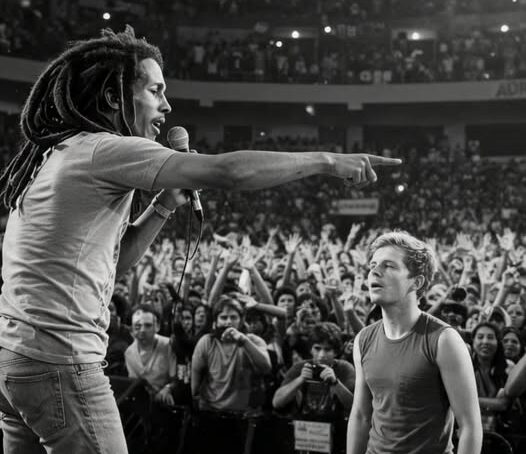
And that’s when it happened. Bob Marley looked directly at him. In an arena of 15,000 people, Bob’s eyes found Derek’s. And for a moment, that felt like eternity. They locked gazes. Derek couldn’t explain what he saw in Bob’s eyes. Not judgment, not anger, not even confusion about why this one man was standing still while everyone else danced.
What Derek saw was recognition, understanding, like Bob could see every dark corner of Derek’s heart and wasn’t afraid of it. Bob kept singing, but he never broke eye contact. And then slowly, deliberately, Bob raised his hand and pointed at Derek. The crowd around Derek went silent, looking to see who Bob was pointing at. Derek’s heart was pounding.
This was it. Bob was going to call him out. Security was going to remove him. His plan was falling apart. But Bob didn’t call security. He didn’t stop the song. Instead, Bob walked to the edge of the stage, still pointing at Derek, still holding his gaze. And he changed the lyrics.
“Brother, you’re running and you’re running and you’re running away,” Bob sang directly to Derek. “But you can’t run away from yourself.”
15,000 people were watching this moment unfold. Derek’s friends in the crowd were confused, waiting for his signal. But Derek couldn’t move, couldn’t breathe. Bob continued, “Brother, you’re running and you’re running and you’re running away, but you can’t run away from yourself.”
Then Bob did something that broke Derek completely. He smiled. Not a mocking smile, not a condescending smile. A smile of pure compassion, a smile that said, “I see you. I know what you came here to do, and I love you anyway.”
Derek’s vision blurred. To his horror, he realised he was crying in front of 15,000 people, in front of his friends, in front of the man he came to destroy.
Derek Mitchell was crying. The song ended. Bob turned away to continue the concert, but something irreversible had happened in those few minutes. Derek sat back down, his body shaking. The black father beside him, the same man Derek had been mentally categorising as an enemy two hours earlier, reached over and put a hand on Derek’s shoulder.
“You all right, brother?” the man asked. “That word, brother?”
Derek shook his head.
“No,” he whispered. “I’m not all right. I don’t think I’ve ever been all right.”
The man didn’t understand the depth of what Derek meant, but he squeezed Derek’s shoulder anyway.
“Music has a way of reaching the places we keep hidden,” he said. “Let it work on you.”
For the rest of the concert, Derek sat in his seat and wept. When Bob sang One Love, Derek sang along through tears. When Bob sang Redemption song, Derek felt every word like a prayer he’d been too broken to speak. Emancipate yourselves from mental slavery. None but ourselves can free our minds. Derek had been enslaved, not by chains or laws, but by ideology, by hatred, by fear disguised as superiority.
And in that moment, listening to Bob Marley sing about freedom, Derek chose to be free. After the concert ended, Derek’s friends found him in the parking lot.
“What happened, man?” one of them asked angrily. “You were supposed to give the signal. We were ready to go.”
Derek looked at them.
These men he’d called brothers. These men he’d fought alongside. These men who’d reinforced his worst beliefs.
“I can’t do this anymore,” Derek said quietly.
“Can’t do what?”
“This, all of this, the hate, the anger. I can’t carry it anymore.”
His friends stared at him like he’d lost his mind. Maybe he had, or maybe he’d finally found it.
“You’re weak,” one of them spat. “That don’t,” Derek interrupted, his voice firm. Don’t say that word. Don’t ever say that word around me again. They left him there in the parking lot. Cut him off completely. Derek drove home alone that night, put all his supremacist materials in a box, and threw them away.
But that wasn’t the end of Derek’s story. That was just the beginning. The next week, Derek showed up at a black church in Oakland. He didn’t know what he was looking for. Forgiveness. Guidance. Understanding. He just knew he couldn’t go back to who he’d been.
The pastor, Reverend James Washington, listened to Derek’s story, listened to his confession about the concert, about his past, about the hatred he’d carried.
When Derek finished, Reverend Washington said, “Son, redemption isn’t something you earn. It’s something you accept. Bob Marley showed you love when you came with hate. Now you have to learn to show yourself that same love. Derek started attending that church, started volunteering in the community, started slowly and painfully dismantling every racist belief he’d built his life on. It wasn’t easy.
Derek lost friends, lost his job when his former group spread the word that he was a traitor, lost the world view that had given him identity and purpose. But he gained something more valuable, truth.
Three years after the concert, Derek reached out to Bob Marley’s management. He wrote a letter explaining what had happened that night in Oakland. How he’d come to destroy and had left transformed. How Bob’s music and that moment of eye contact had saved his life.
Derek never knew if Bob read the letter. By the time the letter was sent, Bob was already sick with cancer. Within a year, Bob Marley would be gone. But Derek carried Bob’s message forward. By 1985, Derek was working full-time with youth outreach programmes, specifically targeting kids in hate groups, trying to pull them out the way he’d been pulled out.
By 1990, Derek was speaking at schools and churches, telling his story, using his past as a cautionary tale and his transformation as a testimony to the power of love over hate. By 2000, Derek had helped de-programme over 200 young people from white supremacist organisations.
In 2001, on what would have been Bob Marley’s 56th birthday, Derek visited Bob’s mausoleum in Jamaica.
He stood there for hours weeping, thanking a man he’d never personally met, but who had changed everything. Today, Derek Mitchell is 73 years old. He runs a foundation called One Love Redemption dedicated to fighting racism through education and intervention. On his office wall hangs a poster from that June 7th, 1979 concert in Oakland.
In interviews, Derek always tells the same story. The story of the night he went to destroy Bob Marley and ended up being destroyed and rebuilt by love.
“People ask me what Bob Marley did that night,” he recalls. Derek says they want to know what magic words he spoke, what special technique he used. But the truth is simpler and more profound than that.
“Bob looked at me, a man who came to hurt him, to disrupt his message. And he chose love. He didn’t see an enemy. He saw a brother. And when someone sees you as a brother, when you see yourself as an enemy, it changes everything,” he says.
The story of Derek Mitchell never made major headlines. There’s no famous footage of that moment in Oakland.
Most people who were at that concert don’t even remember the man in the third row that Bob pointed to. But for Derek and for the hundreds of lives he’s touched since, that moment was everything.
Bob Marley died in 1981, but his message, the message Derek tried to silence, continues through people like Derek.
People who were transformed by encountering love when they came with hate. In 2019, on the 40th anniversary of that concert, Derek gave a speech at Oakland Coliseum Arena. The event was a Bob Marley tribute concert, and Derek had been invited to share his story.
Standing on the same stage where Bob had stood four decades earlier, Derek looked out at the crowd, diverse, joyful, united and said,
“Bob Marley taught me that we are all running from something. Pain, fear, shame. We build walls and ideologies to protect ourselves from confronting what’s really inside us. But music, real music, honest music, it breaks through those walls. It forces us to feel what we’ve been running from.”
He paused, overcome with emotion.
“I came to this arena 40 years ago as a man full of hate. I left as a man full of questions. And over the years, as I’ve searched for answers, I’ve learned this. Love is not weakness. Love is the most revolutionary force in existence. It’s what Bob understood. It’s what he lived. And it’s what he gave to a man who didn’t deserve it. Derek’s voice broke. I didn’t deserve Bob’s love that night, but he gave it anyway. And that undeserved love, that grace is what saved me. The crowd gave Derek a standing ovation.
- A Tell Media report / Source: Life Story


About author