

Uganda’s Ministry of Agriculture, Animal Husbandryy and Fisheries (MAAF) is facing a silent crisis. Despite its critical role in ensuring food security and promoting agricultural development, the ministry is being gradually de-institutionalised with its powers and responsibilities being transferred to militarised entities.
This trend has severe implications for the country’s food production chain, scientific research and the overall performance of the ministry.
Rise of militarised conservation
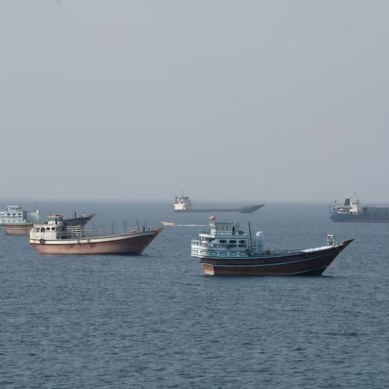
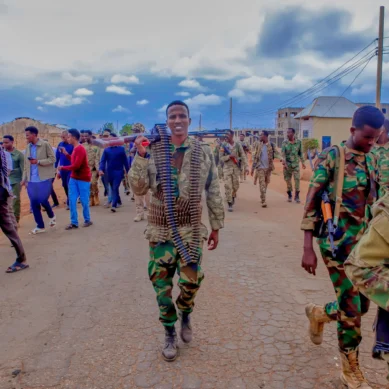
In recent years, Uganda has witnessed a growing trend of militarised conservation with the military being deployed to manage and protect natural resources, including freshwater lakes and wildlife. While the intention may be to enhance conservation and revenue generation, this approach has led to the marginalization of the MAAF and the erosion of its institutional sovereignty.
Impact on MAAF’s performance
The de-institutionalisation of MAAF has several consequences, including:
- Loss of institutional capacity: The transfer of powers and responsibilities to militarised entities has led to a brain drain and a decline in the ministry’s technical capacity
- Constrained scientific research: Scientific research is no longer free to take place without military and political constraints, stifling innovation and progress in agricultural development
- Disruption of food production chain: The militarisation of conservation has disrupted the food production chain, affecting agricultural productivity and food security
- Lack of transparency and accountability: The involvement of the military in conservation and resource management has led to a lack of transparency and accountability, creating opportunities for corruption and mismanagement.
Case study: Operation wealth creation
Creation of Operation Wealth Creation (OWC) is a prime example of the militarisation of conservation and the de-institutionalisation of MAAF. OWC, led by a military officer, has been tasked with promoting agricultural development and wealth creation but its lack of transparency and accountability has raised concerns about its effectiveness and impact.
Conclusion
The de-institutionalisation of MAAF has severe implications for Uganda’s agricultural development and food security. It is essential to restore the ministry’s institutional sovereignty and ensure that scientific research and agricultural development are guided by technical expertise rather than military intervention. When I was studying biology of conservation in the very early 1980s at Chiromo Campus of Nairobi University, Kenya, the military was never mentioned in the core courses of Environmental Conservation and Management of Natural Resources and Ecological Techniques.
The military invasion of environmental conservation and management as well as ecological techniques is an environmental pollutant with serious consequences in medium- and long-term on Uganda’s freshwater and total environment. The military exclusion of the time-tested cultural conservation and management practices from Uganda’s lake systems and environments is an imposition of ecologically and environmentally empty military and political choices of the NRM Government.
It is authoritarian environmental conservation and management and an escape route from accountability and transparency. It does not add any value to the enterprise of conservation of Uganda’s terrestrial (land-based) and freshwater environmental conservation and management. Also by interfering with Uganda’s agroecological and freshwater systems the military is eroding rather than adding value to the ecological, environmental, cultural and food security of Ugandans. It is only perpetuating and proliferating authoritarianism, fear and silence in environmental conservation and management with little thought allocated to long-term ecological, environmental and food security.
Recommendations
Let me just list my recommendations:
- Demilitarise environmental conservation and management.
- Power should respect time-tested environmental conservation methods of the indigenous communities.
- Power should recognize the biological, cultural, ecological and historical linkages of the indigenous communities to the terrestrial and freshwater environments and support their conservation and management of their natural belonging and identity for long-term environmental, ecological, biological and cultural survival in their own environment
- Re-institutionalise the ministry of agriculture, animal husbandry and fisheries to ensure its institutional so strength and restore its critical in the food security of Uganda.
- Government should create a fear free environment so that food production and fishing are not done in fear. If people are driven away by fear, food production and fishing may become no-go areas for many young people in whom food security should depend.
- De-presidentialise decision-making in agree culture ministry of agriculture, animal husbandry and fishing. Presidential ideas such as Operation Wealth Creation, Parish Development Model and Myooga are accelerating ecological, environmental and cultural erosion of food production by undermining the country’s 7 or so agro-ecological systems on which Uganda’s indigenous communities have depended for their food security former security. When food security is eroded, genocide is inevitable.
- Reduce the constitutional powers of the president of Uganda because at the moment there is no limit to what the president can do without consulting anybody or any institution. Consequently the president has subjugated all institutions to himself and most of the ecological, environmental and cultural erosion and ecological, cultural and cultural decay in the country stems from the centrality of the president in environmental conservation and management
- Revalue accountability and transparency in leadership and governance of Uganda and its resources, including the people. Militarisation of everything conceivable is what a ruler needs to bypass accountability and transparency
- Support and value scientific research. Conservation and management of natural resources that is not based on scientific research does not add value to the livelihoods of our people. Currently in Uganda the military is everything for everything. However, even if the government says it is for the natural sciences, not humanities and social sciences, its militarisation policy is undermining scientific research and institutional integrity. This is the case with the ministry of agriculture, animal husbandry and fisheries to the detriment if Uganda and Ugandans.
- De-elitistise environmental conservation and management. Our elite hardly challenge power when power is high-handed or mistakes. In many cases the elites choose silence to fill their pockets and stomachs, yet conservation and management, and even environmentalism, are in their hands. In Uganda it is as if our elites and the military are working together to put nonsense where there was sense in environmental conservation and management and in making our institutions dysfunctional. Silence is approval.
For God and my country.
- A Tell report / By Oweyegha-Afunaduula / Environmental Historian and Conservationist Centre for Critical Thinking and Alternative Analysis (CCTAA), Seeta, Mukono, Uganda.
About the Centre for Critical Thinking and Alternative Analysis (CCTAA)The CCTAA was innovated by Hyuha Mukwanason, Oweyegha-Afunaduula and Mahir Balunywa in 2019 to the rising decline in the capacity of graduates in Uganda and beyond to engage in critical thinking and reason coherently besides excellence in academics and academic production. The three scholars were convinced that after academic achievement the world outside the ivory tower needed graduates that can think critically and reason coherently towards making society and the environment better for human gratification. They reasoned between themselves and reached the conclusion that disciplinary education did not only narrow the thinking and reasoning of those exposed to it but restricted the opportunity to excel in critical thinking and reasoning, which are the ultimate aim of education. They were dismayed by the truism that the products of disciplinary education find it difficult to tick outside the boundaries of their disciplines; that when they provide solutions to problems that do not recognise the artificial boundaries between knowledges, their solutions become the new problems. They decided that the answer was a new and different medium of learning and innovating, which they characterised as “The Centre for Critical Thinking and Alternative Analysis” (CCTAA).


About author