
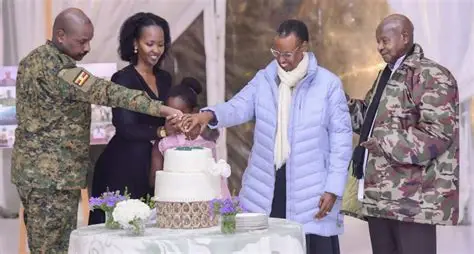
Museveni dynasty: How 40 years of family misrule silenced Ugandans’ voice, stymied hopes of a people
Uganda goes to the polls on January 15 – two weeks from today. However, the same old story prevails as has been the case in the past 40 years: President Yoweri Tibuhaburwa Museveni seeking a sixth term, his wife Janet Museveni keen to remain the power behind the throne, his brat of a son Gen Kainerubaga Muhoozi waiting in the wings inherit the throne and spoilt daughters relishing another chance to abuse ordinary citizens by virtue of proximity to power.
Power corrupts! In word, Museveni wants to retain power for his family.
In Uganda, a family’s grip on power has turned democracy into a spectacle, and progress into a whispered dream. Since 1986, the Museveni family has shaped Uganda’s politics, raising urgent questions: Is this liberation or entrenchment? Some call it entrapment.
Four decades of family rule have weaponised power, suffocated dissent, and left Uganda’s generations with a shrinking space to breathe. It was this reality in Uganda’s politics, which compelled me to write an article titled “Uganda: From Hereditary Chiefs and Kings to Hereditary Politicians (Oweyegha-Afunaduula, 2022). I wrote that hereditary politics, political families, political dynasties and dynastic politicians in Uganda are a creation of President Tibuhaburwa Museveni’s perennial rule. I added that the tendency towards political dynasties is the reason why the public state (of elected officials) gives way to a deep state.
In this article, I submit that President Tibuhaburwa Museveni’s 40 year-rule is silencing the future of Uganda. Civic spaces have been captured by the military. The article identifies instant impacts (1986-2026), long-term consequences and permanent scars on generations.
Let me look at the instant impacts first.
Smoke and mirrors
According to Britannica dictionary, the definition of Smoke and Mirrors is “something that seems good but is not real or effective and that is done especially to take attention away from something that is embarrassingly unpleasant. It is a phrase commonly used in the US, but it will fit very well in my critical thinking.
In Uganda power is no longer just what you acquire through election to a political office, say the office of president of Uganda. Power has become inheritance. There is clear evidence that President Tibuhaburwa Yoweri Museveni has demonstrated, not announced, that his son, General Muhoozi Kainerugaba, is the one he wants to inherit power from him. His actions, such as fast-tracking the promotion of his son from a private to a general in a very short time, simultaneously naming him chief of defines forces (CDF), and fast-tracking the UPDF Act 2025 while simultaneously transferring the powers of appointing and promoting officers to higher ranks, have shown that the General is his choice in case anything happens to him.
Indeed what he used to do, such as ordering the arrest and incarceration of certain Ugandans, is now readily done by the CDF.
The meteoric rise of General Muhoozi Kainerugaba is therefore not a coincidence but a blueprint towards inheritance of power. The general issues public orders like a president. For example, he recently unconstitutionally issued a public order that voters should immediately go home after voting on January 15, 2026, yet the Uganda Constitution 1995 provides that the voters should stay 20 metres away from the ballot box.
So, then how does Smoke and Mirrors come in? In my view, to conceal the ultimate goal of the choice of political inheritance of the post of president unconstitutionally, President Tibuhaburwa Museveni has drawn the attention of Ugandans away from the unpleasant possibility of his son inheriting power to schemes such as Myooga, Parish Development Model (PDM) and Operation Wealth Creation (OWC), which promise illusionary wealth, at a very high cost to the tax payers of Uganda. Unfortunately, as I intimated in another article ‘How the Mafia are De-institutionalising Uganda’, most of the money committed to these schemes end up in the pockets and bank account of the Mafia.
Violence as currency
Violence is the intentional use or threat of physical force, power or aggressive behaviour intended to cause injury, harm (physical, psychological, mental and economic of sexual), damage or even death to oneself, others or a community, ranging from direct acts like assault, displacement to systemic deprivation, dispossession and abuse for self-enrichment or glorification.
When I say violence as currency I mean that violence has become an integral aspect of our society and that the rulers now use it as a tool of governance to generate fear and silence. This way, they are silencing the future of Uganda. When the future of a country is silenced, the country is not there in the future. Something else is: Perhaps the country is a remnant or completely new or integrated in something else complete new. We hear more about silencing guns, not silencing the future of a country. We can silence guns in a country, but in its wake the future of the country may gradually be silenced.
From Luwero’s shadows to tear gas on Kampala streets, dissent is met with brute force. Opposition leaders like Dr Kiiza Besigye and Bobi Wine become symbols of resistance, not governance. Besides, when guns were silenced after the bush war, gunfire moved to Teso and northern Uganda. Finally, when the guns were silenced in Teso and northern Uganda, the country was brought down to its knees. The process of tearing it into small unviable units through districtification and ‘constituencisation’ proceeded to the extent that the former 15 traditional nations are no longer recognisable. The tearing down of the country is still going on under the aegis of state-sponsored violence, destroying the natural belonging and cultural identity of different indigenous groups.
There is no area in Uganda where the indigenous people are not being violently displaced and dispossessed, simultaneously losing their natural belonging and identities to people with exogenous roots, even through genetic invasion and penetration. Indeed a new country is being created with a different identity, genome and citizenry and in which people will no longer, or no longer recognise, their cultural roots. This is dangerous to the long-term survival of Uganda’s indigenous groups.
Economy of favours
In his article, The Economics of Favours, William S. Neilson (1999) noted that some favours are too expensive to perform while some socially inefficient favours are performed. The NRM government has emerged and performed as a system of favours and loyalty, often in the form of political patronage networks.
Political patronage networks, also called patronal politics, are the politics of a country or countries, where people sculpt their interactions around personal exchanges, usually consisting of money and other reward (e g. vehicles, mansions and jobs). Whoever is in a patronage network expects favours from the central actor that also expects loyalty. This is exactly what is happening in the NRM government. Meritocracy and professionalism no longer matter anymore today than they did in the past. Within the patronage network deals are made in shadows and resources are funnelled to loyalists, while public schools crumble and public hospitals beg attention.
Flawed elections
Our elections have become laughable and just a matter of course, with diminishing value addition to the democratisation of the country. The electoral process has been overly militarised, with the Electoral Commission more of less a white elephant. The country has not been adequately prepared for the presidential, parliamentary and council elections set for January 15, 2025. Mass civic education is missing, the voter register has not been displayed 34 days before elections as required. The Electoral Commission seems to operate under fear and Museveni family direction. Besides, the introduction of biometric voting, announced unilaterally by President Yoweri Tibuhaburwa Museveni, raises constitutional and legal concerns. Moreover, if the Electoral Commission is compelled to belatedly adopt the technology, without even raising voter awareness about it, its value to our electoral development will be very suspect. Most vote rigging has been through vote stuffing, but the voters and candidates have not been told how the machines will eliminate the vice.
Long-term consequences of ‘slow burn’
Let me now focus on the long-term consequences of the Tibuhaburwa Museveni family rule over the past 40 years. But first, let me explain what I mean by Slow Burn.
“Slow Burn” describes a gradual, intensifying development, most commonly a romantic relationship where attraction builds over time. However, it can also refer to a slow rising of anger or a narrative or song that unfolds gradually like Kacey Msgrave’s Slow Burn focussing on deep connection or simmering feelings rather than instant passion. It is about savouring the process, whether it is falling in love or developing intense displeasure.
Uganda’s ‘Slow Burn’ is today characterised by:
- Institutions on life support: A judiciary that bends, a military that does policing work, etc
- A government that has become allergic to accountability and transparency;
- A highly discontented citizenry, most of which that survives on the margins of nature;
- Many young people, mainly girls, fleeing to the Arab World in the hope of making ends meet, but are exploited both at home by firms belonging to Mafia and by their government eager to maximise taxes from their meagre remittances, and by their employers in the Middle East who pay them dehumanising wages, and sometimes they fall prey to body organs hunters;
- Democracy in Coma: Votes count less than whispers in State House corridors. The youth, who are the majority of Ugandans, have their votes either manipulated or distorted in service of power; or else they are often silenced, harassed and forced to be absent during voting;
- Emergence of a Divided Nation: Regions have been, and continue to be, bantustanised and side-lined and voices are stifled. While there has been talk of development, transformation and progress by the NRM, its sole leader, Tibuhaburwa Museveni, one time made it a presidential campaign slogan. Progress has been, and continues to be, selective, costly and not for all. The reason is that it is President Tibuhaburwa Museveni’s choice that those who do not support him or NRM do not take a share of the national cake.
Permanent scars on generations
The overstay in power by President Tibuhaburwa Museveni and his preference to place members of his ethnic group and family at the centre of leadership and governance, has wrought permanent scars on present and future generations of Uganda.
Let me mention three big permanent scars on generations.
- Fear and silence have become a culture in the whole society in general and in the institutions of higher learning where both students and academic staff are experiencing intellectual death. In the public space, public intellectuals have been squeezed out and nincompoops and ignoramuses sponsored by the state have consummated the space to entrench fear and silence as political tools of control. Ultimately, whispers, even in the corridors of power, have replaced meaningful and effective debates. Present-day generations have learnt that silence is safer than truth and that lies are all you need to fit in the system of things. Where fear, silence and lies exist and interact corruption thrives. This is the reason why the national budget is highly corrupted and supplementary budgets have become a conduit for robbing public money with impunity. Even borrowing from the international and domestic markets is done with impunity;
- Lost potential in all dimensions of human welfare becomes the rule rather than the exception. Brain drain is the conduit through which talent flees. Besides, ideas die in crowded spaces as people of ideas are dismissed as government opponents or saboteurs. What is left is a narrative of “what could have been”. Therefore, it is a trajectory of regrets rather than progress that persists; and
- An uncertain inheritance is what we have harvested over the years: environmental decay and collapse, piling up of debt, meteoric decline in quality of life for the majority, and a question no one cares to ask: “WHO OWNS UGANDA”?
Let me end this article by hinting on four key examples to punch harder.
- General Kainerugaba Muhoozi’s MK Movement (originally revealed as Muhoozi Project by Retired General David Sejusa Tinyefuza) was re-branded Patriotic League of Uganda (PLU). This is a continuation of the process of militarisation of the governance of Uganda beyond Tibuhaburwa Museveni. In plain sight, a successor is in training;
- Corruption whispers spread further afield reflected in the endless scandals (Karamoja guns, Covid funds, etc), while basic human needs scream louder;
- The Silenced Voices are multiplying: academics and intellectuals in the humanities and social sciences in the universities; journalists jailed, human rights activists “disappeared,” Bobi Wine’s arrest and the recent arrest of a Catholic priest, Fr Deusdedit Ssekabira, by the army, is still fresh in the minds of Ugandans. The question remains: Is this security or siege? and
- Constitutional gymnastics has characterised governance since 1996: Term and age limits erased and power tightened. There has been talk of changing the Constitution to disfranchise the citizens by the president being elected by members of parliament. It will not be a surprise if in future the constitutional provision that voters stay 20 metres from the voting site after casting their votes is erased. It will be the president’s family gaining.
Solutions and resistance
Ugandans must rise up mentally and spiritually, not just vote and wait for results. They must demand transparent elections, mass voter education and adherence to constitutional processes. They must break the fear factor by amplifying voices, protecting spaces for dissent and investing in the many, not the few. And lastly, for Uganda’s Sake: future generations deserve more than a museum of broken dreams. It is time to rewrite the script.
Conclusion
Four decades of Family Rule is enough. The Tibuhaburwa Museveni dynasty does not own Uganda – Ugandans do. When and if the members of the Museveni family go, Ugandans will remain. The question is: Will we wake up before the door locks? The future is not inherited. It is fought for. Let Ugandans fight for what is theirs: Their country, their natural belonging, their identity. If not, others will own the country our natural belonging and identity will be erased.
For God and my country.
- A Tell report / By Oweyegha-Afunaduula / Environmental Historian and Conservationist Centre for Critical Thinking and Alternative Analysis (CCTAA), Seeta, Mukono, Uganda.
About the Centre for Critical Thinking and Alternative Analysis (CCTAA)
The CCTAA was innovated by Hyuha Mukwanason, Oweyegha-Afunaduula and Mahir Balunywa in 2019 to the rising decline in the capacity of graduates in Uganda and beyond to engage in critical thinking and reason coherently besides excellence in academics and academic production. The three scholars were convinced that after academic achievement the world outside the ivory tower needed graduates that can think critically and reason coherently towards making society and the environment better for human gratification. They reasoned between themselves and reached the conclusion that disciplinary education did not only narrow the thinking and reasoning of those exposed to it but restricted the opportunity to excel in critical thinking and reasoning, which are the ultimate aim of education. They were dismayed by the truism that the products of disciplinary education find it difficult to tick outside the boundaries of their disciplines; that when they provide solutions to problems that do not recognise the artificial boundaries between knowledges, their solutions become the new problems. They decided that the answer was a new and different medium of learning and innovating, which they characterised as “The Centre for Critical Thinking and Alternative Analysis” (CCTAA).


About author