

Farmers in Tinderet Sub County, Nandi County, are turning to River Nyando as a lifeline for farming with gravity-fed irrigation systems that are helping them adapt to mounting challenges posed by climate change.
The river, which originates in the high rainfall zones of the Nandi Hills, has become central to sustaining crops and livestock, especially as rains become more erratic and unreliable over the past decade.
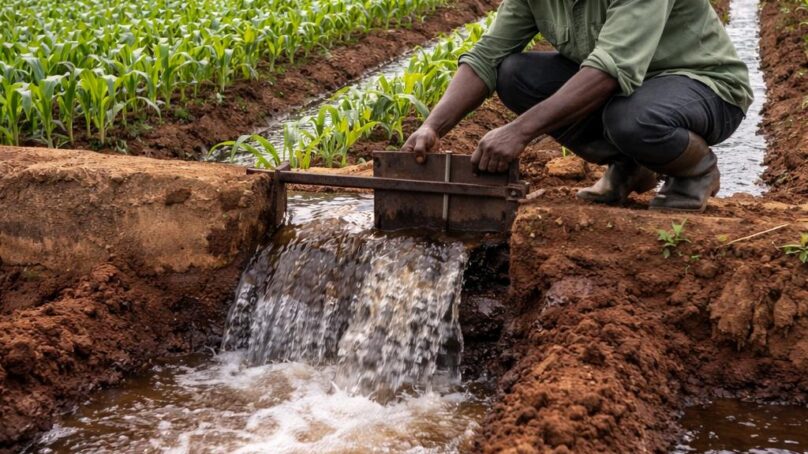
Over the years, farmers have experienced prolonged dry spells followed by sudden, intense downpours – patterns scientists link to climate change. To cope, many households have constructed simple gravity-fed irrigation systems, diverting water from River Nyando through small canals, furrows and pipes to their fields.
This method has allowed farmers to irrigate their crops without the high costs of fuel-powered pumps and has become a practical solution for communities with limited resources.
“Without the river, our crops would fail every season when the rains are late or insufficient,” said James Kiprop, a maize and sweet potato farmer in Kapkong village. “Gravity-fed irrigation has allowed us to keep our farms alive even during the dry months. We can now plant vegetables that need constant water, such as kale and tomatoes and earn a reliable income for our families.”
Similarly, Mary Jepchirchir, who grows beans and other vegetables along the riverbank near Songoliet village, noted that the irrigation system has allowed her to diversify into horticulture.
“I have been able to expand my vegetable plots because I can depend on the river for water. It has given me hope that climate change will not completely destroy our farming,” she explained.
The impact of River Nyando’s water has not been limited to crops alone. Livestock farmers, including Daniel Korir from Kapchemutwa, have reported that the river is a reliable water source for cattle, goats, and sheep during dry seasons when pans and seasonal streams dry up.
“Access to the river has prevented losses of our animals and ensured that our families continue to have milk and meat, even when rains fail,” he said.
Agricultural officers have highlighted the success of irrigation farming along River Nyando has gone hand in hand with climate-smart practices.
Sub-County Agricultural Officer Esther Chepkemoi observed that farmers have increasingly adopted soil and water conservation measures, including mulching, terracing and controlled water use to maximise the benefits of irrigation while protecting soils from erosion during heavy rains.
“The combination of gravity-fed irrigation and climate-smart agriculture has strengthened food security in the sub county,” she said.
Despite these successes, challenges remain. Farmers have raised concerns over the long-term sustainability of River Nyando. Deforestation in the upstream, soil erosion and pollution have increasingly threatened water quality and flow.
Josephat Langat, a community leader from Kaboi village, spoke of the urgency of protecting the river.
“We must plant trees along the riverbanks and prevent surface in our farms. If we do not care for the river, it will no longer support our crops and livestock in the future,” he warned.
The community has begun mobilising for collective action. Local women’s groups and farmer cooperatives have started small tree-planting initiatives along the riverbanks and established community rules for water use to ensure equitable access. These efforts have been supported by the county government and non-governmental organizations promoting sustainable agriculture and climate resilience.
As climate change reshapes rainfall patterns in the area the river has become more than just a natural feature; it is now a strategic resource essential to the survival of local farming communities.
Gravity-fed irrigation from the river has allowed farmers to adapt to a changing climate, maintain food security and protect livelihoods.
For James Kiprop, Mary Jepchirchir and hundreds of other farmers along its banks, the river remains the heartbeat of agriculture – a lifeline communities says they are determined to protect for posterity.
- A Tell Media / KNA report / By Sammy Mwibanda


About author