
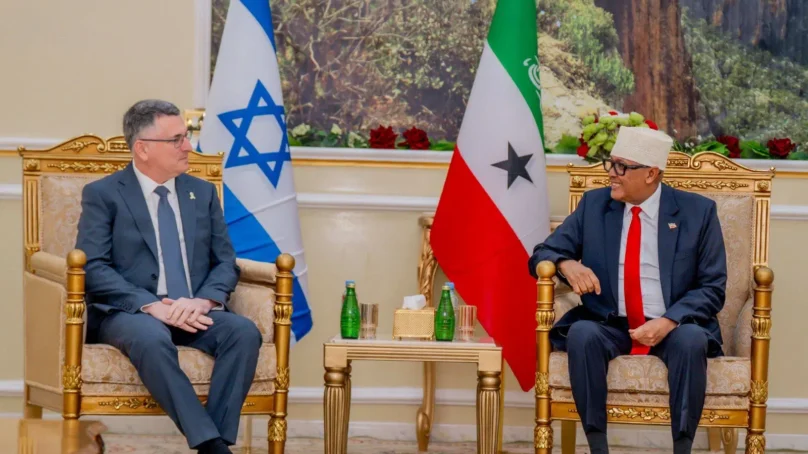
Why and how Somaliland turned to Israel for international recognition to break 34 years of isolation
Somaliland declared independence from Somalia in 1991 after its two largest cities were heavily bombarded during an armed uprising against the military regime of Siad Barre in Mogadishu. Estimates suggest that tens of thousands of people were killed, an experience that solidified Somaliland’s determination to pursue a separate political path.
Efforts to resolve the territory’s status through negotiations have repeatedly faltered. Neither Somalia, nor the broader international community, has ever recognised Somaliland’s declaration of independence, with the exception of Israel.
Shiri Fein-Grossman, CEO of the Israel-Africa Relations Institute and a former member of Israel’s National Security Council, told Israeli news channel i24 that “everyone just looks at the map and understands what Israel is looking for here.”
Fein-Grossman pointed out that Israel, increasingly isolated in the region because of its actions in Gaza, “needs as many friends as possible.”
Somaliland has also repeatedly sought to attract US interest this year by offering access to its coastline for military purposes in exchange for recognition. Most recently, Somaliland’s Foreign Minister Abdirahman Dahir Adam reiterated the offer in an interview with Fox News while another unnamed official said that Somaliland would be willing to host Tomahawk cruise missiles. Sen. Ted Cruz also publicly renewed his support for Somaliland’s recognition in a statement to Fox News.
In response, Somalia’s state minister for foreign affairs Ali Omar said in a lengthy post on X that the breakup of Somalia would undermine rather than enhance security in the Red Sea. AFRICOM previously told Fox News that the US is not seeking a base in Somaliland. At the start of 2025, Somalia undercut the value of Somaliland’s offer in exchange for recognition by pre-emptively granting the US access to all of its strategic ports.
Somaliland officials have since been circumspect in how they have addressed the separate issue of a possible Israeli military base in the country, issuing ambivalent and at times contradictory statements about the subject. Following Israel’s recognition in December, Irro stressed the agreement would not be directed against third countries, and Somaliland’s foreign ministry initially said it would not host an Israeli military base.
A foreign ministry official later told Israel’s Channel 12 that the idea of an Israeli base was being discussed and was very much on the cards. Presidency minister Khadar Abdi later told Bloomberg there would definitely be “an analysis at some point” on the question.
Multiple current and former officials – including three Somali officials, a former Somali security official, an EU security official, and a Somaliland official – told Drop Site that Israel already has an intelligence presence at Berbera International Airport. The senior Somali official and the Somaliland official both confirmed that an elite Somaliland presidential guard unit had returned from training in Israel and that intelligence officers had also received training.
A separate contingent of Somaliland maritime personnel had been sent to Kenya, the Somali official said. Somaliland’s foreign ministry in a response to Drop Site declined to comment on the reports.
Jama Abdullahi Igal Gabuush, a foreign policy adviser to Somaliland’s president and widely regarded as a key figure in Somaliland’s efforts to broker the deal, told Israel’s Channel 14 that security cooperation was already underway and described it as “very significant.”
“But it is not something, you know, amplified. But it is there as a partnership and on a mutual basis,” he said.
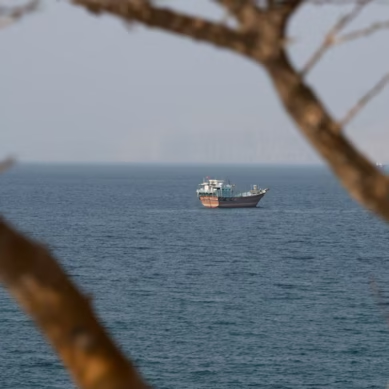
Berbera International Airport is in the midst of a significant upgrade of its military infrastructure, according to an analysis by the London-based International Institute for Strategic Studies, which argues the developments pave the way for Israeli army access to the site. The German Institute for International and Security Affairs, Germany’s leading foreign policy think tank, said the UAE has been working with Israel to help establish a military presence in Somaliland.
Swedish public radio outlet Ekot reported on Israeli plans to establish a base near Berbera, while the French newspaper Le Monde reported that Berbera’s main international airport was being upgraded to host the US and Israel. Late last year, just weeks before the recognition, a delegation from the US Africa Command (AFRICOM) visited the site.
During an Eid address in Hargeisa, Irro suggested that relations with Israel may run deeper than previously understood, telling Somalia’s president in a pointed remark that “Somaliland is not alone today” should Somalia marshall support across the region against it. “As for you, we are capable of dealing with you on our own,” he added.
A senior Somali official told Drop Site: “We’re closely following Israel’s intervention, which doesn’t serve Somaliland or regional security. It only advances their interests at everyone’s expense.”
Somaliland’s recent decision to locate its embassy in Jerusalem – a controversial choice that helps entrench Israel’s political control over the disputed city – further underscores the value it attaches to its relationship with Israel. Somaliland’s newly appointed Ambassador Mohamed Hagi, announced the move on May 18, on Somaliland’s Independence Day.
The decision made Somaliland and Kosovo the only two Muslim-majority states to maintain an ambassador in Jerusalem, breaking with the longstanding practice of locating embassies in Tel Aviv due to the city’s disputed status.
The announcement drew an immediate and unusually unified regional response. The foreign ministers of over a dozen countries – among them Egypt, Saudi Arabia, Turkey and Somalia – issued a joint statement condemning what they called an “illegal and unacceptable” move by Somaliland.
Egypt, Saudi Arabia and Turkey have had increasingly strained relations with Israel amid the wider regional fallout from Israel’s attack on Iran. The dispute over Somaliland has now become a new regional fault line, with the United Arab Emirates supporting both normalization with Israel and Somaliland.
“Israeli recognition does something specific,” Norman, the Somalia expert, told Drop Site, “it removes the ambiguity that has historically kept Somaliland out of the most dangerous alignments.”
Since December, Ansarallah has repeatedly threatened to target any Israeli presence in Somaliland, describing it as a “hostile” foothold on their doorstep.
In January, the ambassadors of Turkey, Egypt and Saudi Arabia attended the inauguration of a regional leader in an eastern territory Somaliland lost to local forces that favour Somalia. That territory has since been formalised into the North East State of Somalia and has become a part of Somalia’s federal system. It has a militarised, closed border with Somaliland, across which people and trade can no longer move.
In an interview with the Middle East-focused magazine Al Majalla, Somalia’s Ali Omar said Mogadishu was seeking closer structural coordination with Saudi Arabia and Egypt on regional efforts to maintain stability in the Red Sea and the Horn of Africa. Somalia has maintained close defence and commercial ties with Turkey since 2011.
Jama Gabuush, the foreign policy advisor to Somaliland’s president, acknowledged at a panel marking Somaliland’s independence that engagement with Israel could risk regional isolation but said Somaliland was prepared to accept that cost in pursuit of recognition.
“Somaliland has to take the stage that it has to take, and you make enemies because of what you want and who you want to be,” he said. “And I think Somaliland is ready for that.”
He said the self-declared republic had spent too many years assuming that holding elections and maintaining peace would automatically lead to recognition by the international community on the basis of democratic values, which hasn’t been vindicated.
Somaliland’s relationship with Israel has appeared generally popular with the public but has raised questions domestically about its substance and its broader implications.
On May 18, lawyer and human rights activist Guleid Dafac, who criticised the Jerusalem embassy decision as inconsistent with Somaliland’s values and international law in a Facebook post, was summoned twice by police.
- A Tell Media report / Source: The Drop Site


About author