



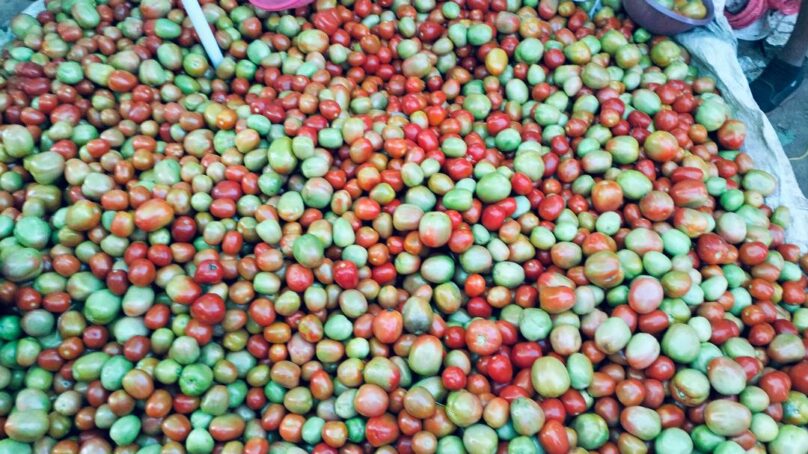
Tomato farmers in Kirinyaga, Nyeri and Laikipia counties are counting losses following surplus production of the commodity that has flooded local markets and pushed prices to record lows.
At Kagio Market – one of the largest farm produce retail markets in the region – a 60 kilogramme crate of grade one tomatoes is retailing for Ksh1,000, a sharp drop from the usual range of Ksh4,500 to Ksh6,000. Grade Two tomatoes is fetching even lower, with a 60 kilogramme crate going for as low as Ksh500
Farmers who KNA spoke to noted that the oversupply has left them counting huge losses at a time when the harsh economic times have become unbearable.
“The cost of quality seeds, labour, pesticides and irrigation was very high this season. I worked hard under harsh weather conditions, hoping for higher yields, but now I cannot even cover the production costs,” John Muthii a farmer at Kirinyaga’s PI area said.
The current warm weather condition is expected to worsen the situation as it is very favourable for tomato farming.
“We have resorted to feeding part of our harvest to livestock because it will rot anyway and the buyers who come to the farm are not making it any easy,” he said. The farm gate price for a 60 kilogramme grade-one crate of tomato is going for Ksh300 to Ksh500 only.
Post-harvest losses have also surged due to oversupply, leaving many tomatoes to rot away and a walk through the markets’ tomatoes section reveals this too well; crates upon crates lay rotting.
Another farmer, Beatrice Wanjiku from Local 20 Murang’a County, expressed frustration over the falling prices.
“I have over 3,000 kilogrammes of tomatoes still in my storage. Buyers are scarce and the few who come to buy offer extremely low prices. Many of us are losing money on transport and labour alone,” she said.
Wanjiku grows tomatoes with irrigation, which she says “does not come cheaply.”
At Mukuyu Market in Murang’a, a kilo of tomatoes is selling for as low as Ksh20 compared to Ksh80 before the festive season just a few weeks ago.
Statistics from the Ministry of Agriculture indicate that Central Kenya produces an average of 150,000 tonnes of tomatoes annually with the peak harvest occurring between December and January.
Agricultural experts have urged farmers to consider cooperative marketing, value addition and off-season production to cushion against such market shocks.
They also recommend exploring processing options such as tomato paste and sauces to reduce post-harvest losses.
“This situation highlights the need for better market linkages and storage facilities as farmers cannot continue to sell at a loss every season,” John Gathumbi, an agronomist in Murang’a, said.
- A Tell Media / KNA report / By Florence Kinyua


About author