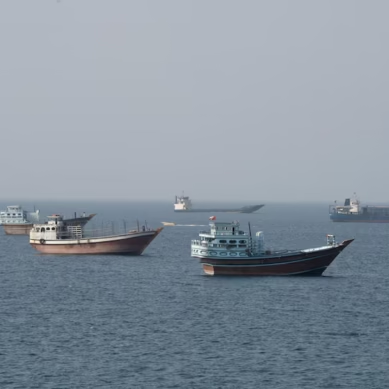


Fishermen haul in nets as families gather under striped umbrellas, children chasing foam at the shoreline. The scent of salt and charcoal mingles with cardamom tea poured from dented kettles.
Mogadishu residents are beginning another day with a quiet insistence on normalcy.
“Here, the ocean reminds us we are still alive,” said Ali Hussein, a middle-aged beach vendor renting plastic chairs and swimming vests. He gestured to a group of university students lounging with notebooks and phones.
“We come to relax, to think. Peace starts in moments like this,” Hussein says.
Mogadishu, the capital of Somalia, has witnessed a tumultuous history since 1991, marked by civil war, insurgency and terrorism. The al-Qaida-linked extremist group al-Shabaab has wreaked havoc, perpetrating frequent attacks that instilled fear and crippled socio-economic development.
During those dark years, the mutual trust that held the community together was shattered. The rhythm of normal life – built on visits, connections and cooperation – largely disappeared.
Mohamud Dahir, a resident, noted that most of the rising generation is unaware of the capital’s heyday. Yet, at a glance, the Indian Ocean still breathes gently onto Lido Beach, offering a glimpse of what was and what could be.
A few kilometres inland, the city’s fish market erupts into colour and sound. Wooden tables overflow with tuna, kingfish and lobster. Knives flash as bargaining remains brisk but good-natured.
“Every day, I walk to the fish market in the Hamarweyne neighbourhood to buy a chunk of fish to feed my children. I also make fish samosas just outside my home,” said Jamilo Abdi, a customer.
Dahir Ali, a fishmonger for over a decade, explained the rhythm: boats at dawn, sorting by mid-morning. “When security improves, business improves.”
“Terror hurts everyone. We reject it because it steals our future.”
Across town, along wide boulevards and newly paved roads, the atmosphere shifts again. Shopping malls hum with order, aisles neatly stocked and barcodes beeping at checkout. Families stroll after work, while teenagers sip iced coffee to escape the sweltering heat. Groups of entrepreneurs convene around laptops, collaborating on opportunities in Mogadishu’s expanding real estate market.
“We want quality, safety and dignity. This is what people expect everywhere else – and what we expect here,” Suudi Omar, a supermarket manager, said.
Along the busy Makka al-Mukurama road, restaurants bustle until midnight, creating a sense of freedom previously unknown to younger residents. “This city, once battered, now buzzes with life,” said Sabir Adan, a waiter. Despite the progress, challenges remain.
Recently, the city saw peaceful protests regarding sovereignty issues, with demonstrators calling for respect for Somalia’s territorial integrity following reports of Israel’s recognition of the breakaway region of Somaliland. Yet, as Mogadishu navigates these winds of change, the spirit of its people shines through.
“Our people want peace, not fragmentation,” said Abdullahi Araye, a municipal representative. “If Mogadishu becomes stable, all Somali people wherever they are will embrace it and come back to their city.”
- A Tell Media / Xinhua report


About author