
For decades, US anti-abortion groups have lobbied domestically and abroad for restricting access to abortion. In the US, their biggest success was the reversal of Roe v. Wade. Now, the Trump administration is delivering new momentum to the movement exporting “family values” to nations overseas.
At anti-abortion activists’ annual March for Life demonstration in Washington, Vice President JD Vance announced sweeping new restrictions on US funding for nongovernmental organisations, foreign governments and UN agencies that promote access to abortion, gender-affirming care and diversity initiatives overseas.
“We’re going to start blocking every international NGO that performs or promotes abortion abroad from receiving a dollar of US money,” Vance told the crowd in January.
The expanded restrictions build on the anti-abortion advocacy work carried out by conservative US non-profits abroad – especially in Africa, where healthcare is highly dependent on foreign aid. The region has the world’s highest estimated proportion of unsafe abortions and highest maternal mortality rates – including the highest number of maternal deaths per 100,000 abortions.
This is part of a series on maternal mortality in sub-Saharan Africa, which has the world’s fastest-growing population and accounts for 70 per cent of global maternal deaths. Around 180,000 pregnancy deaths are recorded every year across the continent.
The new rules represent a radical expansion of earlier US policy that cut assistance to overseas groups providing abortion-related services. Experts say at least $30 billion in US aid could be affected, reshaping health policies worldwide.
“We’re seeing opportunity here to have a consistently pro-life ethic,” Nicole Hunt of Colorado-based Focus on the Family, a conservative Christian evangelical group, said. “We’ve been influencing health policies for a long time with our foreign aid. This is just a new direction.”
In the crosshairs is an international convention signed by African countries two decades ago declaring safe abortion a human right. Known as the Maputo Protocol, it obliges signatory nations to legalise abortion in cases of rape, incest, foetal malformation or risk to a woman’s health. But implementation has been spotty, forcing women to seek illicit procedures. Every year, sub-Saharan Africa records over six million unsafe abortions, according to the African Institute for Development Policy.
Emboldened by President Donald Trump’s policies, US anti-abortion groups now aim to overturn even this limited access to safe abortion.
In Nairobi, Nardos Hagos of the International Planned Parenthood Federation said she is deeply worried for the future.
“We’ve now moved into a new era where we are the ones who are in opposition because the most powerful and influential supporters of reproductive health — the US and a lot of Europe — are now more aligned with anti-rights groups,” she said.
“We’re gonna see more women dying from unsafe abortions.”
It’s difficult to track the full scope of the funding US anti-abortion charitable groups send to Africa.
Publicly available information from non-profit tax filings of 17 such groups show money sent to Africa jumped 50 per cent between 2019 and 2022 to over $16 million, according to an analysis by the Institute for Journalism and Social Change, a research group.
AP’s global investigative team accepts tips securely and confidentially. Choose the method that works best for you.
And the funding kept growing: The organisations spent almost $9.4 million in Africa during 2023 and 2024, previously unreported data analysed by the institute shows.
That’s “just the tip of the iceberg,” said the institute’s Claire Provost.
“What we’re seeing here is just a fraction of what the real investment on the continent is,” Provost said, noting that unlike other tax-exempt charitable organisations, US-based churches and some religious groups are not required to complete annual financial disclosures detailing revenue, contributions and expenses.
It’s not possible to see “even limited information” about how much money The Church of Jesus Christ of Latter-Day Saints, among others, funnel to Africa, she said.
Widely known as the Mormon Church, the Salt Lake City-based church is “increasingly active on the continent, including opposing sexual and reproductive rights issues,” Provost said. With over one million followers in Africa, it has held “Strengthening Families” conferences throughout the continent over the past eight years.
Sean E.R. Donnelly, the church’s communications manager for Africa, said in an AP interview that about a quarter of the $1.5 billion the church spent overseas last year was in Africa, for development projects “with the goal of helping people, especially families,” including in healthcare, education and emergency relief.
Asked about women’s reproductive rights and abortion, he said the church was “not really active” in those areas but noted the issues may be discussed by its African partners during church-sponsored conferences.
“We have the deputy prime minister, we have the ministries of gender, we have all the ministers who are relevant to family and we’re helping them … as they craft policy and strategy to make sure that we protect the family,” Donnelly said of the conferences.
Asked about the church’s position on abortion, he sent a statement outlining that it generally opposes elective abortion in most cases but allows exceptions for rape, incest or danger to a woman’s health in counselling its members. He said via email that the church conducts no activities related to abortion and reproductive rights.
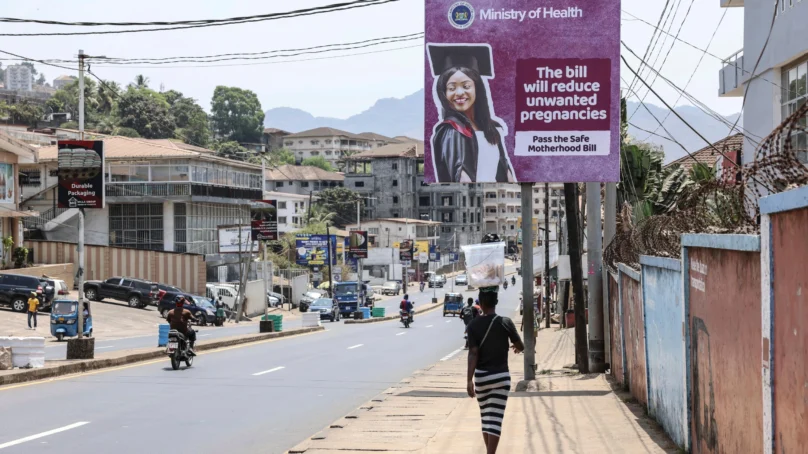
Last year’s church-sponsored conference took place in Sierra Leone at a time when the country was close to decriminalising abortion. But pressure from local religious lobbies stalled the process, local rights groups said. Activists and rights groups have raised the alarm over the influence of local religious groups, whose strategies mirror those of some conservative US Christian groups.
In response to AP’s questions about the conference and any pressures around abortion and other reproductive rights issues, Donnelly said, “This is not how the church operates in Africa or globally.” He also referred AP to the church’s Caring Report, which outlines its humanitarian work globally and does not mention the conference.
It’s tricky to determine how the US money is spent once it reaches Africa because of loose requirements on disclosing financial data in African countries.
Focus on the Family spent $370,000 in Africa between 2019 and 2023, according to the Institute for Journalism and Social Change, which says that likely does not fully capture the scope of the group’s influence or work. Focus on the Family’s Hunt said its mission is “to change hearts and minds on abortion” globally, but she declined to provide details of activities in Africa.
Hannah Ruguru vowed to help women get abortions safely after losing her sister to a backstreet procedure. But her work at a reproductive health clinic in Kisumu in rural western Kenya has proven increasingly hazardous.
She’s been screamed at by protesters and encountered so much abuse on Facebook that she deleted her account, she said.
“Sometimes you can get scared,” Ruguru said. But “at the end of the day, I’m helping women.”
Marie Stopes International, which runs the clinic where Ruguru works, said in a 2024 report that staff in several African countries described online and legal attacks from US-based groups and US-funded local organisations. In Congo, it said, health workers have been detained for days for providing legally permissible services before being released without charge.
“The extent of the opposition has made abortion providers fearful of coming into work,” the report said.
In Ethiopia, the group said, the head of the local office of US-based Family Watch International has “targeted and trolled members of our senior leadership team on social media” and released YouTube videos promoting anti-abortion misinformation.
- An AP report


About author