



Starting in 2018, Cisco Systems began partnering with the Israeli government to set up “digital hubs” in the country, including several based in occupied West Bank settlements.
In the wake of the October 7 attacks, a company-wide email from Cisco CEO Chuck Robbins stressed the “humanitarian efforts” that the company was undertaking in response, providing support for affected Israeli communities and Cisco employees, while adding that “our hope is that this war comes to an end soon, and that we can strive for peace.”
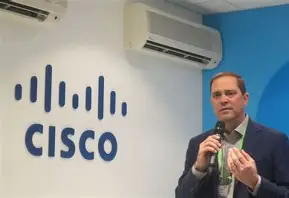
Days later, during an internal company-wide meeting known as “Cisco Beat,” Robbins gave another interview where he stated that Cisco was “working day and night to ship our technology to Israel,” including unique cybersecurity capacities requested by the country.
Internal documents show that the company very quickly saw the war as a means of ramping up an already lucrative stream of business.
A series of corporate security presentations produced immediately after the attacks and provided to Drop Site, titled “Israel ‘Iron Swords’ Update” – the name the Israeli military adopted for its military campaign and subsequent genocide in Gaza – outlined lists of action items for Cisco.
In addition to outlining measures to support accommodation and travel for Israeli employees of the company, the presentations made it clear the company saw the attacks as an opportunity to ramp up its partnership with the government.
One “Iron Swords” presentation deck states that, “Supply of Cisco equipment to Israel will be reinforced, priority given to Cybersecurity equipment,” while assigning designated Cisco employees to “to support Israeli Sales Teams presenting our Cybersecurity solutions to officials and Private sector partners.”
In November 2023, another document labelled “Israel’s CAP Details” detailed a months-long plan to roll out a programme called Security Service Edge (SSE) in Israel. SSE is a cloud-based security platform offered by Cisco that allows for protection of devices and user data regardless of their location.
The rollout was described specifically as a response to the conflict, noting that, “One of the asks for Israel War relief/support is to get Umbrella and/or SSE presence working in the country.”
A spreadsheet showing Cisco sales in Israel managed through a local Israeli partner company called Bynet shows numerous recurring services sold to institutions that make up key nodes of the Israeli security establishment, including the Israeli Air Force, Israeli Navy, the Israeli Defence Forces Computing and Information Systems unit (known by its Hebrew acronym MAMRAM), the office of the Prime Minister, which includes the Mossad and Shin Bet, the Israel Prison Service (SHABAS), an elite reconnaissance unit known as Sayeret Maglan and numerous defence companies owned by or closely tied to the government, including Elbit Systems, Rafael Advanced Defence Systems, and Israel Aerospace Industries.
The contract list also includes Israeli ministries involved in the occupation, including the Israel Electric Company, Mekorot (the National Water Company of Israel), the municipality of Jerusalem, the Israeli Ministry of Justice, as well as major Israeli banks operating in the West Bank such as Bank Leumi, Israel Discount Bank and Bank Hapoalim.
The services provided to these institutions include cybersecurity tools and access to network management and monitoring platforms.
“These are all institutions very complicit in implementing apartheid policies, and that is in addition to specific arms of the military, Navy, Air Force, military intelligence and Israeli police that are listed here,” said Noam Perry, strategic research coordinator at the American Friends Service Committee’s Action Centre for Corporate Accountability, which has been compiling research on Cisco’s business contacts in Israel and also reviewed the client list.
“Cisco is really serving the Israeli government and economy writ large. It is a large company ubiquitous in many places so it is not necessarily surprising, but there is all this need now by the Israeli military and the government for more storage, computing, and connectivity.”
Following the genocide in Gaza, Cisco was rocked by internal dissent over its ongoing collaboration with the Israeli military, leading the company to institute “guardrails” effectively proscribing debate over the topic in 2025 and terminating employees after they raised concerns.
On March 25 of that year, a Cisco executive told employees in a company-wide call that “Some topics are just simply too hard, too painful, too divisive and they take our focus away from our ability to drive Cisco business and one example specifically would be the ongoing conflict in the Middle East.”
The executive added that, “We have made the decision that this topic cannot be discussed, cannot be debated in company or organization-wide meetings.”
The issue of Cisco’s work with Israel, and in particular the MOD, has become more fraught as the Israeli military has increasingly relied upon artificial intelligence systems for targeting and surveillance in its military operations. These data intensive operations require storage and processing of tremendous amounts of information, which many Silicon Valley companies, including Cisco, have been eager to provide.
AI-powered operations conducted by the Israeli military that have automated targeting processes have been blamed for inflicting massive civilian casualties, including during an air campaign that destroyed most of the Gaza Strip.
This week, Microsoft announced that it was firing the general manager of its Israeli subsidiary and other senior staff after an internal investigation into the use of Microsoft Azure cloud services by the Israeli MOD, including for mass surveillance of Palestinians.
According to a report in the Israeli publication Globes, the move came after an internal investigation into the “sales department responsible for working with Israel’s Ministry of Defence,” as well as another recent decision to terminate contacts with the IDF’s Unit 8200 intelligence unit.
Cisco, however, has continued to champion its relationship with Israel, despite growing international backlash.
“For the Israeli arm of Cisco it’s very natural that their employees are part of Israeli society, they want to support their government, and they want to leverage their position as Cisco employees to create a win-win situation. But this is really a problem for people at Cisco headquarters, who are supposed to do due diligence when there are credible accusations of genocide against a particular government, and need to see if there is an issue with these contracts,” said Perry. “If they have done that diligence, it does not show.”
Vicky Wyatt, campaign director at Ekō, an ethical investing activist group, said that companies engaging in cooperation with the Israeli government are now facing “investor revolts, legal exposure, and a wave of scrutiny” unprecedented in the history of the tech sector.
“Cisco built its reputation as a conscious company with technology to connect and empower people,” Wyatt said. “For millions of Palestinians surviving Israel’s war crimes, the company is doing the opposite, supplying the Israeli military with the tools to dispossess and kill by providing the networking backbone of Israel’s AI-powered war machine.”
- A Tell Media report / Source: Drop Site


About author