
When Mouhamadou Seck, director of RADDHO, a Senegalese human rights watchdog, began tracking a widening police crackdown against suspected homosexual men in early February, what had previously been sporadic localised arrests was rapidly becoming something larger.
Between February 4 and 9, police in the capital Dakar arrested 12 men – among them Pape Cheikh Diallo, one of Senegal’s best-known television presenters – on charges of same-sex relations and alleged “intentional transmission” of HIV under Article 319 of the penal code.
The case drew national attention and triggered further investigations, with authorities extending the sweep beyond Dakar through phone data and denunciations. What struck Seck was not only the scale but the role HIV transmission played in the crackdown.
While same-sex relations have long been criminalised under Article 319, the use of “voluntary transmission” charges – often applied solely on the basis of a person’s HIV status – marks a shift in how the law is being enforced.
Monitoring by the HIV Justice Network, an international organisation that tracks the criminalisation of people living with HIV worldwide, puts the total number of detentions under Article 319 since early February at more than 70, with at least 62 linked to the Diallo investigation.
Of those arrested, at least 24 have also been charged with “voluntary HIV transmission”, including instances involving individuals on treatment with undetectable viral loads.
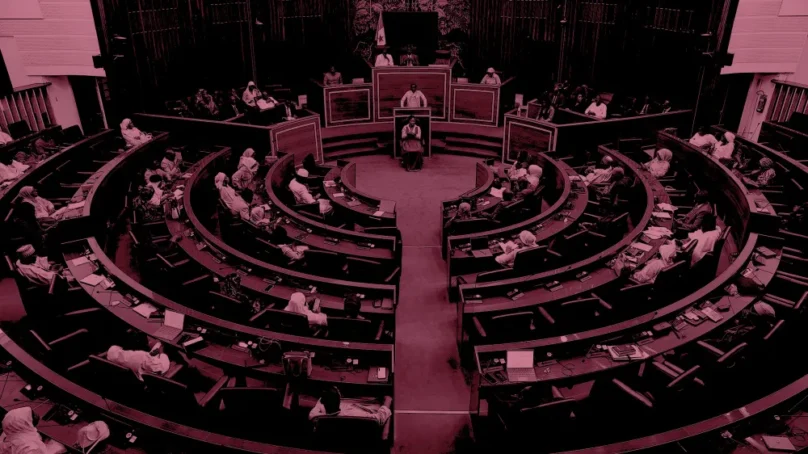
On March 31, President Bassirou Diomaye Faye signed into law amendments passed by the National Assembly by 135 votes to none that doubled maximum sentencing for same-sex relations under Article 319 from five to 10 years.
The “glorification of homosexuality” – defined in the law as any public representation by word, writing, image or sound tending to promote same-sex relations – also now carries penalties of three to seven years in prison and fines of up to five million CFA francs (close to $9,000), as does the deliberate financing of any person or group working to promote these practices. Previously, neither was outlawed.
Alice Bordaçarre of the International Federation for Human Rights (FIDH) said the provisions are broad enough to expose anyone working on fundamental rights. “If you’re fighting for access to health for people with HIV or sex workers, you could be considered as promoting homosexuality,” she says.
Health activists worry fear of arrest and harassment will result in a spike in HIV infection.
Senegal’s general HIV prevalence is just 0.5 per cent, but among men who have sex with men (MSM) it stands at 27.6 per cent. Although the arrests began under Article 319 for alleged same-sex relations, Seck said that, in practice, HIV status can determine whether people remain in detention.
“That explains why, each time there is an arrest, there is a doctor’s requisition to make sure the person is not affected by HIV/Aids,” he said. “Most of the time, when a person is affected by HIV/Aids, they continue to be kept in detention. If the diagnosis shows the person is not affected by HIV/Aids, they are automatically free.”
Cécile Kazatchkine of the Canadian HIV Legal Network, which has been monitoring cases alongside the HIV Justice Network, said this approach is legally incoherent. “You need to prove that the person knew they had HIV: That cannot be proved by forced testing after the fact,” she noted.
“You need to prove that they understood the mode of transmission, that they had sex posing a significant risk, and that they did so with the intent to transmit,” Kazatchkine added.
Several of those charged were on antiretroviral treatment at the time of their arrest, meaning they had an undetectable viral load and could not clinically have transmitted the virus.
On March 19, one case reached court and resulted in acquittal on the transmission charge – the defendant had not known his status until forcibly tested after arrest – but he was nonetheless convicted of “unnatural acts” and sentenced to three years in prison.
“People arrested are forced to do HIV testing and their results publicly shared, all of which are a breach of privacy rights and the right to be treated with dignity,” said Larissa Kojoué, a researcher at Human Rights Watch. “This further deters people from seeking care. We have reports of forced anal examinations, which is a violation of body integrity.”
“The violence continues after detention – family rejection for the most part, risks of mob violence and displacement.”
Kojoué said the risks extend beyond the moment of arrest. “Their safety is compromised in detention. They face physical abuses and even torture, not only by police officials but also other detainees,” she added. “The violence continues after detention – family rejection for the most part, risks of mob violence and displacement.”
Sylvie Beaumont of the HIV Justice Network, whose monitoring draws on newspaper reports in Senegal, noted that the names, professions, HIV status and in some cases home addresses of those arrested have been circulating openly.
The consequences for families have extended into daily life. Seck described the son of one detainee being forced to abandon his football training after classmates discriminated against him following the public disclosure of his father’s status.
Some detainees’ wives felt compelled to publish their own HIV test results to publicly distance themselves from stigma. “The communication around HIV has simply been used to spread information with no protection for their families, their wives, their children,” Seck said.
The impact on community organisations working in HIV outreach has been immediate. Ibrahima (not his real name), a community organiser working with LGBTQ+ Senegalese youth, who cannot be identified for his safety, said his organisation suspended all activities following the February arrests and has not resumed them.
Members of his network are now afraid to seek HIV testing or treatment, avoid outreach workers, and fear being identified or attacked in the community. “There is real fear of [being on treatment] and accessing health [services],” he said. Some members have left the country entirely.
For RADDHO, the operational consequences have been different but equally constraining. Seck said the organisation has been trying to access detainees to document conditions and provide legal support but has been largely unable to do so.
At the time of interview, only one detainee – musician Djiby Dramé – was known to have legal representation. Those released from custody have refused to speak. “We are trying to speak with those affected,” Seck said, “but they prefer not to talk, even under anonymity. It is a very difficult question to break open.”
The effects are measurable within Senegal’s HIV infrastructure. Safiatou Thiam, executive secretary of the national AIDS council, CNLS, said a rapid assessment conducted across 22 treatment sites between 26 and 28 February found consultations had fallen by 35 per cent based on month-end data – from 2,425 patients on January 31 to 1,803 on 28 February.
“The patients living with HIV say they are afraid to come. They do not want to be arrested,” said Thiam. Peer health workers – patients themselves trained to support others through testing, treatment adherence, and follow-up – stopped showing up.
“Many of them stopped working. The organisations felt they were in danger. They were afraid of being arrested,” said Thiam.
RENAPOC, the network of organisations serving key populations at the centre of Senegal’s HIV outreach – which includes MSM and sex workers – was asked by CNLS itself to close its office and shift to remote working.
One of the most prominent forces behind the new law has been Jamra, a Senegalese religious NGO. “Jamra is a very famous organisation in Senegal. It’s everywhere in the media, fighting for conservative things,” said Bordaçarre of the rights federation FIDH. “The organisation published years ago the list of presumed homosexuals and organisations that defend them.”
Thiam noted a direct contradiction in CNLS’s own relationship with the organisation.
“Jamra has three branches – one deals with health, one is religious, and one is political. It is the political branch that works against MSM. There is no agreement within Jamra itself,” she said. “But we work with the branch that deals with health. And that is the contradiction.”
The political wing has been among the most vocal forces pushing for criminalisation. “What they do is fuel hateful discourse,” said Thiam. “And people are more afraid of the communities they live with than even government services – because in a neighbourhood, a person can be lynched, beaten, killed, before the police even arrive.”
Ibrahima said he experienced this directly. “Verbal abuse, threats, and even physical attacks – I was beaten,” he said.
“Human rights organisations are refraining from speaking on the issue. Journalists, commentators, and activists are regularly being detained.”
Jamra did not respond to requests for comment. It was a hesitancy repeated by other organisations contacted for this story, including the DLSI – the government body overseeing HIV and sexually transmitted infection response; ANCS – a national coalition coordinating HIV prevention programmes; and ENDA Santé – an NGO providing health services to vulnerable populations.
“Human rights organisations are refraining from speaking on the issue,” said Ibrahima. “Journalists, commentators, and activists are regularly being detained,” he explained.
The crackdown is landing on an HIV response already weakened by a separate collapse – the US freeze on foreign aid at the beginning of last year. It brought an abrupt halt to the activities of 430 USAID-supported community organisations.
ANCS lost 12 per cent of its total budget to the USAID cuts. Contracts for community mediators were terminated and outreach capacity cut back sharply. Those services included condom distribution, pre-exposure prophylaxis (PrEP) access, and patient follow-up.
The February 2026 arrests have accelerated that retreat – and that cumulative pressure is beginning to push people out of the country.
“People are seeking refuge mostly in Côte d’Ivoire, Benin, and Togo, and to some extent Gambia,” said Kojoué. She confirmed Human Rights Watch has provided supporting letters to Senegalese activists applying for asylum in France, Belgium, Switzerland, and Germany.
RADDHO has also received reports of people leaving for Mauritania and Mali – even though same-sex relations are illegal there as well – and Thiam said many clients known to CNLS had already fled rather than risk longer prison terms under the new law.
Kojoué said what makes the current enforcement “structurally different” from previous waves under Article 319 is that the government has toughened the legal framework around these prosecutions.
It is a trend that is being repeated across West Africa. “The safe spaces are getting extremely limited,” said Kazatchkine. “We have seen new anti-LGBT laws spreading across the region – Niger, Mali, Burkina Faso – narrowing the destinations available to those who leave.”
The push for new and harsher legislation – despite existing colonial-era laws that punish gay sexual relations – reflects an effort to broaden both the scope and enforcement of criminalisation.
The consequences could be far-reaching: “What will happen is that HIV infection will rebound,” warned Thiam.
- A Tell Media report / Source: The New Humanitarian


About author