

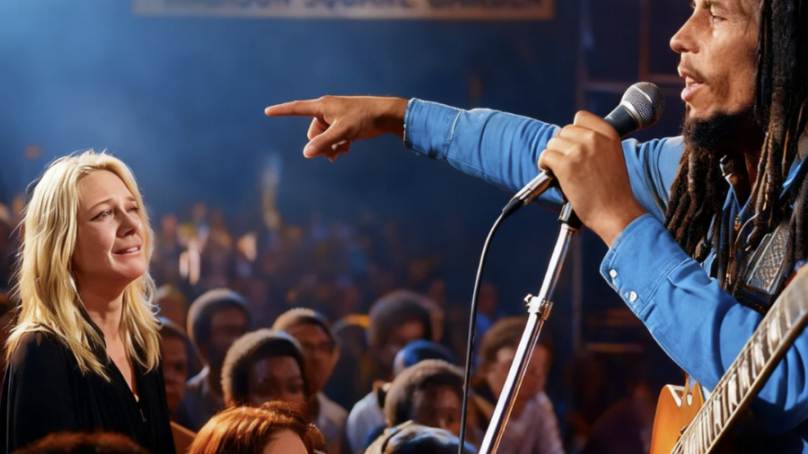
Bob Marley was halfway through No Woman, No Cry when he saw her face in the crowd, and his voice cracked like his heart was breaking all over again. For eight years, he’d performed this song hundreds of times. But he’d never told anyone who it was really written for.
The woman standing in the third row, tears streaming down her face, was the reason those lyrics existed.
She was also the woman he’d been forced to walk away from because their love was forbidden in 1970s Jamaica. What happened in the next four minutes would reveal the secret pain behind Bob’s most beloved song and show 15,000 people the difference between performing music and living it.
In Kingston, Jamaica, 1971, 26-year-old Bob Marley was still building his reputation when he met Sarah Williams, a 24-year-old British teacher who’d come to Jamaica on a volunteer education programme. She was assigned to teach at a school in Trenchtown, the same neighbourhood where Bob had grown up.
Their first meeting was at a community centre where Bob was giving guitar lessons to local children. Sarah had stopped by to introduce herself to the community leaders, and when she heard music coming from the backroom, she followed the sound.
Bob was sitting in a circle with eight children, showing them chord progressions on an old acoustic guitar.
His patience with the kids, his gentle way of encouraging them, immediately caught Sarah’s attention. When he looked up and saw her in the doorway, something passed between them that neither had expected.
“You can join us if you like,” Bob said with his characteristic warm smile. “Music teaches better than words sometimes.”
Sarah spent that afternoon learning basic guitar chords alongside the children, laughing as her fingers stumbled over the strings. Bob’s hands occasionally covered hers to show her finger placement and each touch felt electric. Over the following weeks, they began spending time together. Sarah would stop by after her teaching duties, and Bob would walk her through the neighbourhood, sharing stories of his childhood, his struggles, his dreams of taking reggae music to the world.
Their connection was immediate and profound. Sarah understood Bob’s spiritual philosophy in ways that surprised him. Bob saw in Sarah a kindness and openness that transcended the racial and cultural barriers that divided Jamaica in the early 1970s. But their relationship existed in secret. Mixed race couples faced serious social pressure and even physical danger in Jamaica.
Sarah was staying with a conservative British family who would have been scandalised. Bob’s growing reputation in the music industry could have been damaged by association with a white woman. They met in hidden places, quiet beaches outside Kingston, Bob’s small recording studio late at night, secluded spots in the Blue Mountains where no one would recognise them.
It was during one of these secret meetings that Bob first played No Woman No Cry for Sarah. They were sitting on a cliff overlooking Kingston. The city lights spread out below them like stars. “I wrote this for you,” Bob said softly, his fingers finding the familiar cords. “About the strength you give me, about how love can survive even when the world tries to tear it apart.
“Sarah cried as he sang, understanding that the lyrics weren’t just poetry. They were prophecy. Their hidden relationship lasted eight months. Eight months of stolen moments, secret letters and the constant fear of discovery.
Sarah had extended her volunteer assignment twice to stay near Bob, but her visa was running out and her family in England was pressuring her to return.
More troubling were the threats they’d begun receiving. Someone had seen them together and spread word through certain communities. Bob found his car vandalised twice. Sarah received anonymous letters telling her “to go back where you belong.”
The breaking point came in early 1972. Bob had been offered a recording contract that could launch his international career but the producer had made it clear that any complications in Bob’s personal life could jeopardise the deal.
That night, Bob and Sarah met at their usual spot in the mountains. Bob’s heart was breaking, but he knew what he had to do.
“You have to go back to England,” he said, unable to meet her eyes. I can wait,” Sarah said, taking his hands. “I can find another way to stay.”
“No,” Bob said firmly. “You can’t build your life around waiting for a world that might never change. And I can’t ask you to sacrifice everything for a love we might never be able to live openly.”
Sarah was crying now. The song says “everything’s going to be all right”.
“Do you believe that?” Bob pulled her close, breathing in her scent one last time.
“For you. Yes, for us…” He couldn’t finish the sentence. They made love under the stars that night, both knowing it was goodbye.
Sarah left for England two weeks later. Bob threw himself into his music, channelling his heartbreak into songs that would eventually touch millions of people who never knew their true inspiration.
In Madison Square Garden, New York, March 15, 1979, Bob Marley and the Whalers were at the height of their international success.
The Babylon by Bus Tour was selling out venues across America, and Bob had become reggae’s global ambassador. 15,000 fans packed the legendary venue, representing every colour, culture and background imaginable. Bob’s music had transcended the barriers that had once kept him and Sarah apart but the personal cost of that transcendence remained with him every day.
Bob opened with positive vibration, his energy infectious as always. He moved through Exodus, Jamming and The Heathen, building to the emotional centrepiece of every concert, No Woman, No Cry.
As the opening guitar notes filled the arena, Bob settled into the familiar rhythm. This was always the most personal moment of any performance.
The song that carried his secret history. No woman, no cry. No woman, no cry. No woman, no cry. No woman, no cry. He was two verses in when he saw her.
Sarah Williams, now Sarah Matthews, according to the wedding ring on her finger, was standing in the third row centre section. She looked older, more mature, but her eyes were the same eyes that had watched him play guitar to children in Trenchtown eight years earlier.
Bob’s voice caught on the next line. He tried to recover, but his hands were shaking on the guitar strings. The band, confused by his sudden change in energy, adjusted their playing to match his faltering rhythm.
Sarah was crying, her hands pressed to her mouth. She’d obviously recognised the song’s true meaning the moment she heard it in this context, surrounded by thousands of people singing words that Bob had first whispered to her under starlight.
Bob tried to continue performing, but his emotional control was slipping. When he reached the bridge, everything’s going to be all right. His voice broke completely. He stopped playing and just stood at the microphone, staring at Sarah through the crowd. 15,000 people fell silent, sensing that something profound was happening, but not understanding what.
This song, Bob said into the microphone, his voice thick with emotion. This song comes from a place of love that had to be hidden. From a time when love wasn’t enough to overcome the world’s hate. Sarah was sobbing now, her face buried in her hands. The people around her were looking between her and Bob, beginning to understand that she was somehow connected to this moment.
Bob’s eyes never left Sarah’s face. Sometimes you have to let go of what you love most to protect it. Sometimes the greatest act of love is walking away. He began playing again, but this time the song carried eight years of suppressed pain, longing and regret. His voice soared and cracked, powerful and vulnerable at the same time.
When he sang, “In this great future, you can’t forget your past,” he was singing directly to Sarah, reminding her of what they’d shared, acknowledging that it lived in both their hearts despite the years and distance.
The entire arena was transfixed. Many people were crying without fully understanding why. They were witnessing raw human emotion transformed into music, pain alchemised into beauty. The disappearance.
When the song ended, the silence lasted nearly 30 seconds before the applause began. It was different from the usual concert applause, deeper, more reverent, as if the audience understood they’d witnessed something sacred.
Bob wiped his eyes and tried to spot Sarah in the crowd, but the stage lights were too bright. He could see shadows and movement but couldn’t make out individual faces.
“Thank you,” he said into the microphone. “Thank you for letting me share that with you.”
He moved onto the next song, but his heart wasn’t in it. Every few seconds, he tried to glimpse the third row, hoping to catch another sight of Sarah’s face. During the instrumental break of Get Up, Stand Up, Bob finally shaded his eyes against the lights and looked directly at where Sarah had been standing. She was gone. The space where she’d stood was empty, filled by other concertgoers who’d moved closer to the stage.
Bob scanned the nearby sections desperately, but there was no sign of her. She had vanished as suddenly as she’d appeared, leaving Bob to wonder if he’d imagined the entire encounter.
Had the stress of touring, the emotional weight of performing that song night after night finally caused him to hallucinate the one face he’d never been able to forget.
The search after the concert, Bob was distracted and distant during the usual post-show routine. His band members noticed his unusual mood, but didn’t cry. Bob’s emotional intensity was part of what made him a great performer, and they’d learned to give him space when he needed it. But Bob couldn’t let it go.
During the drive back to the hotel, he convinced his driver to circle back to Madison Square Garden.
The venue was empty now, the crowds long dispersed. But Bob stood outside the building, hoping against hope that Sarah might still be nearby. She wasn’t. For the next three days in New York, Bob found himself searching faces in crowds, hoping to spot Sarah on the street. He even called directory assistants asking for Sarah Matthews.
But there were dozens of women with that name in the New York area, and none of the numbers he tried belonged to his Sarah. His management team, worried about Bob’s state of mind, gently suggested that he might have misidentified someone in the crowd. Stage lights and emotional intensity could play tricks on performers.
They said it happened all the time. But Bob knew what he’d seen. He knew those eyes, that face, the way Sarah cried when music moved her. It had been her and she had been there for that song, and she had disappeared before he could reach her. The letters unknown to Bob, Sarah had indeed been at the concert. She was living in New Jersey now, married to a doctor, mother to two young children.
She’d seen an advertisement for Bob’s concert and bought a ticket impulsively, telling her husband she was going out with friends. She hadn’t expected the emotional impact of seeing Bob perform, of hearing their song sung to thousands of people who had no idea of its true origin. When Bob’s voice broke during the performance, when he spoke about hidden love and walking away, she knew he’d seen her.
But she also knew that approaching him would only reopen wounds that had taken years to heal. She had built a new life, one that was stable and safe, even if it lacked the passionate intensity she’d shared with Bob. She couldn’t risk destroying that for a conversation that might only bring more pain. Instead, Sarah did something that Bob would never know about.
She wrote him a letter, a long heartfelt letter telling him what that night had meant to her, how proud she was of what he’d accomplished, how the song had sustained her through difficult times over the years. She told him about her life now, about her children who loved reggae music without knowing their mother’s connection to its king.
She thanked him for letting her go all those years ago, for choosing both their happiness over their love. But she never sent the letter. It remained in her jewellery box for the rest of her life, alongside a small photograph of her and Bob from their time in Jamaica. Her children found both items after Sarah’s death in 2008, 30 years after that night at Madison Square Garden.
They also found newspaper clippings about Bob’s career, every album he’d ever recorded and a worn cassette tape of No Woman, No Cry that had been played so many times the label was faded beyond reading.
The legacy.
Bob never spoke publicly about what he’d seen that night at Madison Square Garden.
- A Tell Media report / Source: Soft Truth


About author