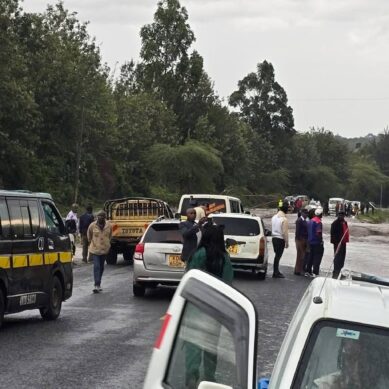



The US failure to effectively support the mission it pushed for has left Kenyan police deployed to fight the gangs of Haiti put the East African country’s contingent in an impossible Catch-22 situation.
The complex security situation in Port-au-Prince is certainly not improving. In late November, Sunrise Airlines suspended all flights to and from the capital, while the National Port Authority issued a maximum alert due to multiple attacks on Port-au-Prince port facilities.
And the insecurity isn’t restricted to the capital. During the weekend of November 29-30alone, at least a dozen people were killed in Artibonite – a central region considered the breadbasket of Haiti, half of which is now controlled by gangs. Hundreds were also forced to flee as their houses were set on fire.
This partly explains why several countries won’t contribute security personnel.
In Panama, which co-sponsored the UN Security Council resolution, President José Raúl Mulino told a press conference days after the vote that he had offered to train Haitian police officers but wouldn’t “send soldiers to Haiti to die there, because that is most likely what will happen”.
The United States, which refused to send security personnel when the MSS was deployed, has expressed no intention to change its position. According to some experts, this is also deterring others from pitching in.
“We will find ourselves in the same situation as before if the US doesn’t provide the largest contingent of troops,” Colonel Himmler Rébu, former commander of the Haitian Army’s Special Forces, said. “They are the ones who have the means to do it on the human, logistical and financial levels.”
TNH reached out to the US State Department for comment on several occasions but received no response to its questions.
So far, the only nation publicly expressing interest in sending soldiers to Haiti is Rwanda, and consultations are reportedly continuing ahead of a potential deployment.
A “force generation” meeting is scheduled for December 9 at the UN Canada mission in New York to get a sense of the countries willing to provide personnel.
The lack of clarity around fundamental aspects of the Gang Suppression Force (GSF) remains a key barrier to participation.
On December 2, Devex, which had access to the force’s concept of operations (CONOPS) draft, reported that potential contributors are hesitant due to its highly belligerent language and legal ambiguity, even as the US continues to order controversial lethal strikes on alleged drug-smuggling boats in the Caribbean.
According to the Haitian security expert, the increasing use of drones to combat the gangs is also a disincentive.
“Countries can’t commit based on a resolution alone,” he said. “And I’m not sure they will be very inclined to deploy troops knowing that a private military company is also intervening on the ground. It only reinforces reluctances.”
Why are drones a major concern?
In March, the Haitian government created a special taskforce to launch a drone campaign targeting gang leaders. For that purpose, it struck a deal with former US navy seal and President Donald Trump ally Erik Prince – a controversial figure known for founding American private military company Blackwater, whose guards were found guilty of a 2007 massacre in Iraq.
In an interview in August, Prince said there was a 10-year agreement between the Haitian government and his firm Vectus Global to fight gangs and help collect taxes. But Haitian Prime Minister Alix Didier Fils-Aimé and other Transitional Presidential Council members have been secretive about the exact role that Vectus Global is playing.
“My concern is that civilians will get hurt, that innocent people will die, because usually when Haiti or any Black country is in the crosshairs of police or military, there tends to be less care about collateral damage,” said Wolf Pamphile, founder and executive director of the US-based think tank Haiti Policy House.
This is, in fact, already happening: Prince’s deadly drone operations have killed at least 32 civilians, including several children, this year.
When asked Ombaka, the spokesperson for the GSF, whether the force was working with Vectus Global, he said it wasn’t. But several other sources drew a clear association between the two entities.
“The Haitian police don’t operate attack drones, only the taskforce, which are the mercenaries,” said Louis Henri Mars, founding member and former executive director of Lakou Lapè, a peacebuilding organisation in Port-au-Prince. “I fear that with the GSF, much more sophisticated drones will be used, with the potential of causing much more collateral damage as their use is increased.”
According to the Haitian security expert, the government has purposely avoided mentioning the name of Vectus Global, fearful of the political fallout of its presence in a country where a president – Moïse – was recently killed by mercenaries. He said the taskforce “includes military, police, and people from Vectus Global”.
“When there are operations on the ground, the government speaks of the task force, so Vectus Global never appears on paper. That will allow them to say that the GSF is acting with the ‘task force’ without ever mentioning Vectus Global,” he added.
The use of drones worries humanitarians too.
Biquet, from MSF, said drones are “increasingly used in civilian areas” of Port-au-Prince. “It makes us fear that there are no rules anymore, that the minimal respect for civilians, be it citizens, humanitarian workers, or hospitals [no longer exists]. The danger is rising,” he said.
The aftermath of a recent drone attack on a Port-au-Prince birthday party where an alleged gang leader was distributing gifts to children.
Losing hearts and minds?
As the country falls into the hands of gangs, some Haitians feel disheartened and disappointed.
After witnessing the MSS fail, Jezirap, a musician in Port-au-Prince, said Haitians have lost all hope that foreign forces will improve the situation.
“Always, those who say they come to help don’t like us. They make things worse and exploit us more, as they have done since colonial times,” he said. “Even if things get better, it will be difficult because the people who created this situation have an ulterior motive. They created this system, this poverty, this insecurity – to get rich. And the rest of us, we merely endure the result.”
Mars, the former leader of a local peacebuilding organisation, was more optimistic. If things are done well, he said, the deployment of the GSF could yield some important results – from the dismantling and demobilisation of gangs to a decrease in kidnapping, to an economic recovery, to even the possibility of holding elections and reforming Haiti’s governance.
“It could also be an opportunity to make ‘justice’ and give hope to the population that their ordeal is over; it could lead to the emergence of a new class of modern entrepreneurs who are aware of their duties and responsibilities towards the population,” he added.
- A Tell Media report / By Daniela Mohor – The New Humanitarian’s Latin America Editor-at-large, based in Santiago, Chile/ Additional reporting by Milo Milfort in Port-au-Prince


About author