

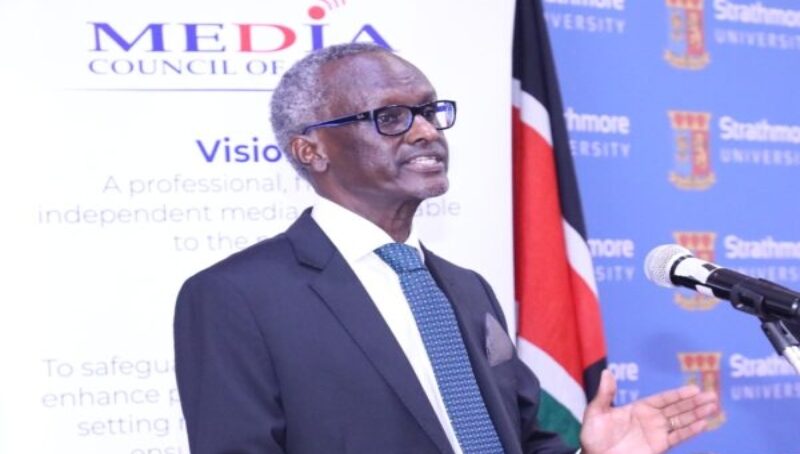
I am indeed enthused and honoured to join you today as we mark the 2026 International Media Freedom Day under the theme: Shaping a Future of Peace.
I thank you for the invitation, and I acknowledge, with great respect, the work carried out daily by members of the media across this country.
This theme Shaping a Future of Peace is not abstract. It speaks directly to where we are as a nation, and more importantly, to the choices we must make going forward as the media, judiciary and other industries and mostly as the proverbial Wanjiku.
Like the judiciary, you in the media are an important voice in shaping a future that is laden with peace for the benefit of the people of Kenya.
State of the nation
As a nation, our 2010 Constitution must continue to be our guide. But we must also be honest with ourselves and accept the fact that we are navigating a period where public discourse is increasingly tense and where political competition is sometimes expressed in ways that test our unity.
And all this against the background of technological advancement for example in the extensive use of unregulated social media spaces. We are seeing a country that is vibrant, but also one that is, at times, polarised. The speed of information, especially through digital platforms, has made it easier for ideas to spread but also for misinformation to take root.
How we respond to this moment will define not just our politics, but our future stability.
Political intolerance and its risks
Political intolerance remains one of our most pressing concerns.
We are seeing a worrying trend where disagreement is no longer just a disagreement but it becomes hostility and especially in our social media platforms and also mainstream media. People retreat into rigid positions, conversations become confrontational, and facts are sometimes overshadowed by emotion and misinformation.
When intolerance grows it weakens our ability to resolve differences peacefully. It creates an environment where suspicion replaces trust and that is a dangerous path for any democracy. Then we should ask ourselves as the media what is our social responsibility to the people of Kenya?
Responsibility of the media in shaping peace
In a climate such as the one I have described above, the media is not a bystander neither is the Judiciary. You are at the centre of how the nation understands itself. The epicentre, the heartbeat. A very important role in Society.
I wish to highly commend the media for the great work you do in this nation, from education, to informing, to setting the agenda, gatekeeping and also entertainment among the many other important roles the Media serves in this country.
And so, allow me to speak to you directly as professionals, as institutions and as custodians of public information. Your responsibility to peace in Kenya is very important, real and significant.
Every headline, every breaking news alert, every panel discussion contributes to shaping public perception. You have the ability to de-escalate tension simply by how you frame an issue. There is also a risk that sometimes some coverage may amplify division even if unintended.
This is why accuracy is not enough. Balance is not enough. Context matters. Tone matters. Timing matters. Language matters. Audience matters. In moments of political tension therefore, restraint is not weakness. It is wisdom.
This does not mean in reporting difficult stories the truth must be softened or bent. It means presenting the truth in a way that informs without inflaming, that questions without provoking unnecessary hostility and that holds power to account without deepening divisions among citizens.
As we approach future election periods the nearest being 2027, this responsibility becomes even more critical. Elections should be moments of choice, not moments of fear.
Media freedom and protection of journalists
At the same time, media freedom must be protected. A free press is not negotiable in a democratic society. Journalists must be able to do their work without intimidation, interference or fear. Any attempt to undermine media freedom ultimately undermines democracy itself.
This is a responsibility that rests not only with the state but with all actors, including those who may feel challenged by media scrutiny.
Role of the judiciary in promoting peace and stability
Allow me now to turn to the role of the judiciary. The judiciary’s role is clear: to interpret and apply the law, and to protect the Constitution.
We are often called upon to make decisions at moments of high national tension, especially during election periods and I speak with authority on this. Our duty nonetheless must be to remain impartial, steady and guided solely by the facts as presented and the law applicable to those facts.
In doing so, we contribute not just to justice, but to stability. When disputes are resolved through lawful processes, the likelihood of conflict is significantly reduced.
Collaboration between the media and the judiciary
There is great potential for meaningful collaboration between the media and the judiciary.
First, in strengthening public understanding of judicial processes we appreciate that court decisions, especially in politically sensitive matters, can sometimes be complex. However, when reported clearly and accurately, they reduce confusion and help prevent unnecessary tension.
Second, in building trust it must be appreciated that fair and responsible reporting reinforces public confidence in the justice system.
Third, in creating space for structured and ongoing dialogue I submit that engagement between the Judiciary and the media can help address concerns around reporting, access to information, and the protection of both judicial integrity and media freedom.
Fourth, in confronting misinformationboth institutions share a responsibility to ensure that information reaching the public is accurate, timely, and contextualised.
Shared responsibility during election periods
As we look ahead, particularly to the next election cycle, the need for collaboration becomes even more urgent. Elections test the strength of our institutions and the maturity of our democracy. During such times, both the media and the Judiciary are placed under intense public scrutiny.
The judiciary must ensure that disputes are resolved fairly and expeditiously. The media must ensure that reporting is responsible and does not inflame tensions. Together, these roles are complementary. Together, they can help ensure that elections remain peaceful, credible, and reflective of the will of the people.
A collective duty to shape peace
Ladies and gentlemen,
The state of our nation is not defined only by our challenges, but by how we respond to them. Peace is not automatic. Peace is built. Peace is strongly calculated through everyday decisions, through responsible leadership, and through institutions that act with integrity. Peace is a necessity for everyone.
The judiciary will continue to do its part. We will uphold the Constitution, protect rights and resolve disputes fairly and without bias. But peace in Kenya will not come from one or two institution alone. Peace is a collective responsibility to all Kenyans of all walks of life.
It must come from all of us and today, I speak especially to you, the media. You are not just observers of Kenya’s story. You are participants in how, what, when, why and how that story is told. That is a very important role indeed.
I urge you to use this influence wisely. Use it to inform, to clarify, to unite where possible, and to challenge where necessary but always with a consciousness of the impact and social responsibility your work has on the nation.
If we work together as the media, judiciary and all stakeholders we can shape a Kenya where freedom and peace go hand in hand. This is our shared responsibility.
Thank you very much.
God bless you. God bless Kenya.
- A Tell Media report / By Justice Isaac Lenaola / Chief Guest Speech by Justice Mr Isaac Lenaola, judge of the Supreme Court of Kenya, on of May 4, 2026, during International Media Freedom Day at the Strathmore University Kenya.


About author