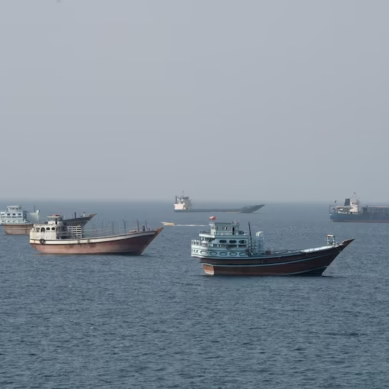

The militarization of Lake Victoria’s ecosystem and other freshwater ecosystems in Uganda has been criticized for disconnecting local communities from their traditional conservation practices and prioritizing foreign interests over indigenous rights. Oweyegha-Afunaduula argues that this approach has led to environmental degradation, human rights abuses, and economic exploitation, with the military’s involvement in managing the freshwater resources excluding local communities and traditional leaders.
The government’s focus on economic growth and resource extraction has overshadowed environmental concerns and community rights, leading to displacement, poverty, and cultural erosion among Indigenous communities. The militarisation of environmental leadership has also undermined community-led conservation efforts and reduced the value of scientific research.
Need for demilitarisation.
To address these issues, demilitarizing environmental leadership is crucial. This approach prioritizes community ecological governance, participatory decision-making, and sustainable practices. Some potential policy reforms to support demilitarization include:
- Community-Based Environmental Management Policies: Develop policies that prioritize community-led conservation and recognize indigenous knowledge systems, as emphasised in Uganda’s National Environment Act (2019.
- Decentralise Environmental Decision-Making: Transfer decision-making authority back to local governments and communities, ensuring inclusive and participatory processes, as outlined in The Constitution of Uganda (1995).
- Environmental Justice and Accountability: Strengthen laws and institutions to address human rights abuses and environmental crimes, ensuring accountability for perpetrators.
- Sustainable Livelihoods and Alternative Income: Support alternative livelihoods for communities dependent on natural resources, promoting sustainable practices.
- Military Role Clarification: Clearly define the military’s role in environmental conservation, ensuring it supports community-led initiatives rather than dominating them, in line with the African Union’s African Convention on the Conservation of Nature and Natural Resources (2017).
By implementing these reforms, Uganda can shift towards a more inclusive and sustainable approach to environmental leadership, prioritizing community rights and ecological conservation.
Therefore, demilitarizing environmental leadership in particular and the Ugandan society in general must be the main preoccupation of a new government beyond President Tibuhaburwa Museveni who has presided over the military capture of everything conceivable in Uganda, including civic responsibility for environmental conservation and management.
There will be no meaningful and effective development in Uganda in the 21st Century and beyond unless soldiers accept that they are subject to civilian authority and return to the barracks.
A lot of public money is being spent on the military just to show that the military is more superior and more sovereign than Uganda and its citizens.
Already, the Chief of Defence Forces (CDF), General Muhoozi Kainerugaba, has declared that Ugandan civilians will never rule Uganda again (Muhimba, 2024).
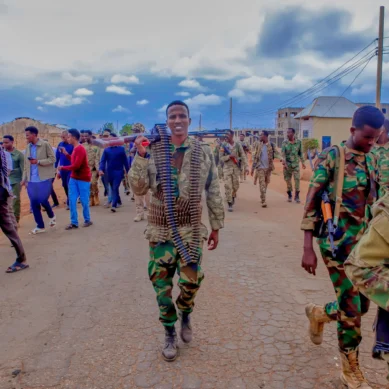
Militarization in Uganda is no longer a political but military project. It explains why the National Budget is disoriented towards the military and State House. It explains why the campaign trail of civilian Bobi Wine during the Presidential Campaigns towards 2026 General Elections. It also explains why the Electoral Commission may find it difficult to declare a civilian presidential candidate winner of the January 15 2026 Presidential Elections. It is about power retention in the hands of the military and exclusion of civilians from leadership and governance of Uganda at whatever cost (human or non-human).
The militarization project is in the hands of President Tibuhaburwa Museveni as the Commander-in-Chief of the Uganda Armed Forces and his son General Muhoozi Kainerugaba, as Chief of the Defence Forces. It President Tibuhaburwa Museveni and General Muhoozi Kainerugaba who have also made it a project to militarize environmental leadership of Uganda in all its dimensions (i.e. ecological-biological, sociocultural, socio-economic and temporal). All the dimensions must be demilitarized for meaningful and effective development to begin taking place in Uganda.
For God and my country.
- A Tell report / By Oweyegha-Afunaduula / Environmental Historian and Conservationist Centre for Critical Thinking and Alternative Analysis (CCTAA), Seeta, Mukono, Uganda.
About the Centre for Critical Thinking and Alternative Analysis (CCTAA)
The CCTAA was innovated by Hyuha Mukwanason, Oweyegha-Afunaduula and Mahir Balunywa in 2019 to the rising decline in the capacity of graduates in Uganda and beyond to engage in critical thinking and reason coherently besides excellence in academics and academic production. The three scholars were convinced that after academic achievement the world outside the ivory tower needed graduates that can think critically and reason coherently towards making society and the environment better for human gratification. They reasoned between themselves and reached the conclusion that disciplinary education did not only narrow the thinking and reasoning of those exposed to it but restricted the opportunity to excel in critical thinking and reasoning, which are the ultimate aim of education. They were dismayed by the truism that the products of disciplinary education find it difficult to tick outside the boundaries of their disciplines; that when they provide solutions to problems that do not recognise the artificial boundaries between knowledges, their solutions become the new problems. They decided that the answer was a new and different medium of learning and innovating, which they characterised as “The Centre for Critical Thinking and Alternative Analysis” (CCTAA)


About author