

Gasoline crisis bites as Kenya’s energy minister assures country ‘there is enough fuel’ in dry pumps
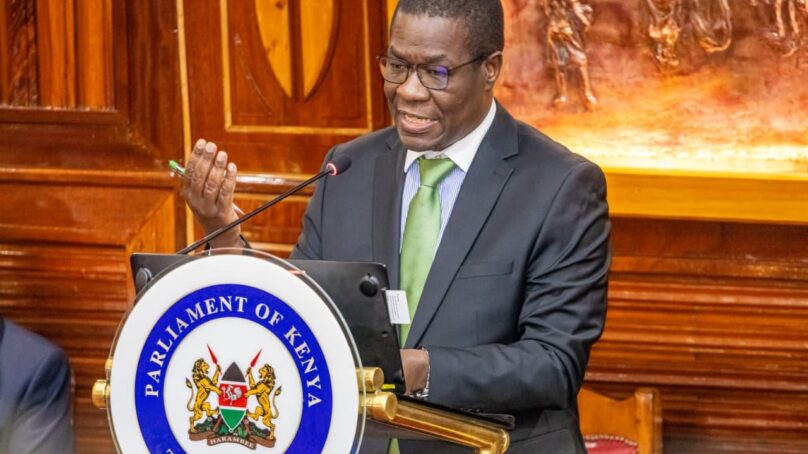
Kenya’s Energy Cabinet Secretary Opiyo Wandayi has assured the country that the government is taking every necessary step to ensure the ongoing conflict in the Middle East does not negatively affect fuel supply or energy stability in the country.
Mr Wandayi gave the assurance on Wednesday when he appeared before the Senate Plenary, where he responded to a series of questions from senators on fuel security, electricity connectivity, compensation for persons affected by power transmission projects and the resilience of the country’s electricity infrastructure in the face of increasingly extreme weather conditions.
Addressing concerns raised by lawmakers over the stability of fuel supply, Wandayi said the government is vigilant and proactive through engagement with key stakeholders across the energy sector to cushion Kenyans from the potentially severe effects arising from the tensions in the Middle East.
He said strategic interventions by the government had so far ensured that the country remained insulated from supply shocks that might otherwise have triggered shortages.
The cabinet secretary also addressed reports of fuel scarcity that emerged in parts of the country from May 5, 2026. He clarified that the temporary disruption had been caused by a technical and administrative hitch, which had since been fully resolved.
He assured the House that normal supply resumed on Wednesday and urged Kenyans not to panic. He further praised the government-to-government fuel importation arrangement, describing it as a critical intervention that had helped shield Kenya from the worst effects of global energy disruptions triggered by the conflict in the Middle East.
Responding to the question posed by Senator Kanar Seki (Kajiado) regarding the number of households in Kajiado County that are currently connected to the national electricity grid, Wandayi revealed that a total of 365,277 households are connected, with the total number of connections countrywide now standing at 10,346,947 households.
He said the ministry had put in place several intervention measures to enhance electricity access in the county, including the implementation of 53 electrification schemes distributed across various constituencies.
According to Wandayi, the Rural Electrification and Renewable Energy Corporation (REREC) had made significant investments in the county over the past four financial years.
“REREC has funded electrification projects worth Ksh1.415 billion, connecting a total of 4,358 customers over the last four financial years to date.
In addition, 310 high masts and streetlights have been funded, impacting thousands of residents in market centres and key streets,” Wandayi observed.
He told the House that the ministry was adopting a multi-pronged strategy to accelerate electricity connectivity in the county, including fast tracking ongoing projects, ensuring equitable budgetary allocation across constituencies and supplying critical construction materials to guarantee timely completion of projects.
The cabinet secretary added that the ministry is also pursuing collaborative financing arrangements with local partners to speed up connectivity.
“REREC is engaging Members of Parliament in Kajiado County to collaborate under the matching fund programme, where the cost of electrification is shared shilling for shilling, subject to availability of budget,” he explained.
He further noted that his ministry was encouraging closer collaboration between REREC and Kenya Power officers to jointly inspect, commission and meter completed projects to ensure they become operational without unnecessary delays.
On delayed compensation for landowners affected by electricity transmission line projects along the Kajiado–Namanga, Sultan Hamud-Merrueshi-Loitoktok and UMMA University-Konza corridors, Wandayi informed senators that significant progress had been made, although a number of affected persons were still awaiting compensation.
He disclosed that a total of 836 Project Affected Persons had been identified across the three projects, with compensation processes currently at different stages of completion. Despite the progress, he said some landowners were yet to receive payment.
According to the cabinet secretary, 108 affected persons along the Kajiado-Namanga transmission line had not yet been compensated, while 37 remained unpaid along the Sultan Hamud–Merrueshi–Loitoktok line and 18 along the Isinya-Konza corridor.
The minister attributed the delays to a number of challenges, including incomplete documentation, land ownership disputes and verification procedures required to ensure compliance with legal and financial regulations.
He assured the House that the ministry is working closely with relevant agencies to resolve all outstanding issues and expedite compensation for every eligible project affected person.
“The government remains committed to ensuring that all legitimate landowners are compensated fairly and promptly. Efforts are being intensified to clear the existing backlog and prevent similar delays in future infrastructure projects,” he said.
Responding to Senator Hamida Kibwana`s question on persistent power outages in several estates in Nairobi following recent heavy rains and flooding, Wandayi said the ministry had conducted a comprehensive assessment of affected power infrastructure and had already implemented immediate remedial measures to minimise future disruptions.
He said some of the interventions included improving drainage tunnels around substations in collaboration with county governments, clearing storm water channels in partnership with agencies such as Nairobi City County government, Kenya National Highways Authority and Kenya Urban Roads Authority.
“We have undertaken a comprehensive assessment of our infrastructure and implemented immediate corrective measures, including improving drainage around substations, clearing storm water passages and working with road agencies to integrate stronger drainage systems in future road designs,” he said.
The cabinet secretary pointed out that the ministry was also undertaking aggressive vegetation management by clearing trees along wayleaves in collaboration with county authorities and landowners in order to minimize outages caused by falling branches and uprooted trees.
He revealed that longer term plans were also being considered to climate proof Kenya’s electricity infrastructure.
Among the measures under consideration, he said, were the reconstruction of older substations affected by changing drainage patterns caused by new developments, raising substation levels several metres above ground, undergrounding power infrastructure to reduce exposure to harsh weather and replacing wooden poles with concrete ones to improve network resilience.
On broader plans to modernise Kenya’s electricity infrastructure in line with global best practices, Wandayi said energy sector agencies had already begun investing heavily in smart grid technology.
“Ministry and its agencies have been investing in a smart grid that is more reliable, resilient and easier to maintain, as operators can quickly detect faults and restore supply. A smart grid will also enhance proper maintenance scheduling and help prevent blackouts,” he said.
- A Tell Media / KNA report / By Joseph Ng’ang’a


About author