

My story begins not with an answer, but with a question – one that has shaped the entire trajectory of my life. As a young boy in Nawaka, Luuka country, under the shadow of British colonialism, I looked at the world and saw a fundamental difference. I asked my father why I was black and the colonialists were not. His reply, which has echoed in my mind for over seven decades, was my first lesson in ecology, although I did not know it then.
Ecology, I have learned, is not merely the study of organisms and their environment; it is the study of relationships, of belonging, of power and of place. He said: “Those people don’t belong to our village. They came from elsewhere. They invaded, conquered, occupied and captured our village. They want to change everything they found here – our lives, the way we live, our way of life, our way of seeing things.”
This was the seed from which my ecological consciousness grew – a recognition that the landscape of power is intimately entwined with the physical and biological landscape.
Tapestry of life
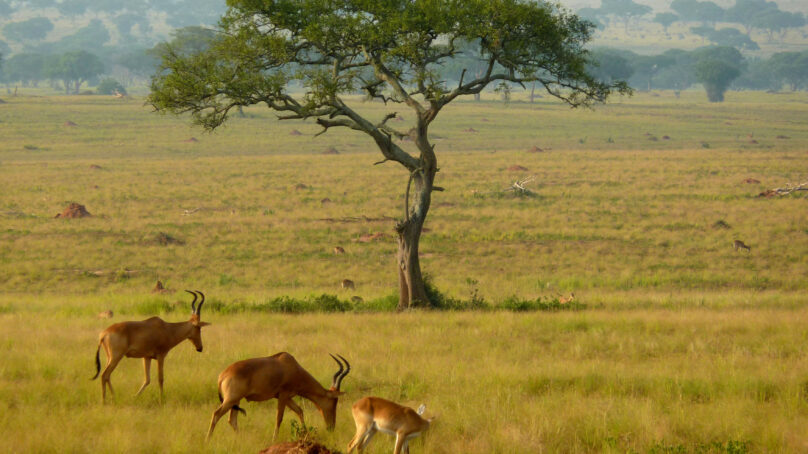
My early world was a universe of staggering abundance and intricate connection. Life was not an abstract concept but the very fabric of daily existence. Our environment was a lush, layered mosaic: vast, fish-rich swamps buzzing with dragonflies and painted with butterflies; expansive forests and woodlands that whispered with mystery; and small, precious grasslands. This was not “nature” as something separate from us; it was our home, our larder, our pharmacy and our playground.
I spent countless hours foraging, learning to read the land not from books, but from taste, touch and observation. The variety was breath-taking. It was a living library of life where every creature had its chapter: from the industrious insects and colourful birds to the imposing mammals – elephants, buffaloes, lions, leopards, and cheetahs – that roamed the margins of our world.
Armadillos and monitor lizards were common sights. The swamps teemed with frogs and the skies were a shifting tapestry of avian life. This daily immersion in biodiversity did more than nourish my body; it ignited an insatiable curiosity. I did not merely see animals; I began to see relationships – the link between the forest and the rain, between the insects and the birds, between the health of the swamp and the fish on our plate. Unknowingly, I was becoming an ecologist long before I learned the word.
Turning point – fear and reverence
My relationship with this vibrant world was not one of naïve romance. It was grounded in a respectful understanding of its dangers. A single morning in 1958 crystallised this. Desperate for mangoes from a tree that nourished our entire village, I climbed high into its branches, only to find myself a few feet from the poised gaze of a large black snake, most likely a black mamba.
In that frozen moment, I understood my place not as a master, but as a participant in a complex web where I, too, could be prey. I descended carefully and never climbed for fruit again. That encounter taught me a profound ecological truth: true reverence for life includes a respectful fear of its power. The wilderness was not a tame garden; it was a sovereign realm with its own rules. This lesson in humility was as formative as any I later received in a university lecture hall.
Unravelling and the calling
As I grew up, the meaning of my father’s warning became horrifyingly clear. The colonial project and the ideologies that succeeded it, was fundamentally an ecological project of homogenisation. The desire to “change everything” manifested as a systematic dismantling of the complex ecological and cultural tapestry I knew. My journey through academia – becoming a zoologist and conservation biologist – armed me with the vocabulary to diagnose the catastrophe I witnessed. The rich biodiversity that had been my childhood companion began to vanish.
The expansive forests were felled. The swamps were drained. The streams silted and lost their fish. The thunder of elephants and the calls of wild dogs faded into silence. The armadillos and monitor lizards disappeared. The once-vibrant sky became monotonous, deprived of its variety of birds.
My personal foraging map, once featuring 85 species of plants, shrank to a pathetic few – millet, sweet potatoes, cassava – monocultures of survival replacing a diet of abundance. This was not “development”; it was impoverishment. It was the “Bantustanisation” not just of political units as I see in today’s Uganda, but of the mind and the land – a fragmentation of wholeness into disconnected, manageable, and degraded parcels.
Relic’s reflection
At nearly 77, I am a relic. I carry within me the memory of a world that no longer exists – a living archive of lost sounds, sights, and tastes. My ecological autobiography is a story of paradise known and lost. But it is not a lament without purpose. It is a testimony.
I write this so that others may understand that the current climate and biodiversity crises are not sudden events. They are the culmination of a long process of disconnection, conquest and simplification that began with the colonial gaze my father identified. The struggle to save life in all its forms – human and non-human – is the struggle to resist this homogenising force to defend complexity and to remember that we belong to the world; it does not belong to us.
Let my story be a template. I urge every person to write their own ecological autobiography. Look back. What birds have vanished from your sky? What streams have gone silent? What foods have you forgotten the taste of? In remembering what we have lost, we clarify what we must fight to restore. Our memories are not just personal nostalgia; they are vital ecological data and the foundation for a politics of life. The child who once foraged in a living woodland became a scientist and a conservationist.
May this testimony inspire new generations to forge their own path of curiosity, reverence and fierce protection for our only, irreplaceable web of life. The future depends on remembering what we once knew.
For God and my country.
- A Tell report / By Oweyegha-Afunaduula / Environmental Historian and Conservationist Centre for Critical Thinking and Alternative Analysis (CCTAA), Seeta, Mukono, Uganda.
About the Centre for Critical Thinking and Alternative Analysis (CCTAA)
The CCTAA was innovated by Hyuha Mukwanason, Oweyegha-Afunaduula and Mahir Balunywa in 2019 to the rising decline in the capacity of graduates in Uganda and beyond to engage in critical thinking and reason coherently besides excellence in academics and academic production. The three scholars were convinced that after academic achievement the world outside the ivory tower needed graduates that can think critically and reason coherently towards making society and the environment better for human gratification. They reasoned between themselves and reached the conclusion that disciplinary education did not only narrow the thinking and reasoning of those exposed to it but restricted the opportunity to excel in critical thinking and reasoning, which are the ultimate aim of education. They were dismayed by the truism that the products of disciplinary education find it difficult to tick outside the boundaries of their disciplines; that when they provide solutions to problems that do not recognise the artificial boundaries between knowledges, their solutions become the new problems. They decided that the answer was a new and different medium of learning and innovating, which they characterised as “The Centre for Critical Thinking and Alternative Analysis” (CCTAA).


About author