

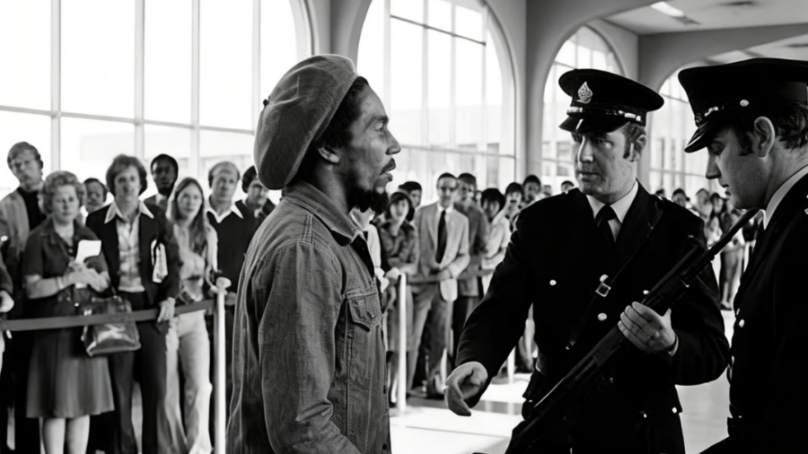
Bob Marley did not expect trouble that morning. The airport was loud in the way only international terminals are. Rolling suitcases, distant announcements, people rushing toward gates with their lives packed into small bags.
It was the late 1970s. Bob Marley was travelling quietly without entourage, without spectacle, no announcement, no special treatment, just another man moving through a system that had never been built with people like him in mind.
He wore simple clothes, a worn jacket, his dreadlocks pulled back loosely, nothing flashy, nothing demanding attention, but attention found him anyway.
As Bob stepped forward in the security line, an officer raised his hand, not hurried, not aggressive, just firm enough to stop momentum. Sir, step aside. Bob paused.
Passengers continued moving. Some glanced over. Most did single quotes. Another officer joined the first, then a third. They spoke quietly using practised language, routine, random procedure. But Bob Marley had travelled enough to know when something was not random. He did not argue. He did not protest.
He stepped where they directed him. A small inspection area near the side of the terminal. Bright lights, bare walls, too clean, too controlled. The officers began asking questions. Where re you coming from? Where are you going? What do you do? Bob answered calmly, politely, without edge. But the questions kept coming, repeating themselves, circling.
One officer looked at his passport longer than necessary. Another watched Bob’s face instead of the documents. A few nearby travellers slowed down. Curiosity crept in. Bob Marley felt it then. That familiar pressure in the chest, not fear, recognition. He had seen this moment before. Different countries, different uniforms, same feeling.
The unspoken suspicion. The quiet assumption. One of the officers asked him to open his bag. Bob did. Clothes. Personal items. Nothing unusual. Still they continued. A supervisor was called. Voices lowered further, eyes sharpened. Time stretched. Bob noticed the way people were now openly watching, some with concern, some with judgment, some with nothing at all.
This was no longer just a search. It was becoming a message. The supervisor looked at Bob and said the words everyone in that space recognised. This is just a random search, sir. Bob Marley nodded slowly, but inside something shifted. He had spent his life singing about freedom, about dignity, about systems that smile while they pressed down.
And now here he was standing inside one of those systems. Not as a performer, not as a symbol. Just as a man being decided upon. One officer reached toward Bob’s bag again. Another stepped closer. The room felt tighter.
Quieter die Bob Marley took a breath. And then instead of saying what they expected, instead of reacting, the way the situation almost demanded, Bob did something that made the officers hesitate, something none of them were prepared for, and the entire tone of the room began to change.
Asterisk Bob Marley did not raise his voice. He did not question authority. He did not ask for names or explanations. Instead, he stood still. The officers expected resistance or fear or at least irritation. They did not expect stillness. Bob placed his hands gently at his sides and waited.
Not defiantly, not submissively, just present. The supervisor watched him closely now, not as a passenger, but as something he could not easily categorise. Another officer cleared his throat and continued the inspection. Shoes, jacket, personal items returned and checked again. Nothing. Still, no one said it was over.
Time passed in an uncomfortable way. The kind of time where every second feels observed, measured. People in the terminal were openly staring now. A woman whispered something to the man beside her. A child tugged on his mother’s sleeve, pointing quietly. Bob felt the weight of all those eyes, not as pressure, as memory.
He thought of Kingston, of narrow streets and open yards, of people searched without reason, stopped without apology. He thought of how easily dignity can be misplaced when procedures replace humanity. The supervisor stepped closer. He asked Bob again what he did for a living. Bob answered softly. I make music.
The supervisor glanced at the dreadlocks, at the worn jacket, at the passport. Music did not seem to fit the picture he had already drawn. One officer leaned toward another and whispered. Their eyes flicked back to Bob. The word random was not used again. Bob Marley felt the moment stretch towards something sharper, a point where one wrong word could harden the room.
He chose silence again. Not because he had nothing to say, but because he understood something the room did not. That silence can disarm faster than argument. That calm can make suspicion uncomfortable. The supervisor finally asked Bob to follow them further inside, away from the open terminal, away from witnesses. The door closed behind them.
The room was smaller, more private, more serious. A metal table, two chairs. Bob was asked to sit. He did. One officer stood near the door. Another leaned against the wall. No. One spoke for a moment. Then the supervisor said something that shifted the air completely. He asked Bob if he understood why he had been selected.
Bob Marley looked up slowly and for the first time since being stopped. He chose to speak, but not the way they expected. Not with accusation, not with defines. With a question, a simple one. And the moment he asked it, the men in that room realised something important. This was no longer a routine search.
This was something else entirely. And none of them were prepared for where it was about to lead. To risk. The room felt smaller with every passing second. Bob Marley stood still as the officers waited for a reaction. There was no anger in his face, no raised voice, no visible resistance, just a calm that felt almost unsettling in a place built on control and suspicion.
One of the officers finally spoke. His tone firm but uncertain. It’s a random search, he said again as if repeating it might make it more believable. Bob looked at him quietly. His eyes were steady, observant, patient. Random means anyone, Bob said slowly. Yet somehow it is always me.
The words landed softly, but they carried weight. Not accusation, not bitterness, just truth. The supervisor shifted in his chair. He had conducted hundreds of these searches, thousands maybe. But something about this man was different. This was not fear he was seeing. It was dignity. We’re just doing our job, the supervisor replied. Bob nodded once.
So am I, he said. I travelled to sing. That is my work. The room fell silent again. The kind of silence that exposes more than noise ever could. Bob placed his hands gently on the table. These were hands that had written songs heard across continents. Hands that had held a guitar in front of crowds seeking hope. Yet here they were treated as a potential threat.
You are free to look, Bob continued. I have nothing to hide. The officers searched his bag more carefully now, almost nervously. Every zipper opened, every pocket checked. Nothing. No contraband, no threat, no reason for the delay to continue, but still no one spoke. The supervisor glanced at the clock on the wall.
Boarding time was approaching fast. You may miss your flight, he said. Bob did not rush. He did not plead. If I miss it, he said calmly. I will catch another. That was when the supervisor looked at him differently. Most people argued. Most people panicked. Most people begged when power was used against them. But Bob Marley stood there as if time itself had no authority over him.
“Doesn’t this make you angry?” the supervisor asked. Bob paused before answering. “Anger would give you control over me,” he said. “And I do not give that away.” The words were not dramatic. They were not rehearsed. They came from a life spent navigating injustice without letting it harden his heart.
The supervisor closed the file in front of him. The search was officially complete. There was nothing left to justify holding him. He handed Bob his passport. You’re clear, he said quietly. Bob took it with a nod of respect. Not triumph, not satisfaction. Respect.
As Bob turned toward the exit, the officers watched him walk away.
Not as a suspect, not as a celebrity, but as a man who had shown them something they were not trained to recognise. Grace. Yet, what happened after Bob reached the gate, what the staff would later realise about that moment would stay with them far longer than any flight delay ever could. Because that silence Bob chose was about to echo.
Bob Marley walked through the terminal with slow measured steps. The noise of the airport returned around him. Rolling suitcases, distant announcements, hurried voices. Yet something had shifted. People looked at him differently now. Not because they recognised him as a musician, but because of the quiet authority he carried at the gate.
Boarding was already underway. The airline gent glanced at his ticket. Then at the clock, then back at Bob. Her expression softened. You were held. For inspection, she said. “It was not a question.”
Bob nodded gently. She hesitated, then leaned closer. “They do that a lot,” she added in a low voice. “But not usually like that,” Bob offered a faint smile.
“Usually,” he said. “People accept it quietly where they fight it loudly.” “And you?” she asked. I stand, Bob replied. That is all. She handed him his boarding pass without another word as Bob walked down the jet bridge.
The moment replayed in the minds of the officers who had stopped him. The supervisor sat back at his desk, unusually still. He had cleared the man followed. Procedure done everything by the book. Yet something felt unfinished.
One of the younger officers finally broke the silence. “Sir,” he said carefully. “That didn’t feel random.” The supervisor exhaled slowly.
“No,” he admitted. “It didn’t. They had stopped Bob Marley because he looked different. Because his hair marked him as an outsider, because his calm unsettled them, because systems often confuse unfamiliar.
Dignity with danger. But none of that was written in the report. Hours later, after Bob’s plane had already left the ground, an internal note circulated among airport staff. Not an apology, not an admission, just a quiet acknowledgement that the delay had been unnecessary. Unnecessary. The word felt hollow.
Meanwhile, Bob sat by the window of the aircraft, watching the city shrink beneath the clouds. He did not replay the incident with resentment. He did not celebrate his composure. Instead, he thought about something else. He thought about how many people had stood in that same room before him.
People without passports that opened doors. People without names that softened authority. People who were not allowed silence, dignity or patience. He closed his eyes to Bob. The search had not been about him alone. It never was by the time the plane landed.
Rumours had already begun to spread quietly among airport employees. Not gossip, reflection. He didn’t argue. He didn’t submit. He didn’t lose himself. Some wondered if they had just witnessed something rare. Others dismissed it as coincidence, procedure, policy. But one person could not let it go. The supervisor.
That night, long after his shift ended, he replayed Bob’s words again and again. Anger would give you control over me. The sentence stayed with him because for the first time in years, he questioned whether control had been mistaken for order, whether authority had been mistaken for truth, and whether silence, when chosen freely, could be more powerful than compliance or rebellion ever could.
The real impact of that moment would not be seen at the airport. Not immediately, not publicly. It would surface later quietly in ways no one expected because Bob Marley had not missed his flight. But something else had been delayed – a realisation.
And when it finally arrived, it would change how that day was remembered forever. The change did not arrive with an announcement. It did not come with discipline, apology or public acknowledgement. It arrived quietly, the way real understanding often does. Weeks later, but supervisor found himself standing in the same airport corridor where Bob Marley had once been stopped.
The line of passengers moved as usual, different faces, different destinations. The system remained intact but something inside him had shifted. When another random search request crossed his desk, he paused. He looked at the name, then at the photo, then at the person standing patiently a few feet away.
For the first time, he asked himself: “Why do not because policy demanded it?” Because conscience finally did. He waved the passenger through. That small moment would never make headlines. No report would record it. No one would applaud but it mattered because change rarely begins with noise. It begins with hesitation. Bob Marley never knew this happened.
He never demanded justice for himself. Never told the story as a victory. In interviews, when asked about authority, power, or resistance, he spoke not of confrontation, but of awareness. People think freedom is loud, he once said. But sometimes freedom is knowing who you are even when others don’t. The airport incident did not turn Bob into a hero.
He already was not trying to be one. What it did was reveal something deeper. Bob Marley understood that systems do not collapse when you fight them head on. They weaken when they are exposed to humanity they cannot control. He had been stopped because of how he looked. He had been released because of how he stood. No shouting, no anger, no submission dot, just presence. Years later, one of the airport staff would speak about that day in private conversation. Not with pride. With reflection, he didn’t make us look cruel. The person said he made us look small. That was the real shock.
Not that Bob Marley endured the search, but that he refused to become what the moment tried to turn him into dot.
The world often expects victims to either explode or disappear. Bob Marley did neither. He remained visible, calm. And that quiet strength echoed far beyond the terminal in his music.
Bob would later sing of freedom not as a demand but as a state of being, of standing firm in love while refusing to surrender your dignity, of choosing silence not because you are powerless but because you are not.
The airport staff returned to their routines. The flights continued. The reports were filed but one thing had changed the moment Bob Marley walked away without bitterness. Mirror had been placed in front of authority and authority had looked into it.
That is why the staff were shocked. Not by what Bob Marley did, but by what they felt afterward, uneasy, exposed, awake.
Bob Marley never needed to lecture them. He never needed to accuse. He simply showed them what a free man looks like when confronted by Power. And that image stayed long after the airport forgot his name.
Long after the moment faded from memory, long after the flight landed, because true impact does not announce itself, it lingers.
And sometimes the most powerful response to injustice is not resistance but dignity that refuses to bend.
- A Tell Media report / Source: Life Story


About author