



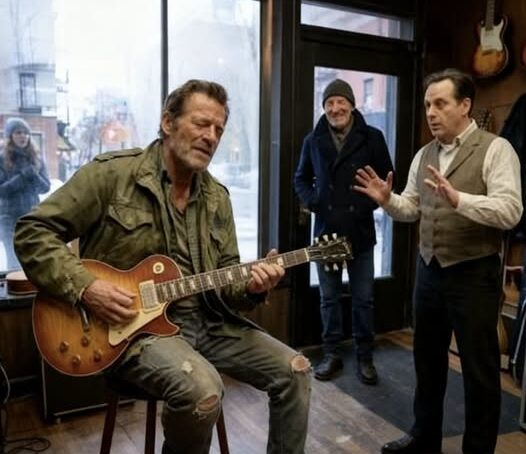
The shop owner didn’t recognise the man standing outside his window. That was the first mistake. The second was what he said when the man came inside.
It was a Tuesday morning in late November. The kind of morning that empties city streets early and keeps them empty. Gray sky, cold, and had arrived without negotiating.
The particular stillness of a weekday before the city fully commits to being awake. The music shop on West 48th Street in Manhattan had been open for 11 minutes. The owner, a man named Gerald Fitch, who had run the shop for 22 years and had strong opinions about most things and expressed all of them freely, was behind the counter with a coffee and a trade publication when the door opened.
The man who came in was wearing clothes that had seen better days. Not ragged, not torn, but worn in the specific way of clothes that have been worn too many times without the option of replacement. A canvas jacket that had lost its shape, work boots with the soles separating at the toe of the left foot, jeans that had faded past the point of fashion and into the territory of simple age.
He was somewhere in his mid-50s with a beard that had not been maintained recently and grey at the temples. And he moved through the door with a slight hunch that people develop when they spend significant time outdoors in cold weather. A protective posture, the body trying to retain whatever warmth it has managed to accumulate.
Gerald Fitch looked at him over the top of his trade publication and made the assessment that people in retail make in the first 3 seconds. The assessment that is sometimes accurate and sometimes the most expensive mistake a shopkeeper can make. And he made it quickly and filed it and went back to his publication.
The man walked slowly through the shop. He was looking at the guitars on the walls with the specific attention of someone who knows what they are looking at. Not the casual browsing of a tourist or a first timer, but the focused evaluating attention of a player. He paused in front of a 1959 Gibson Les Paul Standard that was displayed in a locked case near the back wall.
The centrepiece of the shop’s vintage collection, priced at $85,000 and displayed with the reverence appropriate to something that was less an instrument at this point than an artefact. He stood in front of it for a long time. Gerald Fitch had come out from behind the counter by then, not to assist, to position himself between the man and the case, the way shopkeepers position themselves when they have made their assessment and are acting on it.
The man asked without turning around whether he could see the Lepaul. Gerald said the guitar was not really available for general handling, that it was a museum quality vintage instrument, and that they typically required some demonstration of serious purchase intent before taking it out of the case. He said this in the tone of someone saying something that is technically a policy, but is actually a judgment call, and the judgment call was visible to anyone paying attention. The man turned around.
He looked at Gerald Fitch for a moment without saying anything. Gerald looked back. What Gerald saw was what he had already decided he was seeing, which meant he did not look closely enough to see anything else. The man said quietly and without heat. I’d just like to hold it for a minute.
Gerald said he was sorry, but it wasn’t something they could accommodate without more information about the customer’s intent. He said this while very slightly positioning himself closer to the case, which was a physical sentence as clear as the verbal one. The man nodded. He looked at the guitar in the case for another moment.
Then he looked around the shop at the other instruments on the walls, the acoustics and the electrics and the bases and the banjos. The decades of accumulated inventory of a serious music store, the evidence of 22 years of a man’s professional life organised around the buying and selling of instruments. He looked at all of it with an expression that Gerald would spend some time thinking about later.
An expression that was not angry and not hurt and not the resentful performance of someone who has been insulted and wants the other person to know it. It was something quieter than any of those things. The expression of someone who has encountered a version of this before and has decided a long time ago not to let it cost more than it has to.
He said, “Thank you.” and walked toward the door. He was reaching for the handle when it opened from the outside. The man who came through the door was also in his mid-50s, also wearing a jacket, also apparently just another customer on a Tuesday morning in late November. He was with one other person.
He looked at the man by the door. They were face to face for a moment in the narrow entrance. And something happened in that two seconds that Gerald Fitch watching from the counter could not initially interpret. The man from outside stopped. He looked at the man leaving. He said a name. The man leaving stopped.
He turned for a moment. They looked at each other in the doorway of the shop. And Gerald Fitch watched this and still did not understand what he was watching. Then the man who had just arrived said to the man who had been about to leave:
“Were you just in here?” The man said,
“Yes.”
“Did they let you play anything?” A pause.
“No.”
The man who had just arrived looked across the shop at Gerald Fitch. It was not a threatening look. It was not performed. It was simply direct. The look of someone who has just received information and is deciding what to do with it. Gerald Fitch recognized him at that moment. Not from a gradual assembly of features, but all at once.
The way recognition works when it has been delayed. A sudden collapse of the distance between the person in front of you and the person you know from every magazine cover and concert poster and television screen you have encountered over the past 30 years.
Bruce Springsteen was standing in his doorway. The man he had declined to show the guitar to was still standing next to him. Gerald opened his mouth.
Springsteen held up one hand, not dramatically, just a gesture that said, “Give me a moment.” and turned back to the man beside him.
He said, “What did you want to play?” The man looked at the case at the back of the shop, the Les Paul. Springsteen looked at Gerald. Gerald had the case open in 45 seconds. He carried the guitar to the front of the shop himself.
He said it on the counter. He said nothing because there was nothing that could be said that would not make the situation worse. And he had understood this immediately and completely. The man picked up the guitar. What happened when he played it is the part of this story that everyone who has heard it second-hand asks about. And the answer is both simple and not simple.
He played it the way people play guitars they have known a long time with a familiarity that went beyond technical skill into something more like reunion. The specific ease of a player and an instrument that have the same language. He played for about three minutes moving through something that wasn’t quite a song and wasn’t quite improvisation but was somewhere between them.
The kind of playing that shows you who a player is without announcing it. Gerald Fitch stood behind his counter and listened and understood as clearly as he had understood anything in 22 years of running a music shop that the man playing his $85,000 guitar was one of the finest players who had ever held an instrument in this room.
Not despite the worn jacket and the separated boot sole and the beard that needed maintenance, simply plainly in the notes themselves. When the man stopped playing, he set the guitar carefully on the counter. He looked at it for a moment with the expression of someone saying goodbye to something. Springsteen, who had been standing to the side and listening, looked at Gerald.
He said, “What’s his name?” Gerald did not know. He had not asked. Springsteen looked at the man. The man said his name was Walter Greer. He said it in the tone of someone who has given their name to institutions enough times in the past year to have stripped it of the personalness names usually carry.
Springsteen said, “Walter, how long have you been playing?” Walter Greer said 40 years.
He said he had played in bands through his 30s, had done session work, had taught lessons for a while. He said things had gone wrong in the way things go wrong incrementally, the individual dominoes invisible until enough of them had fallen that the cumulative effect became unmistakable.
He said he had been on the street for 14 months. He said the last guitar he had owned had been sold two years ago when he needed the money for something more immediate than music. He said all of this without self-pity, in the flat declarative tone of someone reporting facts about a situation they are inside and have accepted being inside, at least for now.
Springsteen listened to all of it. Then he said: “What would you play if you had one?”
He said he would play the things he always played. Blues, mostly some country. The kind of music that came from the same place the situation he was in came from. The place where American life got too heavy for the people carrying it.
And the music was what they made out of the weight. Springsteen nodded. He looked at Gerald. He said, “I need a guitar for Walter.”
Gerald began to say something about the Les Paul, about the price, about the nature of the instrument. Springsteen let him finish. Then he said he was not asking about the less Paul.
He was asking Gerald to find a good guitar, a real instrument, nothing decorative, something a player could actually use and he would take care of the rest. He came back with a guitar that was not $85,000 and was not a museum piece, but was a serious instrument, a well-made acoustic with a sound that carried and a neck that fit the hand properly.
The kind of guitar that a working musician would choose because it did the job without getting in the way of the music. He set it on the counter next to the Les Paul. Walter Greer picked it up. He played four bars. He looked at Springsteen. Springsteen said, “That one.” He paid for it. He did not make a production of it. He handed Gerald a card.
Gerald ran it. The transaction happened in the ordinary way that transactions happen in music shops on Tuesday mornings. Except that it was not ordinary at all, and everyone in the room understood that, and no one said so. Springsteen carried the guitar and its new case to the door. He held it out to Walter Greer.
Walter looked at the case. He looked at Springsteen. He said he couldn’t accept it. Springsteen said, “You already played it for three minutes, and it was the best thing that’s happened in this shop in a long time. You’ve already earned it.”
Walter Greer took the case. They stood in the doorway for a moment. Springsteen said something to him that Gerald behind the counter could not hear. Walter listened.
He nodded in the specific way that people nod when they are receiving something they needed and did not expect to receive. Then Springsteen went back into the shop and Walter Greer walked out onto West 48th Street with a guitar case in his hand and the door closed and the shop was quiet. Gerald Fitch stood behind his counter.
He looked at the Les Paul still out of its case on the counter. $85,000 of history and craft and accumulated value. Then he looked at the door through which Walter Greer had walked out with a guitar that cost considerably less and mattered considerably more.
He has told this story three times. Once to his wife that evening. Once to a friend who asked why he seemed different when he came home. Once to a journalist from a small music publication who was doing a piece on vintage guitar shops in Manhattan and asked him as a closing question whether anything unexpected ever happened in the shop. He said yes. He described what had happened. The journalist asked him what the lesson was the way journalists ask that question at the end of stories.
Gerald thought about it for a long time. He said the lesson was that he had looked at a man for three seconds and decided what he was and that the three seconds had been wrong in every direction. Wrong about the man’s relationship to money, wrong about his relationship to music, and most significantly wrong about what he deserved to hold in his hands for three minutes on a Tuesday morning.
He said he thought about it every time a new customer walked through the door. He said he had not made the same mistake again.
Walter Greer was seen six weeks after that Tuesday morning playing outside a coffee shop on 8th Avenue. He had a case open in front of him and he was playing the blues, the kind of music that comes from the place where American life gets heavy.
And the people walking past were stopping and the case was filling and he was playing with his eyes closed in the way that players play when they are so far inside the music that the room around them temporarily stops registering. Nobody who stopped to listen knew where the guitar came from. Nobody needed to.
The music was its own explanation. If this story reached you today, share it with someone who needs a reminder that what a person deserves has nothing to do with what they’re wearing. And if someone ever saw past the surface to something real in you, tell us about it in the comments.
- A Tell Media report / Source: Life Story


About author