
Esau Mwangi is perhaps one of a handful of public servants to have worked and interacted closely with three former heads of state since Kenya attained independence in 1963.
At 83 years and now retired, Mwangi employed as a police officer in the early 1960s, then later moved to the now defunct Special Branch (now renamed National Intelligence Service or NIS). But it was during his stint as a police officer that he brushed shoulders with the three men who once occupied the most powerful office in the land.
Yet, it was President Jomo Kenyatta’s stature that perhaps awed the retired officer among all the other former heads of state who served this country. To him, the freedom struggle icon who once tasted detention under the colonial administration is a shadow that has never faded from his memory.
To Mwangi, Kenyatta is an enigma who can never be wished away; though deceased. The octogenarian now lives in his imposing country home in Mahiga location, Othaya Sub-County, where he has invested heavily in crop and animal husbandry.
“I started my tour of duty at Ichaweri in Kiambu where I used to guard the home of Mzee Jomo Kenyatta after joining the Kenya Police. I served there from 1967 to 1968. I really enjoyed working with Mzee Kenyatta,” Mwangi said.
“Every morning he would converse with me in his mother tongue about inquire my wellbeing. One interesting thing about Mzee was his uncanny memory. He never forgot faces once you interacted with him. He had a very sharp memory,” the former sleuth recounts.
After his transfer from Kiambu, Mwangi again met his former boss in Kericho after the deadly Kisumu clashes following a hostile reception to the president on October 25, 1969. The ensuing fracas resulted in at least 11 people being killed after police opened fire on rampaging mobs who had started hurling stones at the presidential podium.
The ill-fated visit had also come only months after the cold murders of Tom Mboya and Argwings Kodhek, both fiery politicians from the Lake Victoria Basin. To Mwangi it was almost a dream come true – meeting Kenyatta in person.
“After the fracas in Kisumu, Mzee found me on the boundary of Kisumu and Kericho on his back to Nairobi. He immediately asked me what I was doing there and I explained to him about my transfer from Nairobi to Rift Valley. He then asked me whether I had gotten wind of what happened in Kisumu to which I responded in the affirmative.
Mzee then requested me to scout for an amiable place in Nakuru where he could have some dinner away from the prying eyes of the public. To me it was clear the president was not taking anything for granted as far as his security was concerned,” he recounts.
One of the most striking reflections about Mzee Kenyatta’s personality was the public perception of him as superhuman. According to Mwangi, every person including those in his inner circle, held him with a sacred reverence with rumours rife about him having eyes blazing like mystic red orbs.
But while Kenyatta’s frame carried with it an aura of mysticism and invincibility, the former officer says he used to go easy with him. For him the founding father of the nation was just an ordinary man who had been tasked with the leadership of the country from the shackles of colonialism to one of Africa’s most celebrated democracies.
Although he never worked closely with President Daniel Moi, Mwangi’s description of the second president is that he was a social and strangely down to earth man compared to his predecessor.
While Kenyatta was a leader to be feared, Moi made up for this lack of this trait by building social networks with the common people, something which many of his opponents misconstrued as a laid back presidency.
However, the events that followed the aborted 1982 putsch by a detachment of junior Kenya Air Force officers later proved such critics wrong. He recalls that Moi was a workhorse who used to be in office when most government officers were still in their houses mulling over which suit to wear to work.
“Mzee Moi was a sociable personality who could interact with anybody. To me, he was an individual who rarely flaunted the trappings of power but exploited his position to serve the people. Perhaps his humble background played a great role in shaping him to the quiet and humble person he came to be,” stated Mwangi who also hails Moi for his bigger than life heart in giving.
His stint with President Mwai Kibaki came when he became his personal body guard after the NARC coalition swept to power in 2002 and ended the long reign of Moi’s 24-year rule. Perhaps it is this relationship with Kibaki that thrust him into politics and pushed him to be a life member of the Democratic Party (DP) – a political vehicle the former used in staking for the presidential ticket in the NARC camp.
Today he is the national chair of the party although he plans to retire from the position after the 2027 general poll. He describes Kibaki as a brilliant leader who was always quick to listen and slow to speak.
And despite the aftermath of the disputed 2007 post-election election outcome that almost drove the country under, Mwangi claims the country is worse off today devoid of leaders of Kibaki’s calibre.
“Kibaki cared for this country and didn’t mince words when it came to dismissing self-seekers from his inner circle. If he knew you had your own interest, he would never grant you an audience. But he was an excellent listener. He was selfless and could not eat until he was satisfied that everyone else in the room was served. That was Kibaki for you, “he recalls.
But now in his sunset years, Mwangi revels in doing what he loves most after having dined and wined with the high and mighty for decades.
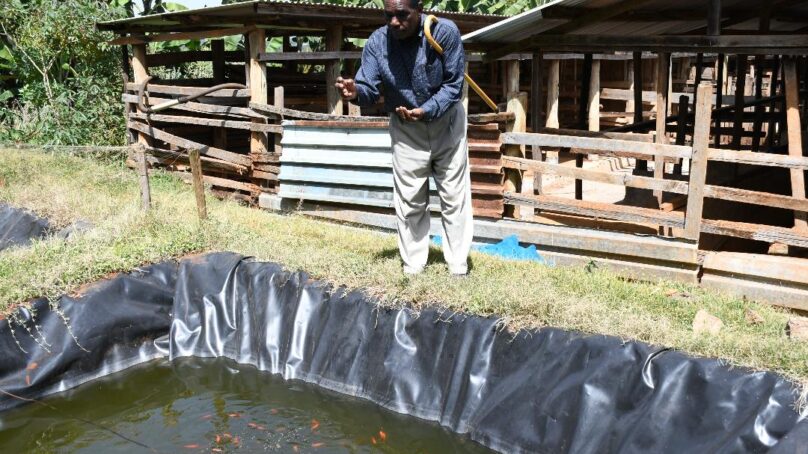
With a singing wood of 500 Hass avocado trees, a number of bee hives, fish ponds, vegetable and plantains in his sprawling hilly farm, life can only get better for this octogenarian who now leads a serene life.
To him, it is the coolness of his leafy compound that grants him true rest. And with this expertise and colourful career in the security establishment is still a source of knowledge for many.
“I worked for President Kibaki as a security adviser until I retired and settled down here as a farmer. I have loved farming because I was brought up in farmlands by my peasant parents. I decided to settle here and become a farmer – growing avocados and also rearing dairy cows and chicken,” Mwangi, who has a master’s degree in security and risk management graduate from Daystar University, says.
“And since I am growing old I decided to scale down because I didn’t want to be stressed in terms of the cost of feeds. In addition, now that I have been the national chairman of the Democratic Party of Kenya since 2004 and this gives me an opportunity to get involved in politics a little.”
However, unlike many who delve into farming in pursuit of profits, the former officer’s intention was purely to keep him active and fit in his twilight years. This is despite the fact most of his avocados are usually flown to European markets where they fetch relatively higher prices compared to other markets.
But the market keeps changing depending on fluctuation in production by leading global avocado exporters such as Brazil. And unlike modern agribusiness practices that rely heavily on agrochemicals and pesticides, his farming is purely organic to the letter – a practice he says is ecologically friendly.
“I don’t want chemicals here in my shamba. Chemicals have destroyed the health of many people. Many farmers who are doing commercial farming don’t care (about the health of consumers). In my farm cabbages, fruits, avocados growing is purely organic,” he stresses.
- A Tell Media / KNA report / By Samuel Maina and Wangari Mwangi


About author