

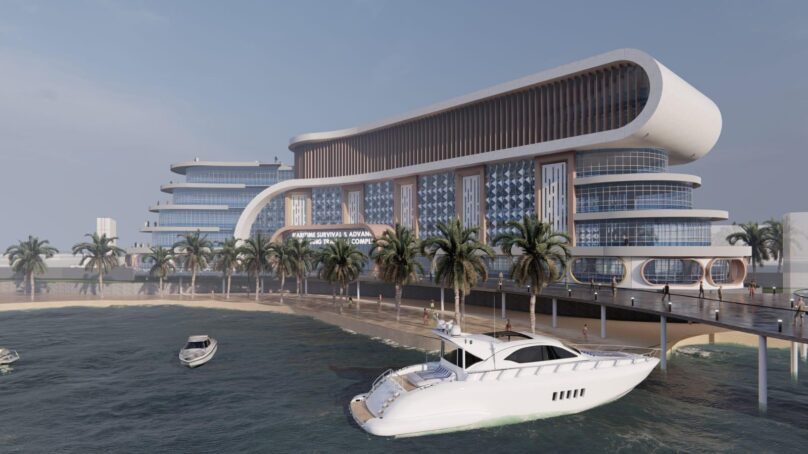
Kenya is strengthening its maritime education and training capacity through the construction of the Ksh2.4 billion Maritime Survival Training and Certification Centre, a flagship project expected to position the country as a leading maritime and blue economy hub in Africa.
The state department for shipping and maritime affairs is spearheading the project at the Bandari Maritime Academy (BMA) in Mombasa.
Construction of the facility currently stands at 20 per cent completion, having commenced in July 2024 and is scheduled for finalisation by December 2026.
The centre will feature survival-at-sea training pools, firefighting simulation units, emergency evacuation facilities, rescue boat operation area and specialised equipment, designed to replicate real-life maritime emergencies.
These facilities will provide hands-on experience and equip trainees with the skills needed to respond effectively to challenges at sea.
One of the first facilities of its kind in the region, the centre will be equipped with modern simulation technologies and infrastructure aligned with global maritime standards.
It will offer internationally recognised training in maritime safety, survival, firefighting, emergency response, rescue operations and other competencies required of professional seafarers.
The Bandari Maritime Academy CEO Erick Katana says that as Kenya seeks to maximize opportunities in the blue economy, investments in maritime human capital remains critical.
He noted that the facility will ensure Kenyan seafarers receive training and certification that meet the requirements of the International Maritime Organisation (IMO) and the Standards of Training, Certification and Watchkeeping (STCW) Convention.
The facility will significantly reduce the need for Kenyan trainees to travel abroad for specialised survival and safety training.
This will in effect lower training costs, improve accessibility, and enable more aspiring seafarers to obtain the certifications required for international deployment.
Additionally, the facility is expected to attract trainees from across East and Central Africa, positioning Kenya as a regional centre of excellence for maritime education and professional certification.
“The Maritime Survival Training and Certification Centre is not just an infrastructure project; it is an investment for Kenya’s future. It will empower thousands of young Kenyans with globally competitive maritime skills and create pathways to employment across the international shipping industry,” Katana explained.
The project is also expected to expand employment opportunities for Kenyan youth by producing internationally certified maritime professionals qualified to work on merchant vessels, cruise ships, offshore installations and maritime support services worldwide.
“Kenya possesses immense human capital potential. By providing internationally accredited maritime training locally, we are opening doors for our youth to access rewarding careers in the global maritime labour market,” the CEO noted.
Beyond employment opportunities, the centre will strengthen maritime safety standards, improve emergency preparedness and support the growth of key blue economy sectors, including maritime transport, fisheries, tourism, logistics, and offshore energy.
“The blue economy cannot thrive without competent and safety-conscious professionals. This centre will play a pivotal role in developing the workforce needed to drive sustainable growth across maritime industries,” Katana said.
- A Tell Media / KNA report / By Sadik Hassan


About author