

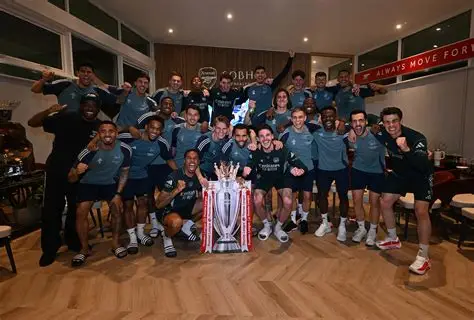
The waiting is over. Twenty-two years, more than a generation, they have waited. They waited and wished and feared and worried and lost hope and cursed and overthought all the eventualities.
And still they waited.
Nobody inside Tottenham Hotspur’s old White Hart Lane stadium on April 25, 2004, as Thierry Henry twirled his shirt around his head and led the Arsenal charge down the pitch to the emotional bear-pit of an away end screaming “Champions!” could have imagined it taking so long to feel that again.
At roughly 9.24pm on May 19, 2026 the final whistle in Bournemouth signalled an impromptu party at the Emirates Stadium. People ran in from every direction, yelling, chanting, crying, falling into fellow members of the tribe.
Fireworks, footballs, people on bikes, people with babies, people in cars tooting their horns, people with dogs, people with bottles of champagne. Highbury felt like the centre of the English football universe.
What were you doing this time 22 years ago?
A lot happens in that stretch of time. People fall in love, fall out of love, have children, watch them become adults, grieve the loss of family or friends, get jobs, lose jobs, get sick, hopefully get better, celebrate special occasions, drift through many, many unremarkable days along the way. It is a quarter of a lifetime, if you’re lucky.
When Arsenal won their previous league title in 2004, Max Dowman, Myles Lewis-Skelly and Cristhian Mosquera were not born. Bukayo Saka, Jurrien Timber and Gabriel Martinelli were toddling around in nappies. Declan Rice and Martin Odegaard were starting to learn letters and numbers in primary school. Mikel Arteta had just turned 22, and was soaking up football knowledge, languages and ideas as an ambitious young midfielder with spells playing in France and Scotland under his belt.
This squad have this season carried the responsibility of millions, worldwide, who put their faith in a talented, dedicated and driven collection of footballers and coaches chosen to represent Arsenal.
It is a lot to carry on your shoulders. The old motto “Remember who you are, what you are, and who you represent” resonates. It ripples. They represent themselves, their team-mates, their families, their club and all these people all over the planet who care about Arsenal. For the length of a brutal, 10-month season, with the spectre of all the attempts behind this one, that carries significant weight.
Along the way, one of the strange themes for many Arsenal supporters is how hard it has been to enjoy. That should be a contradiction – how could they not enjoy being top of the league for so long? But beneath the surface was the overwhelming desire to get there, to not let it slip, to hold on for dear life, which had built up over 22 years.
Arsenal were not even contenders for most of those seasons. But this period of challenging has made it into a four-year title race. After falling short three times in a row, of course, they were going to live with fear until they finally made it.
When Arsenal were defeated in front of their own shell-shocked public by Bournemouth last month, probably the lowest point emotionally of this season, as Manchester City were gifted the chance to jump out at them like a horror movie twist, Arteta wasn’t able to sugar-coat how bloody hard this thing was.
“Today, we have to suffer,” he said. “It’s painful. It’s a terrible feeling. But tomorrow is a different day.”
Since 2004, there have been more than 8,000 days. It has been a long, meandering road through periods of frustration, anger, despair, optimism and – maybe the worst state for anyone in sports – apathy.
Reflecting on the meaningful pivot points along the way brings context to where Arsenal are today, planting their flag, eventually, back at English football’s summit.
A few months after that 2004 title, David Dein, then Arsenal’s vice-chairman, was in Monaco for the Champions League draw. He was asked about Chelsea’s new ownership, and their aggressive approach to hunting talent, which included sniffing around his club’s players. The imagery in his answer (above) was strong, reflecting concerns about a new style of owner coming into the Premier League and flexing unprecedented financial muscle.
The football landscape was changing radically, and Arsenal’s plans to compete while moving from their cosy ancestral home of Highbury to the more commercially viable Emirates Stadium were crushed by the nouveau riche. All projections for a phase with restricted money for signing players while paying for the building work were thrown off course.
Not long after, in January 2005, Chelsea were caught tapping up Ashley Cole at a secret meeting in a London hotel when a waiter whispered to a tabloid newspaper. It marked the beginning of the end of the relationship between Arsenal and Cole. They had a disagreement over a new contract, and he was lured to Chelsea anyway. That hurt, but was also a harbinger of what was to come.
Arsenal became a selling club.
Once Manchester City were under Abu Dhabi ownership in 2008, they helped themselves to Kolo Toure, Emmanuel Adebayor, Samir Nasri and Gael Clichy. Bitterly, Manchester United pulled Robin van Persie away. Cesc Fabregas returned to boyhood club Barcelona. The policy known as “Project Youth”, designed to keep Arsenal ambitious by recruiting the best young talent and developing them to grow a successful team, was picked apart.
These unstoppable sales to supposed rivals symbolised how they were drifting down the Premier League pecking order. For Wenger and Arsenal, it was extremely painful.
“Are you going to play again? Are you going to walk again?” – Aaron Ramsey
Abou Diaby was the closest thing Arsenal had to a new Patrick Vieira, a prodigy who was about to play in a Champions League final in May 2006. Eduardo was a clever striker whose goals helped Arsenal’s title bid in 2007-08. Aaron Ramsey was a central-midfield cog of a young side trying to challenge a couple of years later.
All these players suffered appalling injuries, which Wenger attributed to a Premier League stereotype that his team were soft and needed roughing up.
“It goes along with the idea that, for a long time, to beat Arsenal you have to kick Arsenal,” he said, visibly angry, as this concept had repeated horrific consequences.
Fabregas, a masterful technician and heartbeat of the team for a while, faced the cameras after Ramsey’s double leg break in a match at Stoke City. He was understandably emotional.
“In five years, I have seen three of them,” he said. “There are things in football that are a little bit too much.”
Arsenal were under no illusions that certain teams, encouraged by certain managers, were geared up to go in hard. ‘Oh, they don’t like it up ’em’. But lines of acceptable aggression were crossed.
Ramsey recovered sufficiently to play on for several years. But in the cases of Diaby and Eduardo, their careers were wrecked by their injuries. The loss of Eduardo, and the way the scene immediately after it happened affected his team-mates, was a significant issue as they slipped off the top of the table and a potential title evaporated.
Followers of Arsenal are sensitive to the fact that they were once criticised, ridiculed and targeted for being fancy and fragile. Yet now that they are tough and resilient, that is also regarded as unacceptable. The irony is lost on nobody who lived through all those leg breaks.
There is no sugar-coating it. Pride was trampled and left in the dirt when Arsenal lost 8-2 at Manchester United in August 2011.
Equal foes not so long before, a chasm opened up. Wenger admitted to feeling humiliated. The reaction to this new reality was to make a late-transfer-window trolley-dash around football for five reinforcements. In came proven nous — including an intelligent midfielder from Everton whose arrival would have more impact than anyone would have dared to imagine.
Arteta could not believe it, because it happened very suddenly, very late. He jumped at the chance to join a club who had always caught his eye. As a former Barcelona academy boy, he had felt some kind of connection with the way Arsenal played when he watched Wenger’s best teams on TV.
The 2011-12 season was salvaged, and in time Arteta became captain and helped the team to end a trophy-less period with the FA Cup in 2014. He was in tears after his final ever appearance two years later, feeling the moment before heading into a new chapter of his life in coaching. This club really got to him.
“It’s going to sound mad, but that used to happen all the time in training” — Jack Wilshere
Arsenal scored a one-touch goal against Norwich City in October 2013 that was a footballing work of art. It was a cocktail of razor-sharp skill and playful improvisation, with Jack Wilshere, Santi Cazorla and Olivier Giroud flicking the ball between them at dizzying speed and precision.
This goal bears remembering because, even in the seasons when Arsenal were not able to keep pace at the very top of the table, even during the barren years, they had some fantastic technical players who wanted to play beautifully.
Andrey Arshavin and Tomas Rosicky had maverick style. Cazorla was a pocket maestro. In the period when Mesut Ozil and Alexis Sanchez were in their pomp, Arsenal fans swooned at their excellence. The trouble was it did not easily translate into silverware – even if the top-four-finish trophy was invariably wrapped up.
Tempers flared after Arsenal lost 3-2 at Stoke in December 2014. Some grainy mobile-phone footage captures the tension of the “Wenger out” friction as a group of away fans are held back by police as the manager and players walk through to get on their train back to London.
One shouts at Joel Campbell, a young Costa Rican forward the club had taken a gamble on. The above phrase, urging him to escape this madness, goes viral and becomes symbolic of how things seem to be disintegrating.
Wenger had been taunted by the Stoke crowd throughout that game and had stayed seated. “Arsene Wenger, he’s scared to stand up,” they jeered. The pressurised manager later drily explained why he stayed in the dugout. “They love me so much here that I didn’t want to give them an opportunity to show their love for me.”
It wasn’t a happy time. Frankly, it was toxic.
Cazorla stood over one of the most important free kicks of the Wenger era in May 2014, at Wembley, against Hull City in the FA Cup final. Arsenal were – shockingly, hideously – losing 2-0 with a little over 15 minutes gone and a failure in this game did not bear thinking about. Ten years since their most recent title, nine since any silverware at all. The media were obsessed with the totting up of trophy-less seasons and each one bore down more pressure.
Cazorla scored, Arsenal went on to win 3-2 and Wenger was given the bumps on the pitch by his players. The sense of liberating relief freed everyone up. At the open-top-bus parade, Wenger spoke of how the Emirates, eight years on from leaving their spiritual heart of Highbury, needed a trophy to finally feel like home.
This period was not quite as intense as the modern-day mockery of “second again” but all those seasons without tangible success were hard to endure.
There was a clear contrast between the first and second halves of Wenger’s tenure. His philosophy yielded tremendous success and an aesthetic that won Arsenal worldwide admiration from 1996 to 2006. From 2007 to 2018 the dynamic shifted, and at its most challenging moments there was a wretched division in the fan-base between those who remained loyal to a great manager under any circumstances and those who lobbied angrily for change.
Even so, Wenger was addicted to the club until the end. The ups, downs and stuck-in-between of Arsenal’s ownership have been eventful over the past couple of decades.
Stan Kroenke and his sports portfolio KSE first invested in the club in 2007, and to suggest there was scepticism in north London is an understatement. Arsenal’s historic traditionalism struggled with it.
“Call me old-fashioned,” then Chairman Peter Hill-Wood said, “but we don’t want his sort.” They were wary of a hostile takeover.
Slowly, KSE grew its stake. The most damaging period for the club was when they were effectively in business stasis at the point that KSE owned almost two-thirds and its investment rival, the Uzbekistani billionaire Alisher Usmanov, much of the rest. With such friction within the ownership, it was incredibly hard for Arsenal to move forward.
KSE eventually took sole control in 2018 and turned the club into a private enterprise. In the summer of 2019, a collaboration between some of the club’s most high-profile supporter groups and fan blogs co-authored a statement aimed at KSE entitled “#WeCareDoYou”, airing their concerns about a lack of ambition and a feeling of being marginalised.
“What all of us want,” they wrote, “is meaningful action by Stan Kroenke to reinvigorate this football club.”
Stan’s son Josh did an interview in response and urged the supporters to “be excited”. The proof of the pudding would be in the eating.
It took a while, but the younger Kroenke became more involved. He is a supportive ally of Arteta, and KSE has backed the project fully in recent seasons. He was out on the pitch with all the players, staff and families after the last home game of this season, every inch a part of it all.
Arsenal were caught in a maelstrom of self-loathing when Unai Emery substituted his captain, Granit Xhaka and it turned into a trigger point for all the frustration that had built up around the club. As Xhaka sauntered off the Emirates pitch that October day in 2019, he was jeered by supporters and responded by ripping off the armband and shouting his own invective.
The midfielder was booed upon being substituted against Palace – but what does it all mean for the player, fans, club and its manager?
When the curtain fell on Wenger’s epic 22-year era in summer 2018, Emery was chosen to fill impossibly large shoes. But it was clear quickly that there was too much space behind his heels and his toes had way too much wiggle room. It wasn’t right. There were cracks in the dressing room and blemishes in the squad’s make-up.
The Xhaka incident was the nadir of the Emery spell, a crisis that partly brewed because the new manager dithered about a decision on his permanent captain and eventually asked the players to take a vote.
- A Tell Media report / By Amy Lawrence / Source: The Athletic


About author