



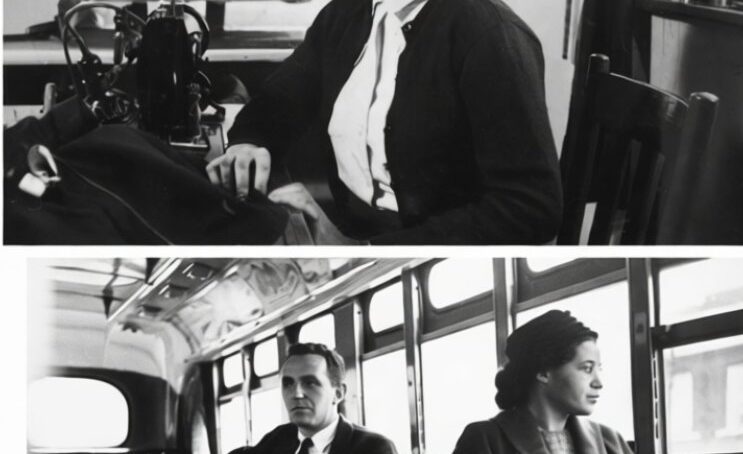
They want Rosa Parks frozen on a bus seat. The truth is she kept fighting long after Montgomery, long after the cameras left, and long after America stopped looking.
The version of Rosa Parks most people are handed is small enough to fit inside a children’s book.
A tired woman. A bus. A single act of courage. A nation awakened. It is a neat story, easy to honour and easier to contain. But the real Rosa Parks did not end in Montgomery. She did not retire into symbolism, and she did not become a quiet relic of a finished struggle.
After the boycott, she entered one of the hardest chapters of her life, marked by unemployment, threats, illness, displacement and financial instability. Yet even there, she kept organising, kept speaking and kept widening the meaning of freedom.
That harder chapter began with punishment. The Montgomery Bus Boycott made Rosa Parks world-famous, but fame did not protect her. She and her husband Raymond both lost jobs, and the family faced severe financial strain and harassment in Alabama.
In 1957, Rosa, Raymond and her mother moved to Detroit, hoping for safety and a chance to rebuild. America loves to celebrate the boycott as triumph, but the after-story tells a more honest truth.
Black heroism has often been praised in public and abandoned in private. Parks paid dearly for helping change the nation. Detroit did not hand her comfort. It gave her another battlefield.
People sometimes speak of Detroit as if it were simply the place Rosa Parks went after history happened to her. But Parks herself came to call Detroit “the Northern promised land that wasn’t.”
The city offered more opportunity than Alabama in some ways, but it also revealed the northern face of racial injustice: segregation, housing inequality, economic exclusion and police abuse without the same southern signage.
Parks did not arrive there to disappear. She arrived there and kept seeing clearly. She understood that racism had not ended. It had changed clothes.
One of the most important turns in her later life came through politics. Rosa Parks volunteered in John Conyers Jr’s first congressional campaign and when he won, she joined his Detroit office staff in 1965. She remained there for more than two decades. This mattered far beyond employment.
Yes, the position gave her badly needed financial stability but it also kept her inside the daily machinery of Black political struggle.
Parks was not sitting in an office as a decorative legend. She worked with constituents, advocated for ordinary people and stayed close to the urgent realities of Black urban life. The woman most Americans remember as a symbol remained deeply involved in the practical work of justice.
And this is where the myth of Rosa Parks becomes especially dishonest. The country prefers the version of her that seems gentle, solitary and safe. It does not always know what to do with the Rosa Parks who supported Black Power, who aligned herself with political prisoners, who stood with younger militants when respectable America wanted distance.
In the 1970s, she attended the National Black Political Convention in Gary. She advocated for Joanne Little, Gary Tyler, the Wilmington 10 and Angela Davis.
These were not symbolic gestures. They were signs of political seriousness. Parks understood that Black freedom could not be reduced to one tactic, one generation or one approved tone.
That part of her life matters deeply in Black history because it reveals continuity where textbooks often impose separation. Too often, public memory divides the movement into respectable civil rights and disruptive Black Power, as though one cancelled the other.
Rosa Parks moved across that false line. She never stopped believing in Black dignity, self-determination and the need to confront structural injustice directly. Her support for younger, more radical struggles showed that she was not trapped in the politics of 1955.
She kept learning, kept adapting and kept refusing the narrow role America wanted to give her. She also took her vision beyond the borders of the United States.
In the 1980s, Rosa Parks participated in the Free South Africa Movement and joined anti-apartheid demonstrations and conferences. She helped welcome Nelson Mandela during his US visit and linked the Black freedom struggle in America to the global struggle against white domination.
That internationalism was not an extra feature of her activism. It was part of her understanding of justice. Parks knew that oppression travels and so must solidarity. Then there was the youth work, which may be one of the most powerful parts of her later life.
In 1987, she co-founded the Rosa and Raymond Parks Institute for Self-Development with Elaine Steele. The institute focused on youth leadership and civil rights education, including the “Pathways to Freedom” bus tours that took young people to key historical sites connected to the Underground Railroad and the civil rights movement.
This was Rosa Parks doing what great organisers do: making sure memory became inheritance. She was not interested only in being remembered. She wanted the next generation equipped.
That is why the later Rosa Parks deserves far more attention than she usually receives. The bus protest made her famous, but the decades after Montgomery show her endurance. They show a woman who survived backlash, poverty, illness and relocation without surrendering her political clarity. They show a freedom fighter who remained active across labour, electoral politics, Black Power, anti-apartheid work and youth education.
They show someone who understood that justice is not a single act of defiance. It is a lifetime of refusing erasure.
So Rosa Parks should not be remembered only as the woman who would not move. She should be remembered as the woman who would not stop. She kept fighting after the cameras went away. She kept organising after the mythology tried to freeze her in place. She kept standing with Black people in all the messy, difficult, unglamorous places where freedom still had to be made real.
That is the fuller truth. And like most fuller truths in Black history, it is far more powerful than the tidy version America prefers.
- A Tell Media report / Source: African American History


About author