


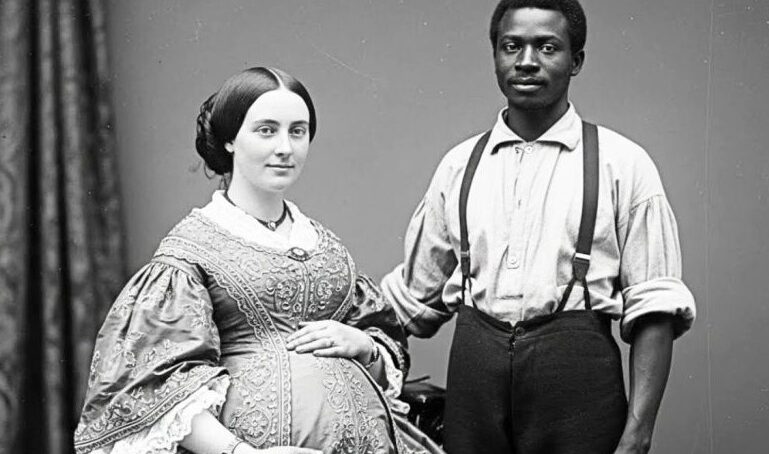
A widow owned a Charleston plantation in Carolina and became pregnant three times by the same enslaved man. Today we’re going back to 1839 to Charleston where a powerful plantation widow named Elellanena Ortega shocked society by secretly becoming pregnant three times by the same enslaved man.
Her story was buried for generations, full of contradictions, power, silence and an impossible secret no one ever dared to tell.
This is a difficult and intense story. So, take a moment, breathe, and listen carefully. Let’s begin. The first time Elellanena Ortega held her own secret in her arms, she understood that some truths are heavier than any lie.
The baby was born in the backroom of the main house on a September night in 1839 when the Carolina heat still clung to everything like a second skin. The midwife was a slave woman named Hattie, who had delivered more than 200 children on plantations across the Low Country. Hattie had seen everything.
She had seen babies born dead. She had seen babies sold before their mothers could name them. She had seen babies with skin too light to explain. But she had never seen a white widow cry the way Elellanena cried that night. Not from pain, from something else entirely – from the weight of what she had done and what she could never undo. The child was a girl.
She had her father’s eyes. And her father was not the man buried in the family cemetery behind the magnolia trees. Her father was in the slave quarters 300 yards from the main house waiting in the dark for news he would never be allowed to hear directly.
This is the story of Magnolia Grove Plantation. This is the story of Elellanena Ortega and Samuel.
This is the story of three children who should never have existed according to the laws of South Carolina in 1839. And this is the story of how love and survival became the same thing in a world designed to keep them apart.
Charleston in 1839 was the wealthiest city in the American South. The harbour brought ships from Europe and the Caribbean, loaded with goods that plantation owners exchanged for cotton and rice.
The streets were lined with elegant town houses painted in soft pastels. Spanish moss hung from the live oaks like curtains in a cathedral. Society balls happened every season. Young women in silk dresses danced with young men in tailored coats while servants in white gloves poured champagne. Everything looked beautiful from the outside.
Everything was designed to look beautiful from the outside. But the economy of Charleston ran on human trafficking. By 1839, South Carolina had been a slave state for over 170 years. The city had one of the largest slave markets in North America. Ryan’s Mart on Charmer Street sold human beings every week. Families were separated.
Children were taken from mothers. Husbands were sold away from wives. The average price for a healthy adult male slave in Charleston that year was approximately $1,200. A skilled blacksmith or carpenter could sell for as much as 2,000. Women of childbearing age were valued for their ability to produce more property for their owners.
This was the foundation of everything. This was the world Elellanena Ortega inherited when her husband died.
Cornelius Ortega was a cruel man. This was not something Elellanena discovered after she married him. She knew it before the wedding. Her father knew it. Her mother knew it. Everyone in Charleston society knew that Cornelius Ortega had a temper that could turn a dinner party into a disaster and a plantation into a place of terror.
He had inherited Magnolia Grove from his father, who had inherited it from his father, who had purchased the land in 1762 and built the original house with timber cut by enslaved hands. The Ortega family was not originally from Charleston. They were Spanish from a merchant family that had made its fortune in Cuba before relocating to South Carolina.
This gave them a complicated status in Charleston society. They were wealthy enough to be accepted. They were foreign enough to be watched. Elellanena married Cornelius in 1831 when she was 26 years old. This was considered late for a woman of her social class. Most women in Charleston married by 20.
Some married as young as 16. Elellanena had refused three proposals before accepting Cornelius. She had believed foolishly that she could manage him, that her intelligence and patience could soften his edges that the cruelty he showed to others would not extend to her. She was wrong about everything. The first time Cornelius hit her was three months after the wedding.
They were arguing about household expenses. She had questioned a purchase he made. He struck her across the face with the back of his hand and told her: “Never question me again.”
She did not question him again. Not out loud. But something changed in Elellanena that day. Something hardened. She learned to watch. She learned to wait. She learned that survival sometimes means becoming invisible inside your own home. Cornelius was worse with the slaves than he was with her. Much worse. He kept a whip in his study.
He used it personally, which was unusual for plantation owners of his status. Most wealthy planters hired overseers to handle discipline. They preferred to keep their hands clean. Cornelius preferred to feel the leather in his grip. He said it reminded the slaves who owned them. He said it maintained proper order.
What it actually maintained was an atmosphere of constant terror. The slaves at Magnolia Grove walked carefully. They spoke quietly. They learned to read his moods from the sound of his boots on the porch. Heavy steps meant danger. Light steps meant he was distracted. Silence meant he was hunting for someone to blame. Samuel arrived at Magnolia Grove in 1835.
He was 24 years old when he was purchased at auction in Charleston. He had been sold away from a plantation in Virginia after the owner died and the estate was liquidated. This was common. When a planter died, the slaves were often sold to pay debts or divided among heirs. Families that had been together for generations were scattered across the South in a single afternoon.
Samuel had lost his mother and two sisters that way. He never saw them again. He never knew what happened to them. He carried that absence with him like a stone in his chest for the rest of his life. Cornelius bought Samuel because he needed a blacksmith. The previous blacksmith at Magnolia Grove had died from a fever that swept through the slave quarters in the summer of 1834.
Fevers were common on low country plantations. The swampy terrain bred mosquitoes that carried diseases white doctors could not explain and slave healers could not cure. Samuel was strong. He was skilled. He had learned blacksmithing from his father on the Virginia plantation. He could make horseshoes, repair tools, forge iron gates, fix wagon wheels.
He was worth $1,500 at auction. Cornelius paid it without hesitating. Samuel was different from the other slaves at Magnolia Grove, and everyone noticed. He carried himself with a quiet dignity that seemed impossible under the circumstances. He did not shuffle when he walked. He did not drop his eyes when white people passed.
He looked at the world directly, carefully, as if he was memorising everything for some future purpose. This made Cornelius nervous. He did not like slaves who looked him in the eye. He tried to break Samuel’s spirit during the first year. He found reasons to punish him. He assigned him extra work. He withheld food rations. Nothing worked.
Samuel endured everything without losing whatever it was that made him different. Eventually, Cornelius gave up. He needed a blacksmith more than he needed submission. He left Samuel alone as long as the work was done.
Elellanena first noticed Samuel in the spring of 1836. She was walking through the work-yard on her way to the kitchen garden when she heard the rhythmic sound of hammer on anvil. She stopped to watch.
Samuel was shaping a piece of iron, bending it into a hinge for one of the barn doors. The muscles in his arms moved with precision. His face was focused, concentrated, almost peaceful. Elellanena had never seen anyone look peaceful at Magnolia Grove. She stood there longer than she should have. When Samuel looked up and saw her watching, he did not look away.
He held her gaze for exactly two seconds before returning to his work. Two seconds. It was nothing. It was everything. Elellanena felt her face flush. She hurried to the garden and spent the next hour trying to understand what had just happened. Nothing happened between them for almost two years. This is important to understand.
Elellanena was not a woman who acted impulsively. She was not a woman who broke rules without understanding the consequences. She watched Samuel from a distance. She found excuses to walk through the work-yard. She asked the house slaves questions about him casually, carefully. She learned that he could read. This was illegal in South Carolina.
Teaching a slave to read had been a criminal offense since 1740. The punishment was a fine for white people and severe whipping for slaves. But someone in Virginia had taught Samuel anyway. His father, people said his father had learned from a sympathetic white minister decades earlier and had passed the knowledge down in secret.
Samuel never spoke of it. He never let anyone see him reading, but the other slaves knew. They knew everything about each other. Privacy was a luxury they could not afford. Cornelius died in December 1837. He was thrown from his horse during a hunting trip and broke his neck. The death was instant. Some people said it was an accident.
Some people whispered that the horse had been spooked deliberately. No one investigated. No one wanted to investigate. The slaves at Magnolia Grove were careful not to show their relief. They kept their faces blank during the funeral. They stood in rows at the edge of the cemetery while the minister spoke about Cornelius Ortega’s Christian virtues and his devotion to his family.
Elellanena stood at the grave in her black dress and black veil and felt nothing. Not grief, not relief, just emptiness, just the strange sensation of being suddenly untethered from a life she had never chosen. The will was read the following week.
Cornelius had no children. His nearest male relatives were cousins in Cuba who showed no interest in managing a Carolina plantation.
Everything went to Elellanena. The house, the land, the cotton crop, the slaves. All the 214 human beings became her legal property on a cold December afternoon. She was 32 years old. She was alone and she was one of the wealthiest women in Charleston.
Charleston society did not know what to do with Elellanena Ortega. Widows were supposed to remarry.
Widows were supposed to find a man to manage their affairs. Widows were not supposed to announce that they intended to run a plantation themselves. But Elellanena did exactly that. She met with lawyers. She met with cotton factors. She reviewed the account books that Cornelius had kept locked in his study.
She discovered that Magnolia Grove was in better financial condition than she had expected. Cornelius had been cruel, but he had not been stupid. The plantation produced over 200 bales of cotton per year. The rice fields added additional income. If she managed carefully, she could maintain everything without a husband. The first year was difficult.
Overseers tried to cheat her. Neighbours tried to pressure her into selling. Men she barely knew proposed marriage with transparent motives. Elellanena refused everyone and everything. She hired a new overseer named Thomas Garrett, a man who came recommended by a Quaker family she had met in Philadelphia years earlier. Garrett was unusual for a southern overseer. He did not use the whip.
He did not believe in torture as motivation. He managed the slaves through a system of incentives and fair treatment that other plantation owners considered dangerously soft. Production at Magnolia Grove did not decrease. It actually increased. Elellanena did not care about the opinions of other plantation owners.
Samuel watched all of this. He watched Elellanena transform from a silent wife into something else entirely. He watched her ride out to inspect the fields in the morning. He watched her meet with the cotton factors when they came from Charleston. He watched her walk through the slave quarters on Sunday evenings, asking questions about sick children and damaged cabins.
No owner had ever done that before. No owner had ever seemed to care. Samuel was careful not to let his watching become obvious. He was careful not to let anyone see the respect that was growing in him. Respect was dangerous. Respect could turn into something else. Something that could destroy both of them. The first time they spoke was in March 1838.
A late frost had killed some of the early cotton plants, and Elellanena was walking through the fields to assess the damage. Samuel was there repairing a broken plough that had been left near the edge of the field. She stopped beside him without planning to stop. She asked about the plough. He explained the problem. The conversation was ordinary.
The conversation was about nothing. But it lasted 10 minutes, then 15, then 20. They talked about the weather. They talked about the soil. They talked about a book she had seen in the Charleston library. Samuel was careful. He did not reveal that he could read. He did not reveal anything that could be used against him.
But he let her see his intelligence. He let her see that there was a mind behind his careful silence. Elellanena went back to the main house that evening and could not sleep. After that, they found excuses. She needed iron work for the garden gate. He delivered it personally. She wanted a new set of hooks for the kitchen.
He measured the space himself. Each interaction was brief. Each interaction was proper. Each interaction left them both more aware of what was building between them.
This was 1838 in South Carolina. A white woman and a black-man could not simply fall in love. They could not court. They could not write letters.
They could not walk together in public. Everything had to be hidden. Everything had to be coded. Everything had to be deniable. The first time they touched was in June 1838. Elellanena had gone to the blacksmith shed after dark to discuss an order for new horseshoes. This was the excuse. This was what anyone watching would have believed.
Samuel was alone. The fire in the forge had burned down to coals. The shed was lit only by the orange glow of dying embers. Elellanena asked about the horseshoes. Samuel answered. Then there was silence. A long silence. A silence that felt like standing on the edge of a cliff.
She reached out and touched his hand.
That was all. Just her fingertips against his knuckles. Just five seconds of contact in the darkness. Samuel did not pull away. He did not speak. He looked at her with those eyes that had memorised everything since the day he arrived at Magnolia Grove. He looked at her and she understood that he had been waiting too, that he had been watching too, that this impossible thing had been growing in both of them since that first moment in the work-yard two years before.
What happened after that night cannot be described as romance in any traditional sense. There was no courtship. There were no flowers or poetry or promises of forever. There was only need. There was only two people reaching toward each other across an abyss that their world had created.
Elellanena knew the risks.
She knew that she could lose everything. She knew that Samuel could lose his life. In South Carolina in 1838, a sexual relationship between a white woman and a black man was not just scandalous. It was criminal. The woman faced social destruction. The man faced death. These were the stakes. They both understood the stakes.
They were careful, more careful than seemed humanly possible. They met only after dark. They met only when the household was asleep. They met only in places where they could not be observed. The blacksmith shed, the far edge of the tobacco barn, a storage room beneath the main house that had not been used in years. Samuel always left before dawn.
Elellanena always checked to make sure no one had seen. They developed signals. A candle in a certain window meant it was safe. A specific arrangement of tools on the workbench meant danger. They lived in constant awareness of discovery. They lived in constant fear. And somehow within that fear, something else survived.
Something that neither of them could name, something that felt like being seen for the first time in their lives. By October 1838, Elellanena knew she was pregnant. She had missed her monthly courses for two months. She had begun to feel nauseous in the mornings. She had seen enough pregnant women, both in society and in the slave quarters, to recognise the signs.
She told Samuel on a Thursday night in the blacksmith shed. She watched his face in the dim light as he absorbed the news. She expected fear. She expected panic. What she saw instead was something like wonder. Something like grief. Something like both at the same time. A child. Their child. A child who would be born into a legal impossibility.
Under South Carolina law, the child of an enslaved woman was automatically a slave regardless of the father’s status. But the child of a free white woman was automatically free regardless of the father’s status. This meant that Elellanena’s child would be born free, legally free. But socially, socially, the child would be an abomination, a scandal, evidence of a crime that could not be forgiven.
If anyone discovered the truth about the child’s father, Elellanena would be destroyed. Samuel would be killed. The child would be taken away and raised in shame. Elellanena began to plan. She had always been good at planning. She had survived eight years with Cornelius Ortega by planning every word, every gesture, every moment of every day.
Now she applied the same discipline to this new problem. She needed to hide the pregnancy for as long as possible. She needed to explain the child when it came. She needed a story that would satisfy the neighbours and the authorities and everyone who would be watching. The story she created was simple.
She told people that she had been corresponding with a cousin in Savannah, a male cousin. She implied that there had been a secret engagement before Cornelius died. She suggested that they had married quietly during a visit she made to Georgia in the spring. She produced forged letters. She created a fictional husband named David Cortez, who had tragically died of yellow fever just weeks after their wedding.
She was a widow twice now. A widow carrying her dead husband’s child. It was a sad story. It was a believable story. Charleston Society accepted it because they wanted to believe it. The alternative was unthinkable. Hattie was the only person who knew the truth. Hattie had been at Magnolia Grove for 40 years.
She had been born on the plantation and would die on the plantation. She had raised Elellanena’s husband when he was a child. She had treated Elellanena’s bruises after Cornelius hit her. She had watched everything and said nothing and kept secrets that could have destroyed families. When Elellanena asked Hattie to help with the birth, Hattie understood immediately.
She did not ask questions. She did not judge. She simply nodded and began preparing the backroom where the baby would be delivered away from curious eyes.
The baby was born on September 14, 1839. A girl, seven pounds, healthy, perfect. She had brown skin, not dark, not light, a colour that could be explained by Spanish ancestry if no one looked too closely.
She had her father’s eyes deep brown, intelligent, already watching the world with that same careful attention that Samuel had. Elellanena named her Josephine. She told everyone that the child took after her father’s Cuban relatives. People accepted this. People wanted to accept this.
- A Tell Media report / Source: Anonymous


About author