

Uganda is a militarily occupied country that conducts regular elections every five years since 1996. In 2000, Uganda was the first country in Africa to embrace the idea of globalisation as the gateway to development, transformation and progress in the 21st century and beyond.
Later, in 2002, the African Union also embraced globalisation as the gateway to development, transformation and progress on the Continent.
By extension, Uganda in particular and the African Union in general embraced the global communication system called World Wide Web of Communication or Internet as the 21st century civilisational framework of communication between peoples and nations.
These days a country is civilised if it fully embraces Internet for its benefits of effective interaction and communication (socially and in business) by remote-sensing.
If a country accepts that its people and itself, become fully integrated in the global communication system, or the World Wide Web of Communication (Internet), its government will make it a policy and practice to build an open society within the increasingly diminishing global village. A closed society is a vice while an open society is a virtue.
A closed society is where, by design, law and policy people and institutions may or may not intercommunicate and selectively communicate with the outside world. In a closed society, human rights abuses by the State are common, and accountability and transparency are undermined in favour of a deep state run by Mafioso.
Today, a closed society is effectively achieved by both heavily taxing and shutting the Internet, particularly during elections. Teaching in schools and universities, many businesses, research networks, funding networks and banking networks are Internet-based. They are inconvenienced when Internet is shut. However, politicians in closed societies are not bothered so long as they get political dividends from shutting Internet.
Authoritarian regimes, which practice deceptive democracy and electoral authoritarianism, are prone to shutting the Internet during elections to conceal malpractices from public scrutiny. They are not bothered about the consequences of shutting the Internet.
During elections authoritarian regimes will reason that they are shutting Internet because of security. In fact, they are denying the citizens or institutions their right to communicate effectively with each other or amongst themselves.
Uganda has frequently been described as a country governed by an ethicised, militarized, authoritarian, personalist NRM regime since 1986. The regime values its interests of power, wealth and domination and despises the identities of the indigenes. This way, it is prone to putting its interests before the public interest.
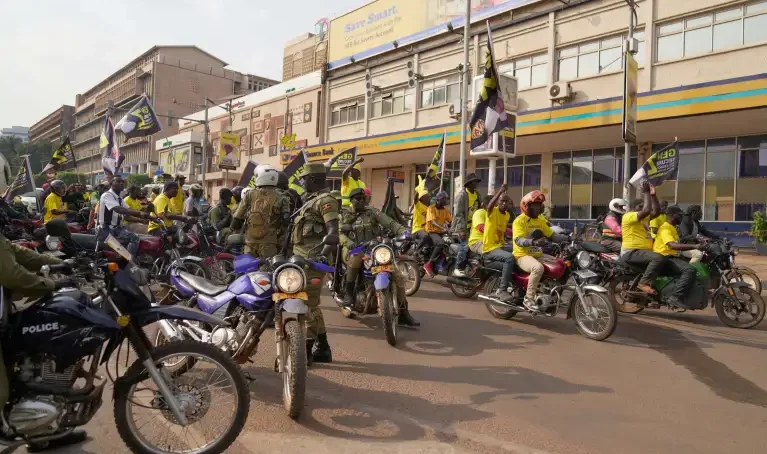
The NRM government conducted countrywide elections on January 15, 2026, not so much to renew leadership but to coronate Tibuhaburwa Museveni and display the military and political supremacy of NRM. At least 17 regime Members of Parliament, including Deputy Speaker of Parliament, Thomas Tayebwa, his boss Anne Annet Among and her husband, Engineer Magogo, were among the unopposed. There were reports that a lot of money was used in the elections. All that the Chair of the Electoral Commission did was to tacitly condemn the use of money in elections, arguing it undermines democracy, but without taking action against the culprits. His inaction undermine d electoral democracy.
Without Internet it becomes extremely difficult for the informed public to monitor or gauge the effectiveness of the Electoral Commission in eliminating electoral malpractices and preventing state interference in elections. There is no doubt by shutting Internet the state concealed malpractices and enhanced its direct control of the people and the electoral process.
On January 14, 2026, the NRM cadre and chair of the Uganda Communications Commission (UCC) George Wiliam Thembo in a statement, and citing security concerns – as expected – announced that Internet and any facilities dependent on Internet, would not be accessed by Ugandans and institutions, except those exempted, including providing what he called essential services, such as banks and government ministries, ostensibly to safeguard public safety, critical national functions and the operational integrity of communicational infrastructure.
This was despite UCC’s “communications for all” and the fact that many countries (such as Kenya) do not conduct elections in an Internet void. It meant that electoral observers from outside were to manifest in an Internet void.
Nyombi’s statement titled ‘Temporary Suspension of Public Internet Access and Selected Mobile Services during the Elected Period’ also suspended sale of new sim cards and Outband Data Roaming Services to Services to One Network Area Countries.
As expected Nyombi’s statement added, “This measure is necessary to mitigate the rapid spread of online misinformation, disinformation, electoral fraud and related risks as well as preventing incitement of violence, even he knew that most violence in the past during elections has been state violence.
The biometric machines, which the chairman of the Electoral Commission, insisted would be used to eliminate electoral fraud, failed. It was not immediately clear that the failure was due to shutting the Internet. The biometric machines were reportedly acquired at the exorbitant cost of Ush22 billion to eliminate electoral theft. Therefore, there was no electoral value for money in acquiring the machines. We are likely to hear of electoral thefts having been committed
People did not start voting at my Bulawa polling station in Ikumbya Subcounty of Luuka District until 9.50 am. Elsewhere voting started much later. NUP Secretary General Lewis Rubongoya said voting in the military and police barracks started as early as 7 am.
In Ngora Voting started at 12 noon. The manual voter register, whose integrity the opposition had many problems with it, was used throughout the country. Biometric machines had failed during the human population census and in the last election but were enforced on the electoral process by President Tibuhaburwa Museveni who reasoned that the machines would eliminate electoral theft. He said there was electoral theft in 2021 and claimed the National Unity Platform (NUP) and Kyagulanyi stole 2.7 million of his votes.
On January 15 2026, the president, soon after voting at Rwakitura, addressed the press and continued to praise the biometric machines, arguing they effective in curtailing electoral fraud. He was unaware that the machines had failed. He said that if his votes were not stolen, he would win by 80 per cent. In fact in many places he reportedly got in excess of 80 per cent. In one place called Kiruhura, in Western Uganda, he got in excess of 99 per cent of the vote. In the past, Western Uganda was where a lot of ballot stuffing was said to have taken place far more than in other regions.
The huge percentages suggest that the more President Tibuhaburwa Museveni has ruled the more his popularity has remained despite the fact that Uganda’s human population is more than 80 per cent youthful and disconnected from his generation.
Millions of Internet users were not involved in relaying information regarding the elections. Radios and Televisions, using their agents and frequently citing the EC, were actively informing the public what was transpiring throughout the country during the voting and after the voting. Therefore, this time round the EC was bound to tally votes, compile results and proclaim winners and losers without contradiction. It goes without saying that the state was in full control the electoral process in favour of the incumbent President and personalist NRM.
In conclusion, cyber-criminals presenting security concerns are there to stay. It is important that if elections continue to be held, Internet is not shut en masse to affect everyone and everything in and outside Uganda negatively. As Fred Muhumuza said on NTV on the voting day, the government should become smarter. It should strategise to deal with the criminals without shutting Internet, which ends up affecting everyone, everything, every institution, every process, every sphere of human endeavour everywhere, and the government itself, negatively.
Shutting Internet is a primitive way of managing elections and dealing with cyber-criminals. We might also keep on asking whether elections still remain a reliable measure of democratic development or are just a means for power retention and political legitimisation of an essentially military regime dressed in civilian cloth at an exorbitant cost to the Ugandan taxpayers. Whatever the case, the electoral process belongs to the organiser – the NRM regime – who’s national Electoral Commission consists of only NRM cadres.
Both the military and militarised police have continued not to conceal their NRM preference and belonging as they manage the security perspective of elections and other perspectives in Uganda. Finally, we should always remember that in 1996, President Tibuhaburwa Museveni said that a mere piece of paper (the ballot) could not remove him from power, and that he is like a quarter pin of a bicycle, which goes in by knocking and comes out by knocking. Elections should be for renewal of leadership in terms of quality, and also the hope of a nation.
- A Tell report / By Oweyegha-Afunaduula / Environmental Historian and Conservationist Centre for Critical Thinking and Alternative Analysis (CCTAA), Seeta, Mukono, Uganda.
About the Centre for Critical Thinking and Alternative Analysis (CCTAA)
The CCTAA was innovated by Hyuha Mukwanason, Oweyegha-Afunaduula and Mahir Balunywa in 2019 to the rising decline in the capacity of graduates in Uganda and beyond to engage in critical thinking and reason coherently besides excellence in academics and academic production. The three scholars were convinced that after academic achievement the world outside the ivory tower needed graduates that can think critically and reason coherently towards making society and the environment better for human gratification. They reasoned between themselves and reached the conclusion that disciplinary education did not only narrow the thinking and reasoning of those exposed to it but restricted the opportunity to excel in critical thinking and reasoning, which are the ultimate aim of education. They were dismayed by the truism that the products of disciplinary education find it difficult to tick outside the boundaries of their disciplines; that when they provide solutions to problems that do not recognise the artificial boundaries between knowledges, their solutions become the new problems. They decided that the answer was a new and different medium of learning and innovating, which they characterised as “The Centre for Critical Thinking and Alternative Analysis” (CCTAA).


About author