
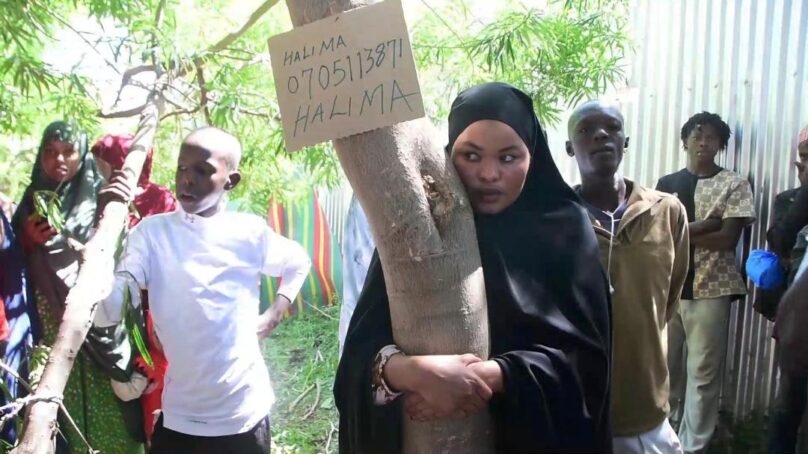
A 21-year-old pastoralist woman has joined the tree-hugging frenzy to raise awareness on rampant gender-based violence (GBV) in Isiolo County in northern Kenya.
Gender-based violence among pastoralist communities is regarded are a ‘staple’ for marriages in such highly patriarchal communities that demands subservience and places the position of a man at the top in social hierarchy.
The move by the young woman has elicited a frenzy in Isiolo as hundreds of residents thronged the venue in the Isiolo county assembly precincts to marvel at her.
Pastoralist communities in Kenya record a disproportionately higher incidence of underage girls and teen marriages. Such unions – that are forced – are invariably executed with violence.
According to activist Halima Boru, 21, she embarked on the 72-hour tree-hugging challenge at 5.00pm on Thursday, January 15, 2026 to raise awareness on GBV. Halima said her move is intended to advocate for the rights of women and girls, whom she noted, were suffering silently despite the vice being widespread.
The Supreme Court of Kenya says in strategic plan to fight the vice titled, Social Transformation Through Access to Justice Sexual and Gender Based Violence (SGBV) Strategy 2023-2030: Trauma Responsive Justice:
“On many fronts, Kenya has struggled to ensure that victims or survivors of SGBV are able to access justice. This is against a backdrop where victims of SGBV are globally recognised as particularly vulnerable and face grave challenges when coming into contact with the justice system.
“In this regard, Kenya’s survivor centred approach towards enhancing access to justice for SGBV victims/survivors has taken shape through a wide range of piece meal policy and institutional reforms accompanied by a variety of strategies and programmes.”
“Most recently in 2022, the Office of the Chief Justice unveiled the Social Transformation through Access to Justice (STAJ) Vision for the Kenya Judiciary. In particular, the strategic plan canvased the issue of access to justice leading to creation of the country’s first SGBV court.”
An Isiolo resident, Batula Ali, who became emotional after seeing Halima, said many women in the county endure abuse without speaking out as a result of the highly patriarchal structure of the pastoralist society. Batula also warned against individuals who are trying to discourage Halima, saying labelling her as shameful only silences GBV victim’ even more. She called on women to speak out against the vice, calling it criminal.
“Despite many women suffering from GBV in silence, only a few have the courage to speak out and explain the challenges they face,” Batula said.
Another onlooker, Nuria Waqo described Halima’s action as a “voice for the voiceless,” noting that many women experience GBV, but fear coming forward to share their pain.
According to Bahari Muhamed, Halima began the challenge at 5:00pm on Thursday and is expected to end her campaign after 72 hours of hugging the tree non-stop.
Mohamed called on well-wishers to support the initiative by providing security, a tent and a public address system to help amplify the message and ensure the success of the campaign.
Isiolo Gender Watch Programme Coordinator Grace Lolim castigated community members who still support societal vices including female genital mutilation (FGM), spouse battering and early marriages saying such retrogressive practices contravene the law and all those found culpable must be prosecuted.
She called upon the government and the other support groups to help gender activists in awareness creation in order to assist in the fight against GBV.
Supreme of Court Kenya strategic plan says: “The quest for justice for victims or survivors of Sexual offenses or SGBV has for many years been encumbered by numerous institutional, social and structural barriers. The state of affairs has manifested in a growing backlog of sexual offences or SGBV cases.
“To address some of the barriers and growing number of case files, the chief justice launched the SGBV court at Shanzu, Mombasa. To strengthen the resolve for enhanced justice for victims or survivors, the office of the chief justice in collaboration with the United Nations office on Drugs and Crime (UNODC) undertook a consultative process to guide the roll-out of Specialised Sexual Offences or SGBV Courts in the country.
“The development of this Strategy was informed by this detailed consultations and analysis in May and June 2022.”
- A Tell Media / KNA report / By David Nduroa


About author