

Western energy companies on Friday signed dozens of agreements with Iraqi officials on oil and gas and pipelines as the OPEC member seeks to deepen relations with the US and develop alternatives to the Strait of Hormuz for getting its energy to global markets.
“We are using an open-door policy,” Prime Minister Ali al-Zaidi said through a translator at a US-Iraq business summit at the US Chamber of Commerce where Iraqi officials and US energy, healthcare and technology companies signed non-binding agreements and memorandums of understanding of more than $60 billion.
“Everybody who has a project can come and talk to us. We will not make it difficult for anyone,” Zaidi said.
The US-Israeli war on Iran has rocked Iraq’s neighbouring country and the wider Middle East. Tom Barrack, an envoy to the region for President Donald Trump, said on one hand the war has created chaos and confusion but on the other Iraq is “at the forefront of a new strategic security alliance” with the US and others.
Zaidi visited Chevron’s headquarters in Houston on Thursday before Iraqi officials signed agreements with the oil major to advance its potential entry into Iraq’s West Qurna 2 and Nassiriya oilfields.
Jake Spiering, a Chevron president of corporate business development, told the Chamber event that his company will be investing in a pipeline to avoid the Strait of Hormuz and create another export route out of Iraq. Such a pipeline could transport Iraqi oil to the west coast of Syria which is on the Mediterranean Sea.
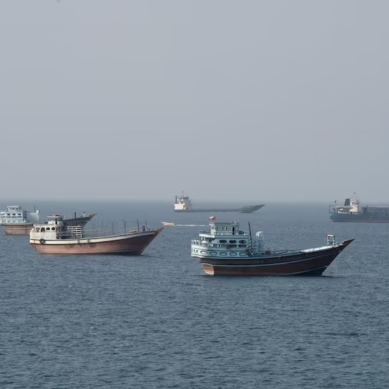
Iraq’s exports have been hit hard by the war in part due to the partial closing of the strait through which 20 per cent of the world’s oil and gas typically flowed.
In the long term, Spiering said, Iraq’s energy potential could make it the Middle East’s equivalent of the US energy trading centres known as the Henry Hub natural gas and Cushing oil hubs.
ConocoPhillips said it had agreed to acquire a 42 per cent stake in BP Energy of Kirkuk Ltd, joining British oil major BP in redeveloping four producing oilfields in northern Iraq.
Meg O’Neill, BP’s CEO, said Iraq has “fantastic potential from a resource perspective” and that the partnerships help with Iraqi and global energy security. BP has a long history in Iraq, having been involved in the discovery of Kirkuk in 1927.
Ryan Lance, the CEO of Conoco, said his company does not have the history BP does in Iraq, but has experience in challenging places like Alaska’s North Slope.
“We are anxious to bring our technology, our know-how, our people and our capital to help the Iraqi people,” Lance said.
Zaidi, on a five-day trip to the US, met Trump at the White House on Tuesday, who said the US would be doing a lot of deals with Iraq, creating jobs for both countries.
- A Reuters report s


About author