



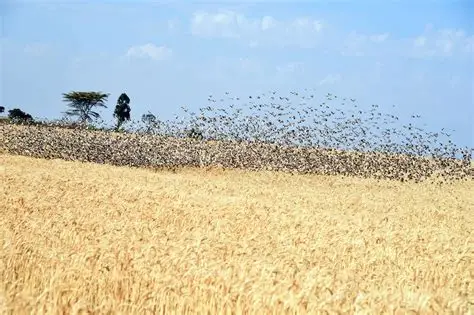
Kisumu County has launched an emergency operation to control an invasion of an estimated six million Quelea Quelea (weaver) birds that have descended on rice-growing schemes and put at least 800 acres of crop at risk.
There is rising fear of imminent food security in the Lak Victoria Basin.
County Executive Committee Member (CECM) for Agriculture Kenneth Onyango said the county has moved swiftly to pulse the threat upon receiving an alert last week. Consequently, Onyango wrote to the Department for Agriculture and the Directorate of Plant Protection and Food Safety about the threat posed by the birds. The department in turn dispatched a team of crop protection officers to the ground to roll-back the threat.
“We met the team this morning and briefed them on what is happening. They have been dispatched to the fields to assess the extent of the damage and recommend immediate remedies,” explained said.
According to a surveillance report by the county department of agriculture, the birds have established at least three major night roosts, with two confirmed in Obange and Ambo areas of West Kano irrigation scheme in Nyando Sub-County.
The roosts located in dense reeds and papyrus vegetation are hosting an estimated five million birds.
The report indicates that about 800 acres of rice, most of it at panicle initiation and early harvesting stages are under immediate threat, with farmers already reporting heavy losses.
“The danger posed by these birds is enormous. The numbers are quite high and this is the second invasion in three years. During the last one, the ministry used drones to spray and scare the birds,” Onyango said.
He said plans were underway to spray the identified roosting sites within the next one to two days, using drones, as part of an integrated control strategy.
“We have the exact coordinates of the roosts. We believe that spraying, combined with other scaring methods, will significantly reduce the damage and minimise losses to farmers,” he said.
“The team from the department for agriculture has come with the necessary pesticides. By tomorrow, spraying should start. Scaring alone is labour-intensive but spraying has proven to be more effective,” Onyango said.
Onyango appealed to rice farmers to remain calm, assuring them that the county government was working closely with the national government to resolve the crisis.
“We want farmers to know that the county has moved very fast. We are hopeful that within the next two days this problem will be brought under control so that farmers can reap from the labour they have put into growing the rice,” he said.
Hesbon Agina, a crop protection officer from the Directorate of Plant Protection and Food Safety said the team was considering whether the spraying could be done with motor vehicles fitted with pumps or if aerial spraying would be required.
The assessment to be carried out today, he said, would also determine whether additional measures including technology-based scaring and other approved control methods would be deployed, depending on the birds’ movement and concentration.
Kisumu County Crop Protection Officer Thomas Oganda said West Kano Irrigation Scheme was the most affected, with multiple blocks already reporting damage. Other schemes, including Ahero in Muhoroni Sub-County, have also been affected, although bird scaring is currently ongoing there.
In South West Kano alone, 37 blocks covering about 3,500 acres have been affected as the birds have migrated from other schemes such as Chiga in Kisumu East where land preparation for planting is ongoing.
Quelea quelea birds are known for their destructive feeding habits and have previously caused significant crop losses in the region, particularly in rice-growing schemes around Kano plains.
- A Tell Media / KNA report / By Chris Mahandara


About author