

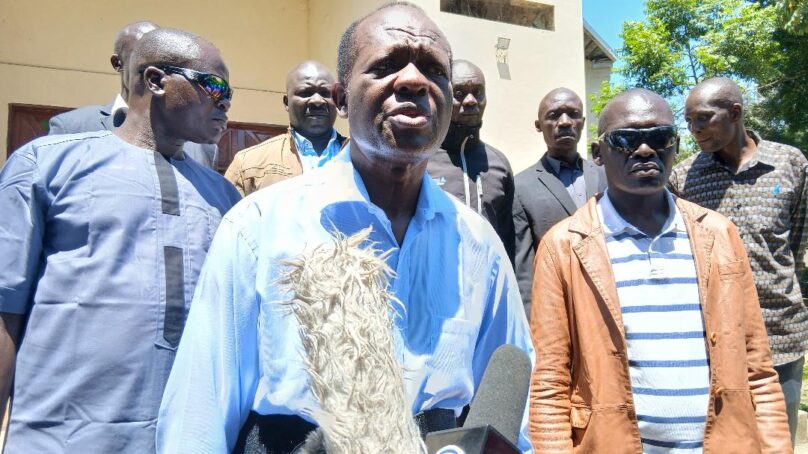
Former Cabinet Minister Raphael Tuju has launched a blistering attack on Shanta Gold Limited, accusing the mining firm at the centre of a land dispute in Rimula, Siaya County, of operating under a veil of secrecy and disregarding community rights.
Tuju’s criticism of Tuju coincided with calls by a Kakamega gubernatorial aspirant, Prof Sylvester Anami, who on Saturday appealed to Ethics and Anti-Corruption Commission (EACC) to put to Kakamega Governor Fernandes Barasa over some Ksh6 billion that is unaccounted for since Barasa came into office. Prof Anami also raised a sink over some Ksh50 million accounts queries that have become a monthly fixture in the finance office.
On Friday, EACC named Kakamega the most corrupt county in the past three years.
Speaking at St Stephen’s ACK Church in Kisumu on Sunday, Tuju said preliminary checks on the company’s structure point to an offshore registration in Guernsey, which he argued shields the identities of its owners.
He claimed that the directors listed locally are nominee figures acting as cover for undisclosed beneficiaries.
“You cannot know where it is coming from. Such arrangements raise serious questions about accountability and oversight in the extractives sector,” he said.
Tuju’s allegations add to suspicions in Kakamega in that senior national government officials, including President William Ruto, Cabinet Secretary for Mining Hassan Joho, and Principal Secretary for Mining Harry Kimtai are scheming to oust locals from the Ksh683.04 billion ($5.28 billion) gold discovered in Ikolomani by Shanta Gold Mining, a company that claims British background.
Prof Anami has added his voice to going questions about the role of the current county leadership in facilitating the capture of Isulu-Bushiangala by Shanta Gold Mining in which the presidency is alleged to have massive interests.
Anami questioned why meetings to discuss mining in Kakamega have been moved to Kisumu, some 60 kilometres away from the mining site. He also questioned why local mining experts have not been drafted into the negotiations for compensation and workshops on mining in Kakamega that have been taking place in Kisumu at the exclusion of local Members of Parliament.
Only Members of County Assembly – most of them semi-literate – are the ones that are invited to such consequential meetings and workshops.
Some 800 households will be affected in Shanta Gold Mining pursuit of the 337 acres of land that hold the precious mineral.
“I smell a rat. It is in public domain that Baraza, as managing director of Lake Turkana Wind Power Project, was implicated in one of the biggest financial swindles in the history of corruption in Kenya. He was named as a key player in the disappearance of close to Ksh18.7 billion that was tracked to Guernsey, which was allegedly covered up by former Ministry for Energy Charles Keter and William Ruto (then deputy president).
Lake Turkana Wind Power Project has been the subject of significant legal and ethical scrutiny due to allegations of money theft and corruption. The Ethics and Anti-Corruption Commission has recommended the prosecution of suspects involved in the scam, Governor Baraza being a key player.
Against the backdrop of gold mining in Kakamega and Rimula in Siaya, questions abound on Kakamega County government’s role in British firm Shanta Gold Mining. There are allegations that Barasa is being positioned t facilitate a swindle similar to his role in Lake Turkana Wind Power Project with the assurance that h would be shielded from prosecution by the president.
In Kisumu, Tuju criticised the firm’s push to access land in Rimula, Siaya County which has led to loss of lives saying residents are being pressured to give way for mining without adequate safeguards.
Tuju insisted that while communities may agree to lease land for extraction, there must be respect for cultural sensitivities and long-standing ties to the land.
The former minister argued that advances in exploration technology including satellite mapping and remote sensing mean companies can identify and exploit mineral deposits without resorting to large-scale displacement.
“It is possible to mine without bringing down people’s homes,” he said, adding that disregard for local concerns risked fuelling wider unrest.
He warned that failure to enforce order and transparency could see similar disputes erupt across the region.
“If you allow this kind of impunity, today it is Rimula, tomorrow it will be elsewhere,” he cautioned.
He further accused the company of embodying what he termed pathological greed, alleging that profit motives were being pursued at the expense of vulnerable communities.
Tuju called for urgent reforms in the mining sector, including full disclosure of ownership structures and stricter safeguards for host communities, warning that failure to act could deepen tensions in resource-rich regions.
At the same time, Tuju linked the dispute to what he described as growing impunity in the country, turning his fire on state agencies.
He claimed more than 100 police officers had been deployed to his private property in a separate land dispute despite court rulings nullifying contested titles.
“Why should the government release policemen to a private property?” he posed, terming the move an abuse of power.
Tuju alleged that the continued presence of security officers on his land, despite favourable court decisions, pointed to collusion between powerful individuals and state machinery. He also raised alarm over his personal safety, claiming he was under surveillance and that vehicles without number plates had been trailing him.
According to Tuju, the individuals behind the alleged scheme to seize his land have the means to deploy security personnel and intimidate opponents.
“The only thing standing between them and that land is me,” he said, warning that his life was in danger.
Beyond the immediate disputes, Tuju pointed to a deeper socio-economic crisis, linking rising tensions in the country to unemployment among young people. He said millions of youth leaving school each year without jobs are increasingly vulnerable to manipulation by powerful interests.
“The goons are not the problem; they are a symptom,” he said, blaming what he described as a leadership failure to address joblessness.
He accused those in power of focusing on lucrative deals instead of tackling pressing national challenges, saying the trend was eroding public trust and fuelling conflict. A Tell Media / KNA report Chris Mahandara

About author