

East Africa’s Ogre that eats own children: Museveni’s court martial and laying bear loopholes in Uganda’s 1995 constitution
The drafting history reveals that delegates agreed courts martial were indeed courts of judicature – but the history is maddeningly silent on whether they could try civilians.
Way Museveni’s abstract policies rendered indigenous Maragoli and other communities stateless in Uganda, nativised refugees
More fundamentally, the very presence of this parallel system enables the government to neglect its obligations to indigenous children, knowing that international sympathy will ensure refugee children are not entirely abandoned.

Same forest, different monkeys: Understanding Uganda’s stalled independence from colonialism
These fifteen nations – Buganda, Bunyoro, Toro, Ankole, Busoga, Bukedi, Bugisu, Teso, Lango, Acholi, Alur, West Nile (containing multiple ethnicities), Karamoja, Kigezi and Sebei – each possessed sophisticated systems of governance, distinct cultural identities and established mechanisms for maintaining peace and security among their peoples. The British did not come to develop these nations; they came to conquer, control and exploit them.

Trouble with Uganda: Opposition is so wedded to power that external onslaught finds outfit plagued with internal failures
Despite widespread socio-economic grievances and democratic aspirations among the populace, the political opposition has consistently failed to coalesce into a credible, unified and effective alternative. This persistent weakness is not a historical accident but the deliberate outcome of a multifaceted system designed to perpetuate incumbent power.

Uganda’s January 15 General Election demonstrates that democracy cannot be built through a process designed to prevent it
We argue that elections under the NRM have become empty ceremonies because the system is engineered around three reinforcing mechanisms: digital authoritarianism, which controls the narrative and isolates citizens.

Museveni boasts after retaining seat he and NRM are forever popular in Uganda 40 years since coming to power
In his speech, Museveni accused the opposition of trying to foment violence during voting. He urged religious leaders to reach out to young people who are likely to be misled into violence.

Authoritarianism: Uganda’s quasi-democracy paints a picture of the East Africa nation’s status as a colossal military barrack stilted on steroids
A closed society is where, by design, law and policy people and institutions may or may not intercommunicate and selectively communicate with the outside world. In a closed society, human rights abuses by the State are common, and accountability and transparency are undermined in favour of a deep state run by Mafioso.

Museveni prepares for 50 years in power after elections agency declares him winner of Uganda’s 2026 presidential race
The musician-turned-politician best known as Bobi Wine took 24.72 per cent of the vote, the final results showed. Wine, whose real name is Kyagulanyi Ssentamu, has condemned what he described as an unfair electoral process and alleged abductions of his polling agents.
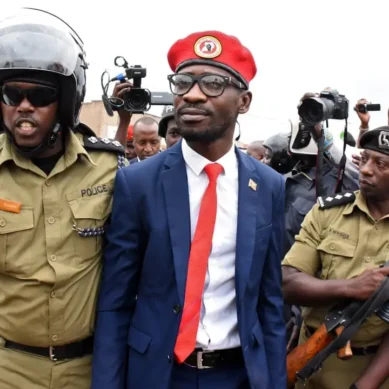
Ugandan police deny arrest of Museveni’s main rival who was allegedly abducted in pre-dawn military raid
Uganda held a general election on Thursday amid an internet shutdown that has been in place for four days, with the military heavily deployed across the country and pockets of violence erupting as people protested parliamentary election results in various parts of the country.

Uganda’s popular opposition leader Bobi Wine abducted in pre-dawn military raid, his whereabouts unknown
As of Friday evening, Museveni, who has been in power since 1986, held a commanding lead with nearly 74 per cent of the vote, the electoral commission said. Wine trailed with 23 per cent.