



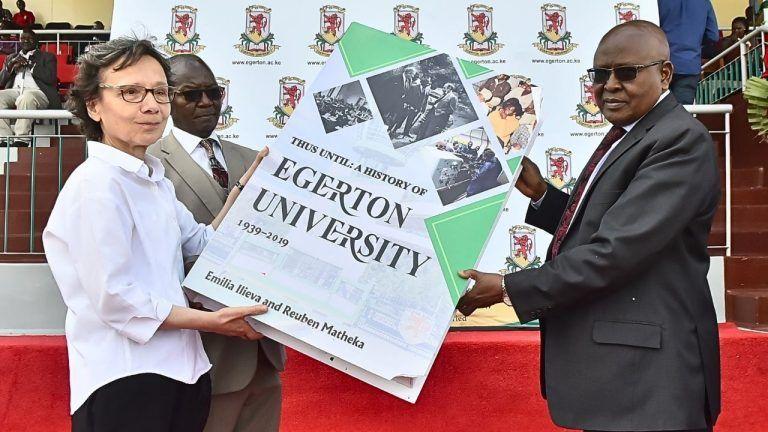
A new biography of Egerton University authored by professors Emilia Ilieva and Reuben Matheka shatters the widely held belief that the institution was founded by colonial farmer, Lord Maurice Egerton of Tatton.
The book, Thus until: A History of Egerton University (1939-2019), an exhaustive 600-page account that tracks the institution’s 80-year evolution from a colonial farm school to a premier agricultural university was officially launched at the Njoro Main Campus in February 2026 to coincide with the university’s 86th anniversary.
For over eight decades, official accounts and historical records have affirmed that Egerton University, the oldest institution of higher learning in Kenya was founded as a Farm School in 1939 by Lord Egerton, a British national who settled in Kenya in 1919 and donated 740 acres of land for its establishment.
The school’s original purpose was to prepare white European youth for careers in agriculture. By 1955, the name had changed to Egerton Agricultural College. A one-year certificate course and a two-year diploma course in agriculture were offered. In 1958, Lord Egerton donated another 1,100 acres of land to expand the institution.
The authors of Thus Until: A History of Egerton University (1939-2019), a book that chronicles critical milestones that the university has achieved since its formation when it was conceived and initially run as a stronghold of supremacist settler ambitions with commercial agricultural interests, now state the institution was a colonial government initiative aimed at revitalizing settler agriculture.
The title “Thus Until” is a direct translation of the university’s motto, Sic Donec, which also served as the family motto for the Egerton of Tatton line.
The book traces the motto to the first Baron Sir Thomas Egerton who lived between 1540 and 1617. The book narrates that he was the family’s “most renowned representative” and was highly valued by the royal family.
It recounts that he was made a Baron by King James I who ascended to the throne on March 24, 1603. Having become a “Baron, Egerton of Ellesmere”, Thomas then introduced this phrase as the family motto. In 1610 he “was elected Chancellor of Oxford University.”
The authors indicate Lord Egerton’s vital contribution to the establishment of the school was land. The idea was, however, not his, but that of the colonial government, which, having been motivated by his passion, decided to name it after him.
The book records that the decision to name the school after Lord Egerton created the perception that he was not only a benefactor, but also a founder of the school, adding that it was an erroneous perception that was maintained for a long time.
Over the years, new Egerton University students, among many other people, have been told during their orientation, that Lord Egerton had solely started the school with only three students in the first intake.
But the book debunks the myth. First it clarifies that the school was “inaugurated on
May 9, 1941,” and “twenty-two boys were admitted in the first intake, followed by other successful candidates in 1942.”
The authors are both professors at the university with Prof Emilia Ilieva serving as a Prof of Literature, while Prof Reuben Makau Matheka is a Prof of History at the same institution.
Early chapters of the book published by East African Educational Publishers (EAEP) in Nairobi discuss the Egerton family and the “Happy Valley” period, while later chapters examine leadership transitions, curriculum experiments and the impact of national education policies.
The book consists of 13 substantive chapters. It documents the school’s journey from a “whites-only” farm school in 1939 to a multi-racial college in the 1960s and finally its elevation to a full public university in 1987.
The narrative places Egerton within broader global and national politics, detailing how it transitioned from a tool of colonial ideology to a central player in Kenya’s decolonisation and national development.
Although the first batch of students were admitted in 1941, the year 1939 is viewed as the inauguration period as it is the year the colonial government made a conclusive decision towards the founding of the school.
In that year, the book states, “The colonial government was about to take an important step in the development of European education in Kenya, allowing for its flexibility and diversity.”
This step was arrived at following earlier discussions and recommendations on the need to establish a farm school that would, among other things, “revitalise settler agriculture.” The idea of starting “a school farm in general terms,” was outlined in a May 1939 meeting by the s of the European primary schools in Nairobi, Nakuru, Eldoret and Kitale,” the authors write.
The director sought to know if the principals had pupils who “might show interest in such an establishment for the post-primary education.”
The principals gave a node, but not before they showed their reservations for the name of the school. They said his “unfortunate wording created the impression that the school was meant for the mentally disabled and was therefore likely to discourage parents from sending their sons to it rather than lead to the desired backing.”
Having agreed on the need to start a farm school, a proposal was developed and presented to the government for consideration, and it was strictly to be for Europeans (and at first only for boys); and specifically, be “a twin facility comprising a training farm and secondary school,” according to the book.
When approached for his donation of his Ngongongeri Farm, which had been seen as appropriate for the project, Lord Egerton readily obliged, giving 500 acres straight away. He gave no conditions to this donation but only asked that should the project not be accomplished; the land should be handed back to him “free of any legal or other charges.”
Nevertheless, the chronicle does not at any point insinuate that Lord Egerton the naming of the school after him or his estate. In fact, it emphasises that he was away for almost a decade during the school’s preparatory period.
“Following the outbreak of the Second World War, in December, 1939, Lord Egerton travelled to England and would not see Kenya again for the next nine years,” the book records.
The government also debated on other alternative names before it settled on the Egerton name for the school. During its initial stages, the farm school and training farm was called the Njoro Farm School as well as Agricultural School, Njoro. However, soon after the official opening, the government decided to name the school, Egerton School of Agriculture.
By bequeathing the land and being thrust at the heart of such a massive education venture, Lord Egerton was also satisfying his long-held vision and interest in education. The book narrates how by the 1920’s he had established at least two schools on his farms for his workers’ children. The schools – Ngata and Ngongongeri primary – which exist to date – may not have been set out of an “altruistic motive,” the book states. Rather, like the colonial settler he was, the schools were “a way of keeping parents on the farm.”
The book is a thorough, historical, chronological and well-researched account of Egerton University from a whites-only college when it started in 1939 through to the expansion it has experienced over the years, culminating in being a full university.
More than any other university in Kenya, Egerton has a long and colourful history; but like all the other universities, it has suffered from the political, economic and financial challenges of the time, especially since the double intake of the 1990s.
The book mainly highlights agricultural and educational policies and seeks to steer away from the “Happy Valley” hype so characteristic of the period. The reader will learn about the Egerton family in Chapter Two, and particularly about Lord Egerton himself and the colonial circumstances within which he lived.
The chapter dispels some of the popularly held myths about him. Chapter Three deals with the beginnings of the college and the various structural and curriculum experiments tried out and the kind of enrolment and students it experimented with as an all-white establishment. The chapter ends with Africans beginning to agitate for change. With great attention to detail, the latter chapters put the university in a broader local and international context, thereby elevating its relevance to the readers.
According to Prof Ilieva, the book is already receiving positive responses. It has so far been reviewed by the Saturday Nation and the Old Africa magazine. Top-notch academic journals have asked the publisher for review copies. These include African Studies Quarterly, Journal of Modern African Studies, Higher Education, and Comparative Education Review.
She further noted that the book has drawn the attention of prominent historians like Prof Dane Kennedy and Prof Charles Hornsby and has already found its place in libraries of overseas universities like the Library of the University of California, Berkeley.
- A Tell Media / KNA report / By Jane Ngugi


About author