

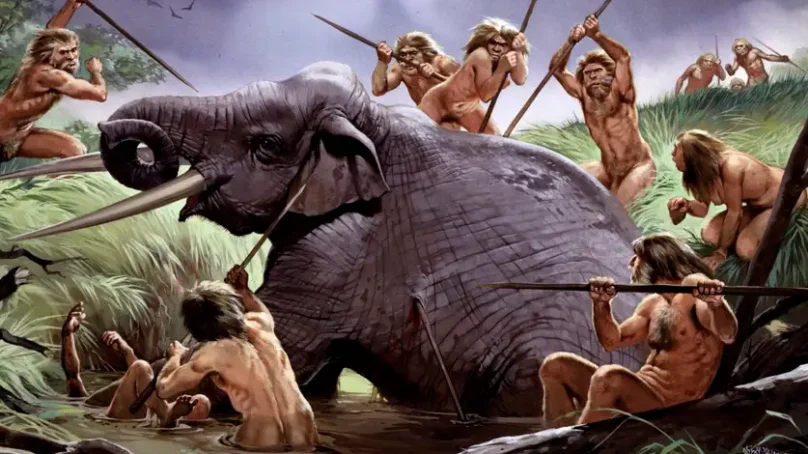
A 1.78-million-year-old partial elephant skeleton found in Tanzania associated with stone tools may represent the oldest known evidence of butchery of the giant herbivores.
Butchering an elephant is an extraordinarily difficult feat, requiring serious tools and cooperation, with the reward being a protein bonanza.
Now a team of researchers led by Manuel Domínguez-Rodrigo at Rice University in Texas say ancient humans may have achieved this milestone 1.78 million years ago at Olduvai Gorge in Tanzania.
“At about 2 million years ago humans were systematically consuming animals like gazelles or waterbucks, but not bigger game,” says Domínguez-Rodrigo.
In 2024, The Times of Israel report that a new paper by researchers at Tel Aviv University had suggested that there is a link between the disappearance of large prey and advancements in hunting and technology
When elephants started disappearing from the Middle East some 400,000 years ago, it was a major crisis, and not just for the ancient elephants. Early humans across the region, including in what is now Israel, depended on elephants for their diet. Eventually, humans adapted, learning how to hunt smaller prey such as bison, deer and gazelles, until those, too, disappeared from the landscape or their numbers were too small to hunt. This forced humans to adapt to even smaller prey such as rabbits and birds, and, eventually, to domesticate plants and animals during the agricultural revolution.
The paper from the peer-reviewed Quartenary journal by Tel Aviv University researchers Dr Miki Ben-Dor and Prof Ran Barkai says as “humans were forced to find new food resources, their hunting tools improved, allowing them to hunt smaller prey that moved faster.”
“Animal prey prevalence and availability had a profound influence on human culture and biology,” Barkai, a professor of prehistoric archaeology at Tel Aviv University, is cited as saying.
The Tims of Israel says reported that Barkai and other researchers have published previous articles delving into how the size of animal prey declined through time, from mega-herbivores such as elephants to small prey such as waterfowl and rabbits.
But, The Times says, “In this recent article, the researchers matched the decline in animal prey size to improvements in hunting tools, from wooden spears to stone-tipped spears to bows and arrows to domesticated dogs. As the prey got smaller and wilier, the hunting tools got more advanced, lethal and precise.
“Until now, there’s no explanation for the reason why people changed their stone technologies throughout the 1.5 million years of human evolution in the Levant,” said Barkai. “In this recent paper, we put together these two data sets of animal prey availability, and stone tool chronology suggested a nexus and linkage between the two.”
The elephants that stampeded through the Middle East prior to 400,000 years ago were called “straight tusk elephants,” with the largest males reaching some 13 tonnes in weight. In comparison, the average African bush elephant today is around 7 tonnes for males. “They were huge, even larger than the mammoths in Europe,” Barkai said.
Early humans would kill elephants sparingly, but when they did, it was cause for celebration, as it could feed their community for months. Archaeological sites across the Middle East and the world have documented rituals and artwork revolving around elephant hunts.
Early humans would smoke the meat or keep it in cold running water to preserve it for months. They kept the marrow inside the bones and would crack the bones open weeks later to eat.
According to Institute for Environmental Research and Education (IERE), “The primary reasons ancient humans hunted elephants were for survival, focusing on obtaining essential resources like meat, ivory, and hides; however, as societies developed, hunting elephants also served social, cultural, and economic purposes.”
IERE report published in October last year notes that elephants have roamed the earth for millennia and are majestic creatures that have shaped landscapes and played a vital role in ecosystems.
“Equally enduring has been the human interaction with these behemoths, an interaction often defined by the hunt. Why did humans hunt elephants? The answer is complex, evolving across time and cultures, driven by needs ranging from basic survival to economic gain and social prestige. Understanding this history provides crucial context for contemporary conservation efforts and our relationship with the natural world.”
- A Tell Media report / By James Woodford


About author