


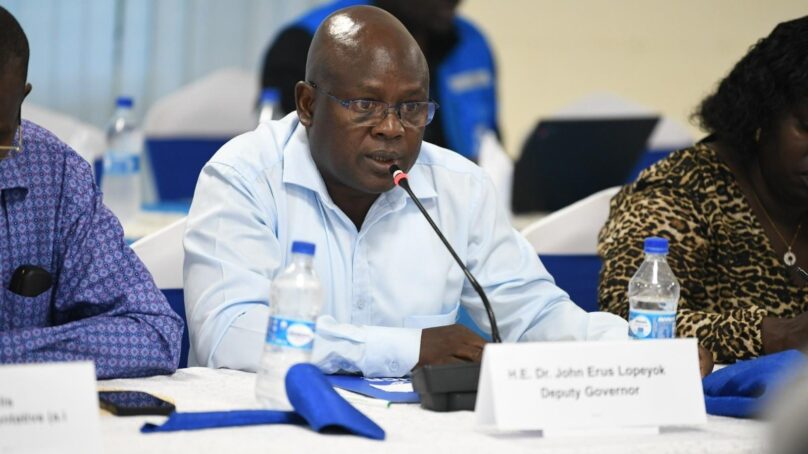
Turkana Deputy Governor John Erus has called for increased long-term development financing and stronger private sector engagement to support sustainable refugee integration and host community resilience.
Dr Erus made the call during a meeting with officials from the World Bank’s Fragility, Conflict and Violence (FCV) Mission to Kenya led by FCV Advisor Xavier Devictor. The delegation is assessing forced displacement programming and resilience investments in the country.
The deputy governor underscored Turkana’s unique position as host to Kakuma Refugee Camp and Kalobeyei Integrated Settlement, home to nearly half a million refugees and asylum seekers. He described the forced displacement in Turkana as a long-term development reality that requires sustainable, government-led systems rather than short-term humanitarian responses.
He reaffirmed the county’s support for the Refugees Act 2021 and the National Shirika Plan, particularly on service harmonisation, local integration and inclusion of refugees in county planning frameworks.
However, Erus noted that development financing must incrementally strengthen county government systems to ensure sustainability and accountability.
“There must be reciprocal investment in Turkana West to unlock economic potential and enable the county government to deliver services effectively,” Erus demanded.
He highlighted growing pressure on land, water, pasture, schools and health facilities due to rapid population growth and climate change, noting the close link between displacement and climate vulnerability in the arid region.
The deputy governor called for scaling up of livelihood investments, market access and financial inclusion to reduce dependency. Without strong private sector participation, he observed, the socio-economic goals of the National Shirika Plan may not be realised. He proposed a greater role for the International Finance Corporation (IFC) in driving that pillar.
He cited the Kakuma-Kalobeyei Challenge Fund (KKCF) as a working model for inclusive economic growth.
KKCF Senior Operations Officer Luba Shara said the fund has invested $12 million, matched by private businesses and supported enterprise development in the refugee and host communities.
UNHCR Representative Robil Ellis and Kakuma Sub-Office Head Santeesh Nanduri reaffirmed partnership with the county government. He noted that opportunities in agriculture and livestock value chains supported under the Kalobeyei Integrated Socio-Economic Development Plan (KISEDP(.
KISEDP is a 15-year comprehensive multi-sectoral and multi-stakeholder initiative to benefit refugees and local communities in Turkana County. It aims to bridge the gap between humanitarian assistance and development in response to increasing needs, risks and vulnerabilities faced in new and protracted displacement situations.
Nanduri said over 8,000 acres of arable land and more than 600,000 livestock present significant economic potential, but called for additional water investments to unlock productivity.
He emphasised the need to transition from dependency-driven aid models to productive local economies anchored on viable value chains and job creation.
County Executive for Lands Faith Aletea informed the delegation that the county has initiated the process of land allocation to accommodate the growing refugee population, alongside ongoing community engagement.
Senior county officers present included Deputy County Secretary Joseph Nyang’a and Kakuma Municipality Manager Peter Emuria.
- A Tell Media / KNA report / By Peter Gitonga


About author