

Along the shores of Tanzania’s Dar es Salaam, the rhythm of waves meeting the Indian Ocean is frequently interrupted by plastic bottles, broken glass and scattered debris lining once-pristine beaches.
In this bustling port city, rapid urbanisation and inconsistent waste collection have fuelled a growing environmental challenge, with household garbage and industrial refuse often ending up in waterways and along the coastline.
During heavy rains, clogged drainage systems push waste into rivers that empty into the ocean, compounding pollution along beaches and threatening marine ecosystems. For many residents, improper disposal has long been the norm, born of necessity, limited infrastructure and lack of awareness.
Yet amid these challenges, a quiet transformation is taking shape, one that reframes waste as an opportunity. At the centre of this shift is The Recycler Limited, a local waste management and recycling company.
Peter Emmanuel, project coordinator, described the company’s mission simply: “We give life to waste.”
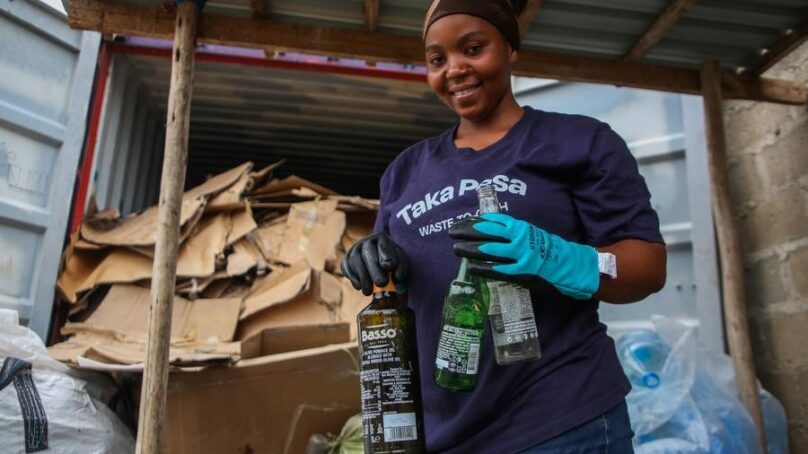
Through collection, sorting and recycling, the company converts discarded materials into reusable resources, while its most impactful initiative lies beyond corporate clients, within local communities. Launched as a grassroots outreach programme, Taka Pesa – Kiswahili for “waste to cash” – incentivises households to collect and separate recyclable waste in exchange for money.
The project not only reduces environmental pollution but also creates income streams, particularly for women.
“The goal is long-term sustainability,” Emmanuel said. “We provide both environmental and economic empowerment, especially for women, so they can eventually run similar initiatives independently.”
However, changing habits has proven difficult. Many households still dispose of all waste in a single bin, making recycling more labour-intensive. Behavioural resistance, rooted in inconvenience and lack of familiarity, remains a key obstacle. To address this, Taka Pesa offers direct financial incentives.
By assigning tangible value to waste, the initiative motivates residents to sort materials more carefully.
“When people know they will be paid, they begin to see waste differently,” Emmanuel said at the firm’s waste collection point at Mbezi-kwa-Zena, located 200 meters from the Indian Ocean beach. The impact is already visible in neighbourhoods like Mbezi Beach, where informal waste collectors have become vital players in the recycling chain.
Among them is Justine Samuel, who now earns a living by gathering discarded materials.
“Before, we used to throw everything away,” said Samuel. “Now, waste is money.”
Samuel collects plastics, broken bottles, and boxes, sometimes making between Tsh20,000 and Tsh25,000 (about $7.74 and $9.68) per day. The income supports his family and allows him to send his child to school. Beyond personal gain, he notes a broader transformation: cleaner streets and fewer hazardous materials scattered in the community.
Similarly, Oliva Msigwa, a supervisor overseeing waste collection in the Mbezi-kwa-Zena area, highlighted the project’s social impact.
“Before, waste was everywhere – on the roads, in open spaces,” she said. “Now, people collect it because it has value.”
Msigwa added that most participants in her area are women, working together to gather and sell recyclables. Payments are made immediately after weighing, reinforcing trust and participation in the system. At the operational level, collected waste undergoes meticulous processing.
Plastics are cleaned, labels removed and materials shredded into raw inputs for manufacturing. Some are recycled in-house, while others are supplied to partner industries. Scrap metals, for instance, are sent to firms dealing with repurposing. Notably, about 60 per cent of the materials handled by the company originate from ocean waste, much of it carried by currents from other parts of the coast, including Zanzibar, said Emmanuel.
Looking ahead, The Recycler Limited aims to expand Taka Pesa nationwide, with plans to establish centres across Tanzania within five years. Its vision is to transform waste management into a decentralized, community-driven economy. This local momentum aligns with national efforts to promote sustainable practices.
National Environment Management Council (NEMC) in collaboration with environmental stakeholders is marking the International Day of Zero Waste with a three-day public education campaign in Dar es Salaam.
According to NEMC Compliance and Enforcement Manager Hamadi Kissiwa, the event, running from March 28-30 at Mnazi Mmoja Grounds, is intended to shift public perception under the theme “Waste is an Opportunity.”
The campaign promotes the “3Rs” principle, namely reduce, reuse and recycle as a pathway to minimising pollution, improving resource efficiency, and generating income. It also highlights the global challenge of food waste, which contributes an estimated 10 per cent of greenhouse gas emissions.
For Dar es Salaam, where the ocean continues to carry the visible consequences of waste mismanagement, such initiatives offer a glimpse of a different future, one where communities are not just cleaning up their environment, but building livelihoods from it.
A worker moves recycled cardboard boxes in Dar es Salaam, Tanzania, March 19, 2026. A worker shows recycled glass bottles in Dar es Salaam, Tanzania, March 19, 2026.
- A Tell Media / Xinhua report s


About author