

When reggae legend Bob Marley composed and recorded Redemption Song, the United States was startled. It resonated with the yearnings of the world’s downtrodden. It gave the wretched of the earth a sense of belonging and psychological liberation. The end of subjugation appeared nigh and the downtrodden liberation.
This was shortly after Bob Marley’s Buffalo Soldier hit became synonymous with liberation of Black race from hegemonic White domination and in the process turned Marley into a target for US’ Central Intelligence Agency (CIA) assassination, which they accomplished.
Marley’s messages delivered through his songs had acquired messianic status and the US dreaded it. The script is being repeated in Uganda and President Yowri Museveni’s is not sitting pretty.
A similar phenomenon is being experienced in Uganda in the countdown to the January 25 General Election. Music has long been a powerful tool for resistance and liberation in Uganda, echoing the beats of change from South Africa to Mozambique. Now, as a “War for Freedom” theme gains momentum in Uganda, opposition leader Kyagulanyi Ssentamu (Bobi Wine) is using political songs to rally Ugandans toward a different narrative.
National Resistance Movement and National Resistance Army (NRM/NRA) rebellion, often sold as a liberation for Uganda, has left many questioning its promises, fuelling a belief that the country’s journey remains unfinished.
Music fuelled struggles in South Africa (anti-apartheid anthems like Nkosi Sikelel’ iAfrika, Zimbabwe (Chimurenga songs), Angola and Mozambique, amplifying unity and defiance. In Uganda’s bush war in the Luwero Triangle (1981-1986), songs mobilised the largely Baganda rank-and-file, although the rebellion’s regional ambitions – extending influence into Rwanda and eastern Congo – raise questions about whose liberation it truly served.
It is very useful to look at Bobi Wine’s journey from ghetto stories – in Ghetto – to anthems like Situka (Shake up). His music critiques governance, inequality and champions youth empowerment, morphing into a rallying cry for People Power and NUP. As he sings, Situka means Shake up in Kiswahili, not just for myself but for every Ugandan.”
This way Bobi Wine is focused meaningful and effective liberation of Uganda in its entirety: its identities, belonging, independence, nationality, sovereignty, citizenship, cultures and all the captured civic spaces.
Bobi Wine’s political quest for the new liberation of Uganda and it’s people can be cast in three themes:
- Resistance against oppression, combined army-police brutality
- Calls for accountability, social justice
- A “new Uganda”: United, inclusive, equitable, reclaiming sovereignty
It is most likely that most Ugandan politicians – those in power and in Opposition – have allocated anytime to critically think and reason about Bobi Wine’s new station in Uganda’s body politic. They are looking at him in very simplistic and dismissive ways. Many of them focus on his past in the spirit of ‘No Change’ and fail to see that he has moved miles ahead and that his messages speak to both the old and new generations of Ugandan. I have heard the more critically aware academics and intellectuals that abhor their current situation of fear and silence admitting that Bobi Wine might be the one they have been waiting for to liberate their academia and themselves from capture and estrangement.
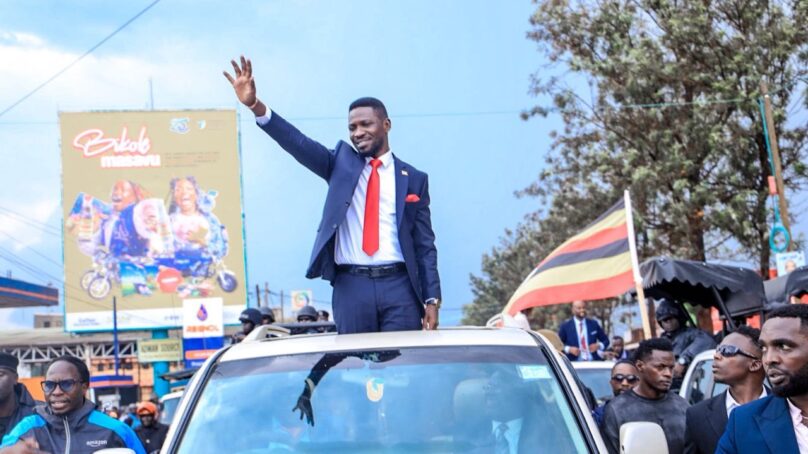
What all this means is that Bobi Wine’s music and his own person have impacted the Ugandan society and people quite profoundly in less than a decade. It will never be the same. Not even the brutality of the army and police and the letdown of Ugandans by orthodox politicians will decelerate the wind of change that Bobi Wine and his music have ushered in, especially among the young people. It is not true that the crowds that have recently thronged Bobi Wine’s rallies in all parts of the country are just anxious to see a former music icon as many Orthodox politicians are wrongly emphasizing to the diverse electorate.
It seems the people want the new narrative Bobi Wine is putting across. They are tired of hearing the same old narrative from the 1980 in a century of new information and new communication. If course just like President Tibuhaburwa Museveni said he is the master of violence, Bobi Wine has cast himself as the beneficiary of the digital age.
Therefore, I can unequivocally state that Bobi Wine’s impact is three in one:
- He has energized youth, filled stadiums, fuelled protests
- He has bridged generational gaps, making change feel tangible less fearful and less silent
- He and his supporters face censorship, arrests, but he has shown courage and leadership in adversity as he continues to spread his influence and liberation messages through digital spaces, thereby being visible globally
- The “New Liberation” narrative (NLN) appeals to the young generations of Ugandans and is embraced by some older Ugandans who were not convinced by the Old Liberation Narrative (OLN).
- There is growing discontent with corruption, unemployment, occupation and restricted freedoms. This is fuelling a belief that Uganda’s liberation is incomplete. Bobi Wine continues to tap into this frustration, using music to amplify a call for systemic change, much like Fela Kuti did in Nigeria – blending protest with art.
Therefore, if anyone thought art and music were useless and should be devalued in schools and universities, it is a good lesson we learn from Bobi Wine that they are effective tools for liberation.
Challenges and Reflections
Many obstacles remain to be confronted by Bobi Wine’s New Liberation Movement: These include state crackdowns and censorship. However, Bobi Wine is balancing hope with caution, adapting his activism to survive and spread his message of new liberation. So far so good for his New Liberation narrative. It now remains for Ugandans to use the ballot paper to show that the message of New Liberation has sunk in their minds, even if President Tibuhaburwa Museveni said a mere piece of paper cannot remove him from power and that he is like a quarter pin of a bicycle, which goes in by knocking and comes out by knocking.
Whatever political achievements Bobi Wine has recorded using digital space, music and art, two questions will remain begging for answers:
- How does music translate to tangible change?
- Can music unite Uganda’s diverse voices beyond urban hubs?
Well, we have to wait for critical analysts who have been on Bobi Wine’s presidential campaign trail to tell us what they critically think and how they critically think 5 years later so we Bobi Wine plunged himself in the messy politics of Uganda. Ultimately, however, it is what the voters vote ( New Liberation or Old Liberation?) and what the managers of the coming 2026 General Elections decide to tell the world came out of those elections.
Conclusion
Bobi Wine’s music is a rallying cry for a Uganda seeking renewal, challenging the status quo and inspiring hope. As the country listens to the beat of – Situka – the question remains: will the rhythm of change outlast the silence?
For God and my country.
- A Tell report / By Oweyegha-Afunaduula / Environmental Historian and Conservationist Centre for Critical Thinking and Alternative Analysis (CCTAA), Seeta, Mukono, Uganda.
About the Centre for Critical Thinking and Alternative Analysis (CCTAA)
The CCTAA was innovated by Hyuha Mukwanason, Oweyegha-Afunaduula and Mahir Balunywa in 2019 to the rising decline in the capacity of graduates in Uganda and beyond to engage in critical thinking and reason coherently besides excellence in academics and academic production. The three scholars were convinced that after academic achievement the world outside the ivory tower needed graduates that can think critically and reason coherently towards making society and the environment better for human gratification. They reasoned between themselves and reached the conclusion that disciplinary education did not only narrow the thinking and reasoning of those exposed to it but restricted the opportunity to excel in critical thinking and reasoning, which are the ultimate aim of education. They were dismayed by the truism that the products of disciplinary education find it difficult to tick outside the boundaries of their disciplines; that when they provide solutions to problems that do not recognise the artificial boundaries between knowledges, their solutions become the new problems. They decided that the answer was a new and different medium of learning and innovating, which they characterised as “The Centre for Critical Thinking and Alternative Analysis” (CCTAA).


About author