


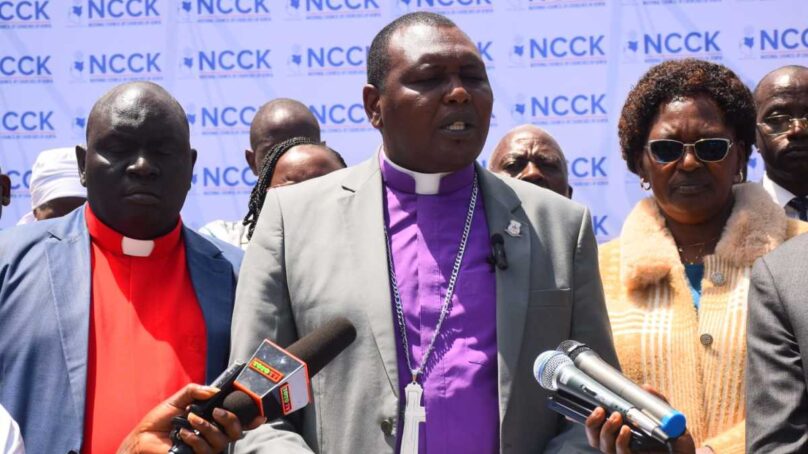
National Council of Churches of Kenya (NCCK) has expressed concern over what it describes as a growing culture of politically linked violence, warning that Kenya risks sliding into a state where criminal gangs wield huge influence if decisive action is not taken.
In a statement issued, the church organisation said it had documented more than 30 incidents involving alleged goons since the beginning of the year, describing the trend as alarming and called for immediate intervention by the government.
The NCCK drew parallels with Haiti, where Kenya recently concluded its participation in the Multinational Security Support (MSS) Mission. Kenya deployed 750 police officers to Haiti between June 25, 2024, and April 28, 2026, to support efforts aimed at restoring public security, combating armed gangs, protecting critical infrastructure, and creating conditions for democratic elections.
According to the council, Kenyans had expected the experience in Haiti to reinforce the importance of preventing the emergence and growth of criminal gangs at home.
Instead, the organization argued that recent developments suggest lessons from the mission have not been adequately applied.
In a statement signed by NCCK Chair Elias Otieno Agola and General Secretary Canon Chris Kinyanjui, the church leaders voiced concern over what they termed an increasing reliance on politically-affiliated groups to influence or suppress political activities.
The pair warned that the normalization of such groups could lead to escalating violence, weaken state institutions, and undermine constitutional democracy.
The statement released on Monday also referenced recent events at ACK St Stephen’s Church in Kisumu, describing the incident as an example of rising political tensions. The council cautioned that confrontations involving rival political supporters could evolve into broader challenges to public order if left unaddressed.
The NCCK called on President William Ruto to take immediate administrative action against any government officials found to be sponsoring or mobilising violent groups. It argued that addressing the issue early would help safeguard national peace and stability.
The council recommended urgent establishment of a multi-sectoral forum for religious leaders, civil society organisations, the private sector, political actors and security agencies. The proposed forum would examine the country’s security environment, discuss measures to curb politically motivated violence, and develop strategies to promote peaceful elections before, during, and after the 2027 General Election.
The NCCK also cited the 2025 National Crime Research Centre report, The Proliferation and Resilience of Criminal Gangs in Kenya, saying its findings underscore the need for coordinated national efforts to address gang activity.
The council reaffirmed every Kenyan’s constitutional right to make political choices freely and to participate in free, fair, and regular elections.
It urged all political leaders and citizens to reject violence and uphold democratic principles, warning that failure to do so could have long-term consequences for the country’s peace and governance.
- A Tell Media / KNA report / By Joseph Ng’ang’a


About author