


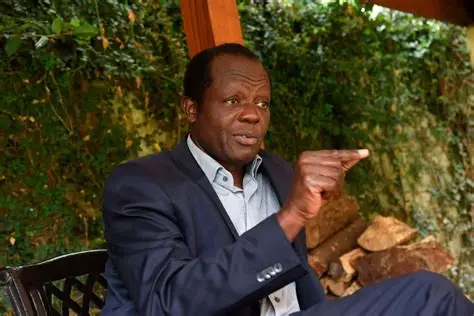
Milimani Commercial Court in Nairobi has offered former Cabinet Minister Raphael Tuju reprieve after it ordered a stay of disposal of his Dari Limited properties in upmarket Karen estate in the Kenyan capital city.
Dari Limited was scheduled to go under the hammer but orders by Justice Moses Ado Otieno to stay the ruling by a London, United Kingdom, court pending the hearing and determination of an appeal by Tuju that may swing the pendulum in favour of the embattled former minister.
At the centre of the dispute is Tuju’s previous four offers to offset the East African Development Bank facility with a buyout through Kenya Commercial Bank offer. The offer was inexplicably declined by the court that did not consider substance of KCB buyout.
The dispute has since taken a political trajectory with Tuju accusing President William Ruto of arm-twisting him to let go of the property that sits on 30 acres of land at a close-fisted rate or “be taught who the president of the Kenya is.”
Against this backdrop, human rights judicial activists opined that Kenyan courts are capable of being human and expressed confidence that the London court ruling that had stripped Tuju of Dari Limited properties would be trashed. The activists celebrated the stay orders with a post on social media that screamed: “Breakthrough today (March 18, 2026).”
The most critical update for the public, noted the activists, is the intervention by the Milimani High Court today under Case No. HCCOMM/E636/2024.
Preserving the business: Mr Justice Moses Ado Otieno issued an important order today, March 18, 2026, which protects the “substratum of the dispute.”
Freeze: There is now a temporary freeze on any sale, transfer, assignment, alienation or disposal of the properties – LR No. 11320/3 and LR No. 1055/165 – until further orders of the court.
Priority hearing: While the court was not inclined to immediately remove police officers without hearing all parties, it recognised that “time is of the essence” and ordered the application to be heard on an expedited, priority basis.
Timeline: All respondents must file their responses within three days, with the highlighting of submissions set for April 7, 2026.
Appeal: This intervention follows the High Court’s ruling on March 9, 2026, which struck out the case based on res judicata. Raphael Tuju and Dari Limited have since lodged an appeal before the Court of Appeal to challenge that decision.
Hidden history: The 2018 KCB buyout.
A major point of public interest is that a solution was drafted years ago that could have prevented this entire crisis:
Successful negotiation (May 7, 2018): A letter from the firm Shapley Barret & Co Advocates (partner D. Oyatsi) to V.A. Nyamodi & Co Advocates confirmed that negotiations for the transfer of a portion of the loan facility had “ended successfully”.
KCB offer: Kenya Commercial Bank (KCB) Limited was set to take over a portion of the loan facility totalling $10 million.
Insurance & Costs: The balance of the loan was to be secured by an insurance bond as agreed. The legal fees for managing this successful negotiation were calculated at Ksh17,772,616.
The 2015 foundation: This buyout was intended to resolve the original Facility Agreement dated April 10, 2015, which established the debt with the East African Development Bank (EADB).
What is at stake? The business premises.
These are about more than just numbers on a page; these are thriving business entities that serve the community and the economy.
The properties under protection are:
L.R. No. 1055/165 (Dari Business Park): The core business premises located on Ngong Road.
L.R. No. 11320/3: A prime property that forms part of the essential business security.
When the value of the security and the livelihood of these businesses are weighed against the debt, the law must look at proportionality.
If a $10 million buyout and an insurance bond were already on the table in 2018, why was an auction pursued? This is where the humanity of the law must intervene.
Procedural conclusion
The statement today acknowledging “public interest” and “transparency” is a ray of light. It reminds the country that while debt is a legal fact, the process of recovery must remain human and constitutionally sound. We must ask: Does ignoring a drafted settlement in favour of a traumatic auction constitute bad faith.
- A Tell Media report / By Faith Mirunde Hakala – Ms Hakala is a public legal educator and a long-serving paralegal in Kenyan judiciary.


About author