

National government and county leaders have agreed on urgent and long-term measures to tackle Kenya’s worsening drought.
The measures will include re-programming key World Bank-funded agriculture projects to prioritise immediate relief.
Agriculture and Livestock Development Cabinet Secretary Mutahi Kagwe said the drought response will be treated as an all-of-government effort, addressing livestock, crops and human livelihoods as one inter-connected system.
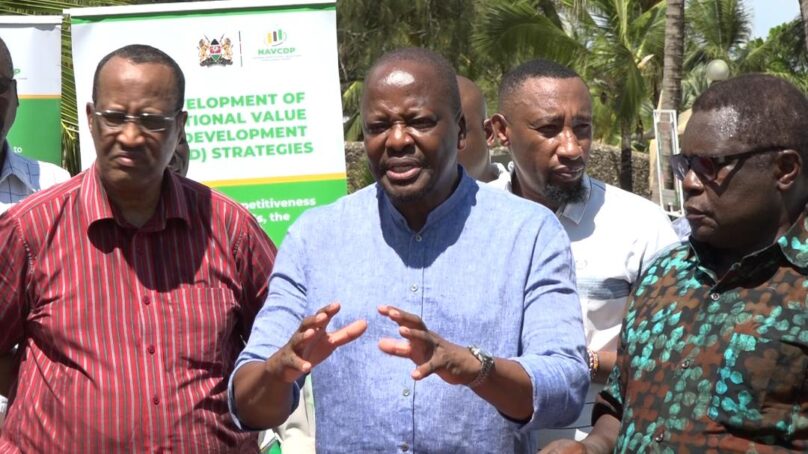
Speaking in Malindi after a high-level meeting with the Council of Governors (CoG) Agriculture Committee and the ASAL Governors Caucus, Kagwe said leaders had agreed on the need to respond to current realities while laying permanent solutions to avert future crises.
The two-day discussions centred on the Food Systems Resilience Programme (FSRP) and the National Agricultural Value Chain Development Project (NAVCDP). FSRP is being implemented in 13 drought-stricken counties, while NAVCDP covers the remaining 34.
“We sit at a critical point where we must reprogramme these two programmes to respond to the current drought reality, while also putting in place permanent solutions to avert future crises,” Kagwe said.
He noted that modern technology is transforming previously unproductive areas into potential food producers, adding that regions should no longer be defined solely by rainfall.
“An area should not be defined by lack of rainfall alone. With irrigation, places like Garissa can become net producers of crops such as rice, while parts of Baringo County are now coffee producers,” Kagwe said.
The leaders agreed that Kenya must reduce reliance on rain-fed agriculture by scaling up irrigation, feedlots, fodder reserves and storage facilities to cushion farmers during climate shocks.
Livestock disease control was also identified as a priority, with renewed commitment to tackling Foot and Mouth Disease and advancing Kenya’s goal of becoming a tsetse-fly-free country – key steps for boosting productivity and exports.
Kagwe said the Kenya Agricultural Digital Integration Centre (KADIC) will play a key role in modernising the sector, linking counties through digital platforms on soil data, pest control, animal identification and vaccination records to improve productivity, traceability and access to international markets.
Youth inclusion was strongly emphasised, with Kagwe urging deliberate integration of young people into both FSRP and NAVCDP.
“Young people must begin to see agriculture as modern, profitable and ‘cool,’ especially in value addition,” he said.
Governors present noted that several counties had started recording livestock losses due to prolonged drought and underscored the need for swift action.
CoG Agriculture Committee Chairman and Bungoma Governor Kenneth Lusaka said counties will play a central role in planning and implementation going forward, noting that donor-funded programmes must be jointly designed at national and county levels.
“Capacity-building funds must be re-allocated. Going forward, resources will no longer be absorbed by recurrent expenditure,” Lusaka said.
ASAL Governors Chair and Garissa Governor Nathif Jama backed CS Kagwe’s remarks that the programmes must recognise the unique characteristics of counties with dual climates and mixed livelihoods and warned against rigid classifications that limit opportunity.
Also present was Baringo Governor Benjamin Cheboi, senior Ministry of Agriculture, FSRP and NAVCDP officials among others.
- A Tell Media / KNA report / By Emmanuel Masha and Martin Mwangolo


About author