
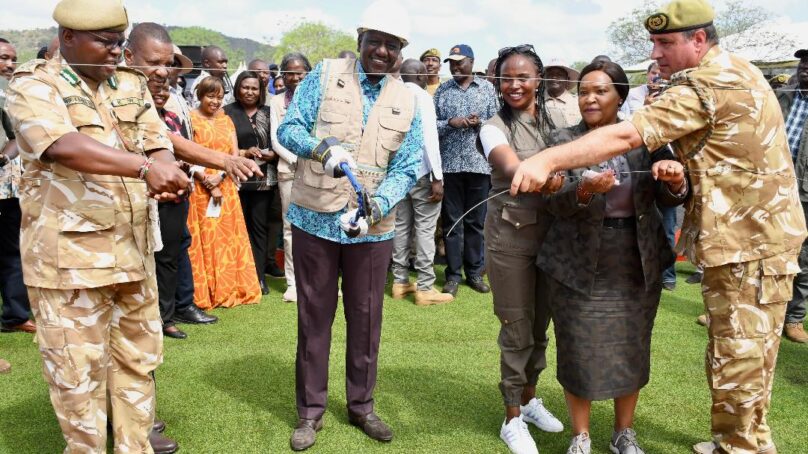
Kenya President William Ruto has unveiled an ambitious revenue-generation strategy for Tsavo West National Park that will include constructing five high-end hotels and tapping into carbon credit sales from the newly launched Tsavo West Rhino Sanctuary.
The plan to build high end hotels has quickly raises concerns about his personal interest. During last month Maasai Cultural Festival in Amboseli National Park, it emerged that President Ruto, his daughter Charlene and Kajiado Governor Joseph ole Lenku were behind the high-end tourist facilities under construction in national parks.
The Tsavo National Park initiative is expected to turn around the park’s financial performance and ensure communities in Taita Taveta, Kajiado and Makueni counties benefit from its proceeds.
Speaking during the official launch of Tsavo West Rhino Sanctuary on Tuesday, President Ruto acknowledged that the park currently operates at a loss, making previous commitments on revenue sharing with residents unattainable.
“Initially, we had agreed with the people of this county and I had directed KWS and the department to plan on how we can share the revenue that comes from this national park. But I was given the balance sheet and told that this place has no profit,” the president said.
He explained that operational expenses and staff salaries surpass the park’s income, making it necessary to introduce new strategies that will unlock the park’s potential and generate meaningful returns for local communities.
The president announced that the first pillar of the revitalisation plan involves constructing five premium hotels inside the park, targeting high-value tourists willing to pay top rates.
“We will have five new hotels that will be constructed in this place. Those five new hotels will be high-end so that when a tourist comes, they will pay $500 or $1000 per night. Even in Masai Mara that is the price to be paid,” he said.
The second component of the strategy focuses on selling carbon credits generated from the expansive 3,200-square-kilometre sanctuary. The president noted that the sanctuary – now the largest rhino sanctuary in the world – will attract both conservation interest and tourist attention.
“This is the largest Rhino Sanctuary in the world. It is twice the size of Masai Mara and three times bigger than Meru National Park,” he said, adding that its vastness and the presence of endangered black rhinos will appeal to tourists seeking premium wildlife experiences.
President Ruto directed the Kenya Wildlife Service (KWS) and the Ministry of Tourism and Wildlife to fast-track implementation of both the hospitality and carbon credit plans to ensure the park becomes financially sustainable while also delivering tangible benefits to families living near the conservation area.
KWS Director General Professor Erastus Kanga said the sanctuary is expected to hold more than 2,000 black rhinos once fully operational, significantly boosting Kenya’s tourism sector. Tourism currently contributes about 10 per cent to Kenya’s GDP with wildlife tourism accounting for a major portion of visitor interest.
“So that is how important wildlife is in this country. Anywhere you are in this country, when you are holding Ksh100 shillings, then remember Ksh7.50 out of those Ksh100 is because of rhinos, because of the elephants, because of the giraffes and other animals in our parks,” Prof Kanga noted.
He added that five high-end tourism operators have already expressed interest in establishing facilities within the park, a move expected to create employment opportunities for young people from the three beneficiary counties and generate tax revenue for the national government.
Prof Kanga emphasised that carbon credit sales present a new and sustainable revenue stream. “The president has directed us that we must do a carbon credit project. The sanctuary alone is a big area and is a magnet that we can start now selling carbon credits. The returns that we are going to get, we should be able to share with the communities in Taita Taveta, Kajiado and Makueni counties,” he said.
Tourism and Wildlife Cabinet Secretary Rebecca Miano described the sanctuary as both a conservation and economic asset that will attract high-value tourism while supporting enterprise development. She said the project aligns with the government’s wider tourism strategy which recognizes that sustainable growth depends on wildlife conservation.
The newly expanded sanctuary also addresses congestion at the Ngulia Rhino Sanctuary, which has been accommodating 150 black rhinos within a 92-square-kilometre area. The expansion merges these rhinos with 50 from the Tsavo West Intensive Protection Zone, creating a founder population of 200 black rhinos for the larger sanctuary.
The government has invested more than $4.7 million in advanced security technologies to safeguard the sanctuary. These include AI-enabled cameras, drones, aerial surveillance, over 300 security personnel, 250 kilometres of upgraded fencing, and 40 newly built ranger houses.
President Ruto projected that the initiative will create more than 18,000 jobs and generate over $45 million in conservancy and tourism-related revenue by 2030.
Kenya currently hosts approximately 2,100 rhinos, including 1,060 black rhinos – representing 78 percent of the global Eastern Black Rhino population.
- A Tell Media / KNA report / By Arnold Linga Masila


About author