



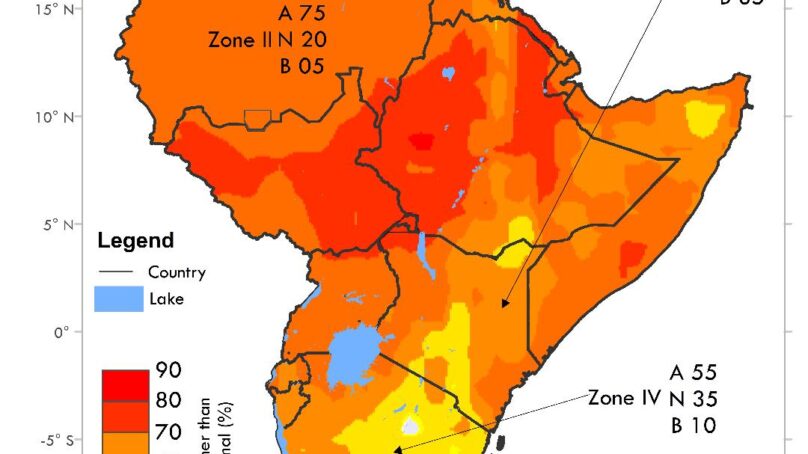
Kenya is expected to experience below-normal rainfall and warmer-than-average temperatures during the June to September 2026 season, according to the Intergovernmental Authority on Development (IGAD) Climate Prediction and Applications Centre (ICPAC).
The latest regional climate outlook and forecast issued during the 73rd Greater Horn of Africa Climate Outlook Forum in Addis Ababa, indicates that western and coastal parts of Kenya are among areas likely to receive below-normal rainfall during the period, which is a critical season for several sectors including agriculture and water resources.
In a press statement, ICPAC said some parts of coastal Kenya are, however, expected to record near-normal rainfall, offering slight relief in areas dependent on seasonal rains.
ICPAC noted that the June to September season is likely to be warmer than usual across much of the Greater Horn of Africa, with Kenya also expected to experience above-normal temperatures.
The agency warned that the projected dry and warm conditions could negatively affect rain-fed agriculture, water availability, livestock production, food security, public health and hydropower generation.
The forecast also raises concerns over possible pressure on pastoral communities and increased vulnerability in arid and semi-arid areas, already facing climate-related challenges.
According to ICPAC, the evolving 2026 climate conditions resemble those experienced during the strong El Niño years of 1997 and 2023, when several parts of the region, including western Kenya, recorded below-normal rainfall.
Speaking during the forum, IGAD Deputy Executive Secretary Mohamed Abdi Ware emphasised the need to translate climate information into timely action and preparedness measures across the region.
“Across the region, we are increasingly shifting the conversation from ‘early warning’ to ‘early warming linked to anticipatory action,’ recognising that climate information must ultimately support action and preparedness to make a difference.”
Fetene Teshome, Director General of the Ethiopian Meteorological Institute, called for sustained investment in climate services and regional cooperation to strengthen resilience across the Greater Horn of Africa.
“We must continue to invest in and expand systems capable of generating knowledge-based, user-tailored climate information at both the national and regional levels,” Teshome said.
ICPAC said it will continue providing regional updates, while Kenya’s meteorological authorities are expected to issue more detailed country-specific forecasts and advisories.
Meanwhile, the Kenya Meteorological Department (KMD) has said that the country will in the next 24 hours experience rainfall in a few parts of the country with heavier rainfall likely in the highlands of the west of the Rift Valley.
Giving a summary of the weather from tonight to 9.00 p.m. Wednesday, KMD says strong southerly to southeasterly winds exceeding 25 knots (12.5 m/s) are expected in parts of the northwestern, northeastern, coastal and southeastern lowlands.
In the highlands west of the Rift Valley, the Lake Victoria Basin and Rift Valley counties, including areas such as Kakamega, Kisumu, Nakuru, Narok, Uasin Gishu and Kisii, showers and thunderstorms are expected in a few places tonight.
The region will have mainly sunny intervals, with light morning rains in some areas and more widespread afternoon showers and thunderstorms.
- A Tell Media / KNA report / Wangari Ndirangu


About author