
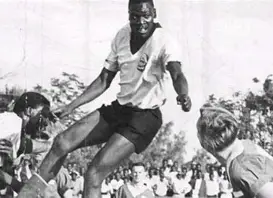
This month, Kenya Premier League Champions Gor Mahia FC, will be marking 45 years since the killing of striker Nicodemus Arudhi in Kalolni Estate, in Nairobi’s sprawling Eastlands neighbourhood.
Arudhi was rich as he combined robbery and football.
Eastlands is Nairobi’s crime capital with a history that stretches back to the precolonial era in the 1950ww through the 1980s. Today, the inner city remains a dangerous settlement that hosts armies of low-income earners that ply their trade in neighbouring Industrial Area as unskilled labourers, domestic workers, artisans and the like. There’s a substantial presence of a middle class, too.
This was the staging ground of the football and criminal careers of one of Gor Mahia’s most gifted footballers. Were it not for his criminal exploits, Nicodemus Arudhi would have cemented his name into annuls of football history – the cherished sport in Kenya.
He is a crime legend though.
The deadly player was dedicated to the game and would always be the first to report for training sessions, which earned him a call up to the national team, Harambee Stars. But besides his lustre on the pitch, Arudhi had a double life: he was one of the deadliest armed gangsters in Eastlands.
He was a serial robber who served several years behind bars. In those days, players barely earned enough to live on. But Arudhi lived lavishly. He could afford wearing expensive shoes, clothes and watches. He paid beer bills for his Gor Mahia teammates during moments of carousal.
Arudhi was therefore seen as a criminal who only played football as a side hustle or as a camouflage of his criminal adventures before he was gunned down on June 22, 1981.
Arudhi was the last born in a family of two. He was the son of Nicodemus and Salome Owidhi. The latter ran an eatery business in Nairobi’s Kariokor Estate – less than two kilometres from Nairobi’s central business district.
Born in 1944, Arudhi’s official name was Daniel Odhiambo but he had several nicknames.
He played for Luo Union and later flourished at Gor Mahia.
The most intriguing tale about Arudhi is that in 1965 he was released from Kamiti Maximum Prison so he could bolster Harambee Stars squad that was preparing for the Gossage Cup (now Council of East and Central Africa Football Associations or Cecafa Senior Challenge Cup). To the government of the day, football was a matter of life and death, which explains how and why a deadly gangster had to be granted the freedom so he could play the national team.
Arudhi played for the national team between the 1960s and 1970s. He featured for Kenya in the African Cup of Nations in 1972 in Cameroon and was in the starting line-up for Harammbee Stars in matches against Togo, Cameroon and Mali. Arudhi even scored against Mali. A year later he was sentenced to three years in jail for robbery with violence in Kaloleni – then a middle income estate in Nairobi’s Eastlands.
One bizarre thing about Arudhi is that he loved his solitude more than anything else. One of his teammates observed that Arudhi would buy beer for them, then isolate himself.
“He had curious drinking habits. After a game, he would hail us and say, ‘chagueni mbili, mbili!’ (Let’s have two beers each) and then retire to a corner in solitude. He would take his drink quickly and before you knew it, he vanished,” recalled former Gor Mahia and Harambee Stars midfielder Allan Thigo in a past interview with the Daily Nation. Thigo died and was cremated in Kisumu last month.
Despite his shadowy world, Arudhi was described as a generous person who would gift his closest friends clothes, watches and radios.
Arudhi’s story has strong echoes of former notorious Colombian drug lord Pablo Emilio Escobar Gaviria who led the Medellín cartel who become one of the world’s most powerful drug traffickers in the 1980s and the early 1990s. Escobar stole from the rich and shared his loot with the poor in slums.
2Arudhi was gentle, generous and very hardworking. He was crazy about training. But he had a secret: the guy was a gangster! He never told us how financed his lavish lifestyle, though. He kept this to himself. To his closest friends, he often gave gifts such as radios, watches and shirts,” according to Thigo.
The late Joe Kadenge, one of the iconic footballers in Kenya revealed that most teammates had a clue of Arudhi’s criminal bent. However, the same was never brought out and was only talked about in whispers.
The serial criminal would find himself on the radar of Patrick Shaw – a dreaded crime buster who is said to have viciously dealt with notorious criminals. One day, Shaw – a White police officer inherited from the colonial government by Kenya after independence in 1963 – passed by Arudhi’s mother’s food joint in Kariokor and sent a warning:
“Tell your son to stop what he is doing or else I will stop him. I am coming for him. I will kill him!”
According to police accounts, on the night of June 22, 1981, the law caught up with Arudhi. Patrick Shaw accosted him and ordered him to surrender his guns. Instead, he attempted to escape and that is when he was sent sprawling on the ground with a shot in the back. Arudhi lived by the gun, he died by the gun. Patrick Shaw was a dreaded marksman.
Arudhi’s execution caused a furore in parliament as Siaya County Governor James Orengo, then MP for Ugenya sought to have a clear account of what transpired. His burial ceremony was given a wide berth by majority of teammates. This is because Patrick Shaw was said to attend the burial of his victims just to get information on the closest friends. The government compensated the family with Ksh250,000.
- A Tell Media report / By Special Correspondent – additional reporting by ‘Who Owns Kenya’


About author