



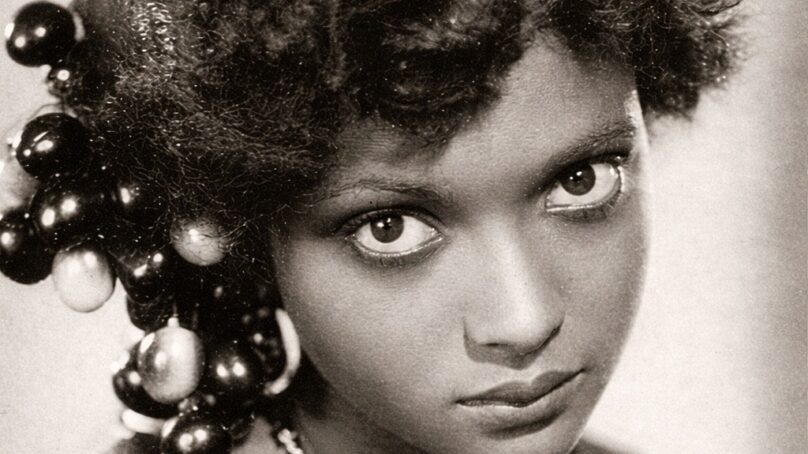
When she died in 1967, Variety didn’t run an obituary. Neither did Jet. Neither did Ebony.
The first Black performer in major Hollywood studio history died at 54, and the industry she had cracked open could not find one paragraph to mark her passing.
In 1935, MGM released a film called Reckless, and the woman audiences heard singing through Jean Harlow’s mouth was Nina Mae McKinney. Her name appeared nowhere in the credits.
McKinney was born in Lancaster, South Carolina on June 12, 1912, and arrived in Harlem as a teenager carrying a face the press would struggle to describe because nothing in their vocabulary had been built to hold a Black woman’s beauty without diminishing it.
They eventually settled on comparisons: the Black Clara Bow first, and then the Black Garbo, as if beauty required a white reference point to be legible to the people writing the columns.
She was working as a chorus girl in Blackbirds of 1928, third from the right, when King Vidor arrived in Harlem looking for actors for his all-Black sound picture, Hallelujah! She had decided that this was her moment. So she did what she had learned to do: she made herself impossible to miss, walking back and forth in front of the casting building until Vidor stopped and looked.
He said afterward that she was beautiful and talented and glowing with personality. He gave her the starring role.
Hallelujah! opened in 1929 to strong reviews, and MGM, impressed by McKinney’s vivid performance as the seductress Chick, signed her to a five-year contract on May 20, 1929. She was the first Black performer in history to sign with a major Hollywood studio.
In five years under that contract, MGM gave her two films. Two. Hollywood could accommodate Black women in service, as mammies, as maids, as loyal background to white stories. It could not accommodate a beautiful Black woman at the centre of a story that asked white audiences to invest in what happened to her.
So Hallelujah! became both her greatest achievement and the ceiling she would spend the next decade pressing against from below. She went to Europe in the early 1930s, where audiences received her with something closer to what her talent warranted, and she performed in venues that did not require her to reduce herself to fit inside someone else’s idea of what a Black woman was allowed to occupy on a stage.
She came back to the United States for Sanders of the River in 1935, appearing opposite Paul Robeson in what should have been a major film for both of them. But the production had been rewritten into a piece of pro-British colonial propaganda so blatant that Robeson walked out of the premiere in protest, furious at what had been done to a project he had believed in, and McKinney’s role had been cut considerably in the process.
And then, also in 1935, MGM found a use for her in Reckless: she would provide the singing voice that came out of Jean Harlow’s mouth while her own face appeared nowhere in the film. Her name was not in the credits.
That was the five-year contract in full, two films and a borrowed voice given to a white star in a picture that never showed her face. MGM had signed the first Black performer in studio history and used her accordingly.
She returned to the United States for good in 1939, married the trumpeter Jimmy Monroe in 1940, and worked primarily for Black production companies in films that at least allowed her to occupy the screen fully and completely. Monroe would later marry Billie Holiday; McKinney would eventually relocate to Athens, Greece, and then return to New York, and the details of her final years are sparse in the record.
What the record does hold is that her influence outlasted her visibility. Dorothy Dandridge’s Carmen in the 1954 film Carmen Jones was patterned directly on McKinney’s Chick, the role that had launched her career and then revealed the ceiling of it, the character that had proven she could carry a film and then shown, in the decade that followed, that Hollywood had no plans to let her prove it again.
She died on May 3, 1967, from a heart attack at Metropolitan Hospital in Manhattan. She was fifty-four years old, and Variety did not run an obituary, and neither did Jet, and neither did Ebony and one paper that did acknowledge her passing called her only “an entertainer” and did not name the church where the funeral would be held.
The trade papers had tracked every contract and premiere and casting decision since Hollywood was invented. They did not find space for the first Black performer in major studio history on the day she died.
Eleven years later, in 1978, the Black Filmmakers Hall of Fame gave her a posthumous award for lifetime achievement. In Lancaster, South Carolina, across from the Courthouse in the town where she was born into a world that had already decided what it owed her, a mural now carries her face alongside the other famous names the city produced.
Jean Harlow’s voice in Reckless is still audible in archival prints, and the voice belongs to a woman whose name the credits never carried. Nina Mae McKinney held the first major studio contract in Black Hollywood history, sang through one of the biggest white stars of her era without a single line of acknowledgment, and died in Manhattan while neither Variety nor Jet nor Ebony found space to say that she was gone.
Fayard Nicholas, who knew what it was to perform in an industry that took Black talent on its own terms, said it plainly: she could act, sing, dance and wisecrack with the best of them, but she came along too early and there was no place for her.
There was a place. They just gave it to someone else and used her voice to fill it.
- A Tell Media report / Black History


About author